(Shutterstock)
How is it humanly possible to run 100 kilometers through mountain terrain, without sleeping, where the air is thin and the weather turns without warning?
I can barely jog around my neighborhood for 30 minutes without feeling like I'm dying. But Tia Sukma, 31, a film producer, runs back-to-back Saturdays and Sundays specifically to simulate the exhaustion of race conditions, because that's what she'll encounter when she races.
How can a person run for 45 hours, surviving on just 5-minute naps at water stations? Willy Aditya, event director for Bandung Ultra 100, says athletes train for this by running from dusk to dawn.
And if a full 42 km road marathon – a feat so demanding that fewer than 1 percent of the population ever finish one – already sounds extreme, consider this: the 50 km Merbabu Sky Race, according to its founder Sri Agus, is equivalent in effort to running 120 km on a road.
But perhaps even more difficult to comprehend than the sport itself is how fast it has grown.
While trail running events typically offer multiple categories, from 13 km entry-level routes to ultras exceeding 100 km, it's the longer distances that have come to define the sport's culture.

Thank you!
For signing up to our newsletter.
Please check your email for your newsletter subscription.
Which leads to the question the rest of us mortals have: why?
A sport on the rise
When Bandung Ultra 100 first launched in 2017, trail running in Indonesia was a niche pursuit, driven by a small community of nature enthusiasts who happened to enjoy hiking. Participation at the race peaked at around 800 runners before 2020. For the race’s 7th iteration at the end of August, Willy expects 2,000.
The numbers tell a similar story elsewhere. Merbabu Sky Race, which launched in 2023 with 580 participants, welcomed 1,600 in 2024, 1,800 in 2025 and 2,700 runners from 14 countries this year. It would have drawn 3,500 to 4,000 if the national park's quota hadn't capped it. Registration opened in November and closed within six weeks. Bali's BTR Ultra is estimated to have drawn close to 6,000 participants this year, with Siksorogo Lawu Ultra attracting around 5,700.
The growth hasn't come without consequences. In 2025, several trail running events across Indonesia recorded serious incidents, including fatalities, predominantly in shorter categories where qualification requirements were lax. BDG Ultra 100 responded by introducing mandatory race qualifications even for its 13 km category this year - and has already turned away nearly 1,000 applicants who didn't meet the criteria.
A younger demographic is entering the sport, drawn in by social media and the visible explosion of trail-running content online. But veteran runners still dominate. Sri Agus estimates that roughly 65 percent of Merbabu Sky Race participants are above 30.
“This makes sense because this is a sport that rewards endurance more so than speed, something experienced runners are more adept at,” he says.
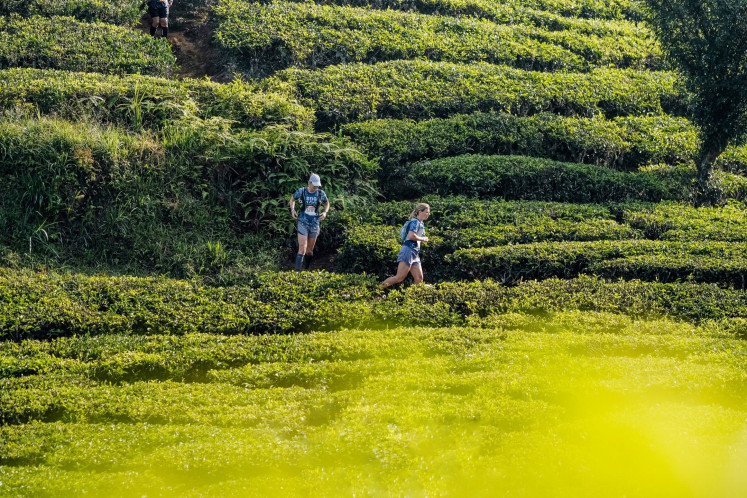 (Courtesy of BDG Ultra 100)
Why they run
Ask trail runners why they do it and the answers resist easy summary. But a few threads keep emerging.
The variety is part of it. Unlike road marathons, where the route is largely predictable, trail running offers a different experience every time. "On one race you could have a fun rolling run going up and down the hills," says Tia, who recently completed her 3rd 100 km ultra. "On another you trek through tricky gravel, or jog beside the sea under the scorching sun." The diversity in scenery and technical difficulty, she says, makes the experience feel fresh regardless of how many races you've done.
Social media has accelerated the sport's visibility in ways even its participants find surprising. Tia regularly meets new runners who first learned about trail running through her own race documentation. "A few years ago when I joined a 50 km trail run, maybe it was just 10 other girls alongside me," she says. "Now, people sharing their experiences has made information easy to come by, making it seem less daunting."
Willy frames it as a cultural shift. Running, he says, has become the new skateboarding - a sport where even people who don't train seriously have adopted the aesthetic, the gear, the identity. "Proving your mettle through things like trail running is the cool lifestyle now," he says. "It's become its own subculture that people aspire toward."
But there's something specific about trail running that road racing doesn't quite offer. "If you like basketball, you can't really say you've competed in the NBA," Willy says. "But for trail running, you can compete in the same challenge that athletes you adore also attempt. It's a distinct achievement that people are proud to showcase online." The finish line is the same whether you're an elite or a first-timer. That's rare in sport.
Sri Agus offers a more existential answer. "It's just you alone against the elements," he says. "You feel incredibly small against this huge mountain to overcome. For the longer runs especially, it becomes a personal mission to prove yourself."
He's noticed something else too: the longer someone has been in the sport, the quieter they tend to become about it. Veteran ultra runners post views and stories. Newer runners post medals and finish times. The sport, it seems, eventually turns the performance inward.
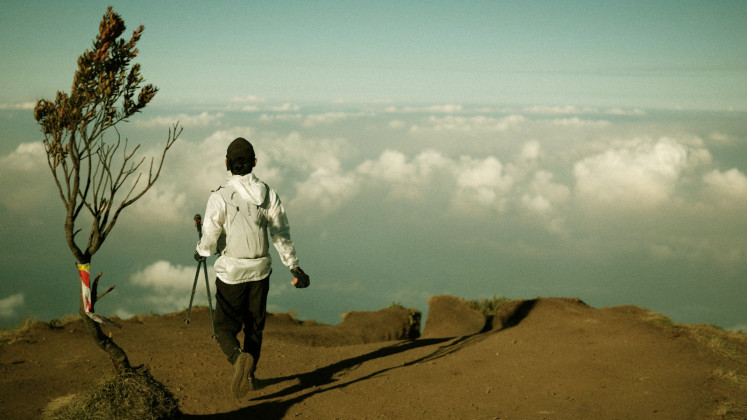 (Courtesy of Merbabu Sky Race)
What it costs
The intro to this piece opened with a question: how is it humanly possible to run 100 km without sleeping?
Tia knows she can withstand sleeplessness better than most. To complete events totaling 300 km without sleeping, she structures her training around this knowledge and running back-to-back on weekends, not when she's fresh, but when she's already tired. "You have to train when you don't feel fit," she says. "You should run when you're tired, when you're sleepy, because that's exactly what you'll encounter on race day."
This is what trail running involves: experiencing what falling apart feels like, and knowing you can keep going anyway.
For the 45-hour category at Bandung Ultra 100, athletes do sleep, just not much. Willy describes runners arriving at water stations and asking volunteers to wake them after five minutes. Then they get up and run again.
The physical demands are compounded by the terrain. Sri Agus explains that elevation gain, technical ground and altitude make even a 50 km race in the mountains doubly harder than anything on a road.
At certain points on course, runners are also completely alone. No other runners visible ahead or behind. The weather can turn without warning. Mandatory gear – headlamps, emergency blankets, whistles, hydration packs – exists not as bureaucratic requirement but because people need it for survival.
The financial cost is real, too. For a Jakarta-based runner, even before accounting for gear, joining the BDG Ultra 100 requires budgeting around Rp 3-5 million ($180-300) for transport, accommodation and registration. Merbabu Sky Race runs closer to Rp 5 million before gear.
The mandatory equipment adds more. “I bring dozens of energy gels on top of this too,” Tia adds. Energy gels start from around Rp 17,000 each and are usually taken every 30 minutes.
It's part of why the sport skews older: trail running requires disposable income as much as it requires physical endurance.
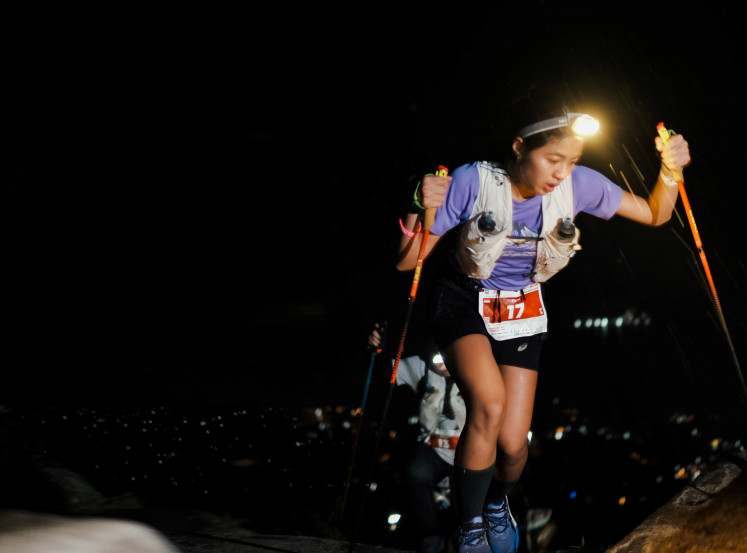 (Courtesy of Tia Sukma)
The pull of it
After everything I've learned, I still can't claim to fully understand why someone would choose this. But I think I understand it better than I did.
Trail running, at its core, is a sport that asks you to find out what you're made of when there's no one around to see. The finish line is real, the medal is real, but what Sri Agus is describing - that moment alone on a mountain, small against something enormous - sounds less like a race and more like a reckoning.
The community is growing, the events are filling up faster than ever and somewhere on a mountain in Central Java this weekend, someone might be running through the night on legs that have been going for 24 hours, asking themselves why they signed up for this.
I do enjoy a good hike. And after going down this rabbit hole, I'll admit: my interest is piqued. I should probably start by making it around my neighborhood without stopping first.
Aqraa Sagir is a writer for The Jakarta Post's Creative Desk. He’s chronically online in the hope it would be a useful asset for the job.