The Jakarta Post
Please Update your browser
Your browser is out of date, and may not be compatible with our website. A list of the most popular web browsers can be found below.
Just click on the icons to get to the download page.


Popular Reads
Top Results
No results found. Please check your search term and try again
Can't find what you're looking for?
View all search results
Popular Reads
Top Results
No results found. Please check your search term and try again
Can't find what you're looking for?
View all search resultsVice presidential race: Beyond names and personal loyalty
As Jakarta’s political elites scramble to fill the vacant vice presidency, Indonesia must look beyond partisan loyalty and equip its next deputy with the formal mandate needed to tackle overlapping national crises.
Change text size
Gift Premium Articles
to Anyone
Share the best of The Jakarta Post with friends, family, or colleagues. As a subscriber, you can gift 3 to 5 articles each month that anyone can read—no subscription needed!
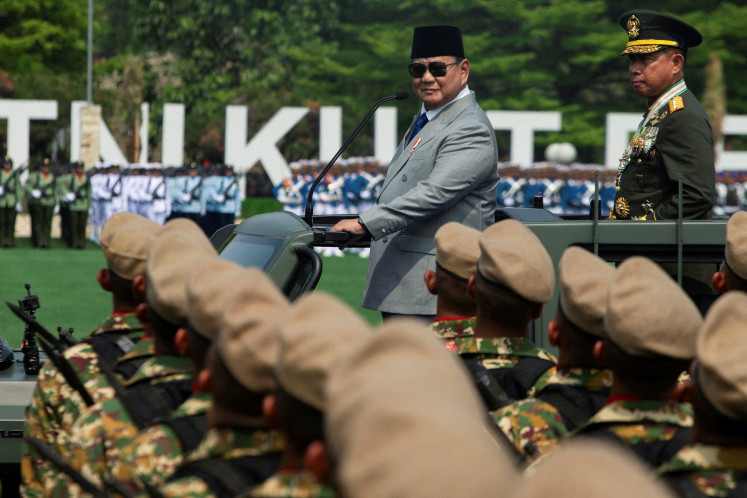
 President Prabowo Subianto (center), flanked by House of Representatives Deputy Speaker Sufmi Dasco Ahmad (left) and People’s Consultative Assembly (MPR) Speaker Ahmad Muzani (right), speaks to journalists after submitting two vice presidential nominees at the Senayan Legislative Complex in Central Jakarta on Nov. 23, 2026. (Youtube/The Presidential Secretariat)
P
resident Prabowo Subianto has submitted two vice-presidential candidates to the People’s Consultative Assembly, less than two weeks after Gibran Rakabuming Raka resigned as vice president on Nov. 12. This marks only the second time an Indonesian vice president has quit since Mohammad Hatta stepped down in 1956, and the first since the 1998 Reform era.
The resignation carries two distinct dimensions. The first is political: the vacant post has triggered a contest among parties both inside and outside the governing coalition, with potential successors already circulating. The second dimension is far more consequential. As a functioning state, Indonesia urgently requires an active vice president to help steer the administration.
Indonesia is facing acute, overlapping crises. From January to July 2026, the Forestry Ministry recorded 202,004 hectares of burned land, a 69 percent surge over last year, with fires spreading from Kalimantan to Papua. Meanwhile, Statistics Indonesia (BPS) reported that 8.07 percent of the population (22.93 million people) lived in poverty in March. Although open unemployment hit a 32-year low of 4.65 percent in May, 7.22 million citizens remain jobless, and only 41 percent of workers hold formal employment.

Public administration analysts call these "wicked" problems, a term coined by Horst Rittel and Melvin Webber in 1973 for issues that defy simple definition, lack clear endpoints and cross organizational boundaries. Forest fires implicate forestry, agriculture and regional governments, while poverty spans social affairs, education, health and village administration. Neither crisis belongs to a single ministry.
As governance academic B. Guy Peters notes, inter-agency coordination is fundamentally political rather than technical. Within Indonesia’s bureaucracy, ministries fiercely guard their budgets and programs, leaving a president governing the entire archipelago unable to arbitrate every dispute personally.
The next vice president must be judged on the work ahead rather than party ties or personal loyalty, not just who takes office, but which challenges they will tackle and what solutions they can deliver. Gibran’s departure leaves a void atop the executive branch; because the vice presidency is a state office rather than a partisan prize, the debate must look beyond names.

The 1945 Constitution offers little guidance. Article 4(2) states only that the president is assisted by a vice president, leaving that role undefined. Unlike Max Weber’s bureaucratic model of fixed, rule-bound duties independent of the officeholder, Indonesia’s vice presidency works in reverse: lacking a statutory portfolio, each incumbent must carve out a role or wait for assignments.