The Jakarta Post
Please Update your browser
Your browser is out of date, and may not be compatible with our website. A list of the most popular web browsers can be found below.
Just click on the icons to get to the download page.


Popular Reads
Top Results
No results found. Please check your search term and try again
Can't find what you're looking for?
View all search results
Popular Reads
Top Results
No results found. Please check your search term and try again
Can't find what you're looking for?
View all search resultsTaruna Nusantara and the rise of the new semi-military elite
Tracing the history of Taruna Nusantara, from the anti-colonial Perguruan Taman Siswa through to its founding during the New Order, illustrates how it claimed its place in nationalist politics and how its reach is spreading through the Prabowo administration.
Change text size
Gift Premium Articles
to Anyone
Share the best of The Jakarta Post with friends, family, or colleagues. As a subscriber, you can gift 3 to 5 articles each month that anyone can read—no subscription needed!
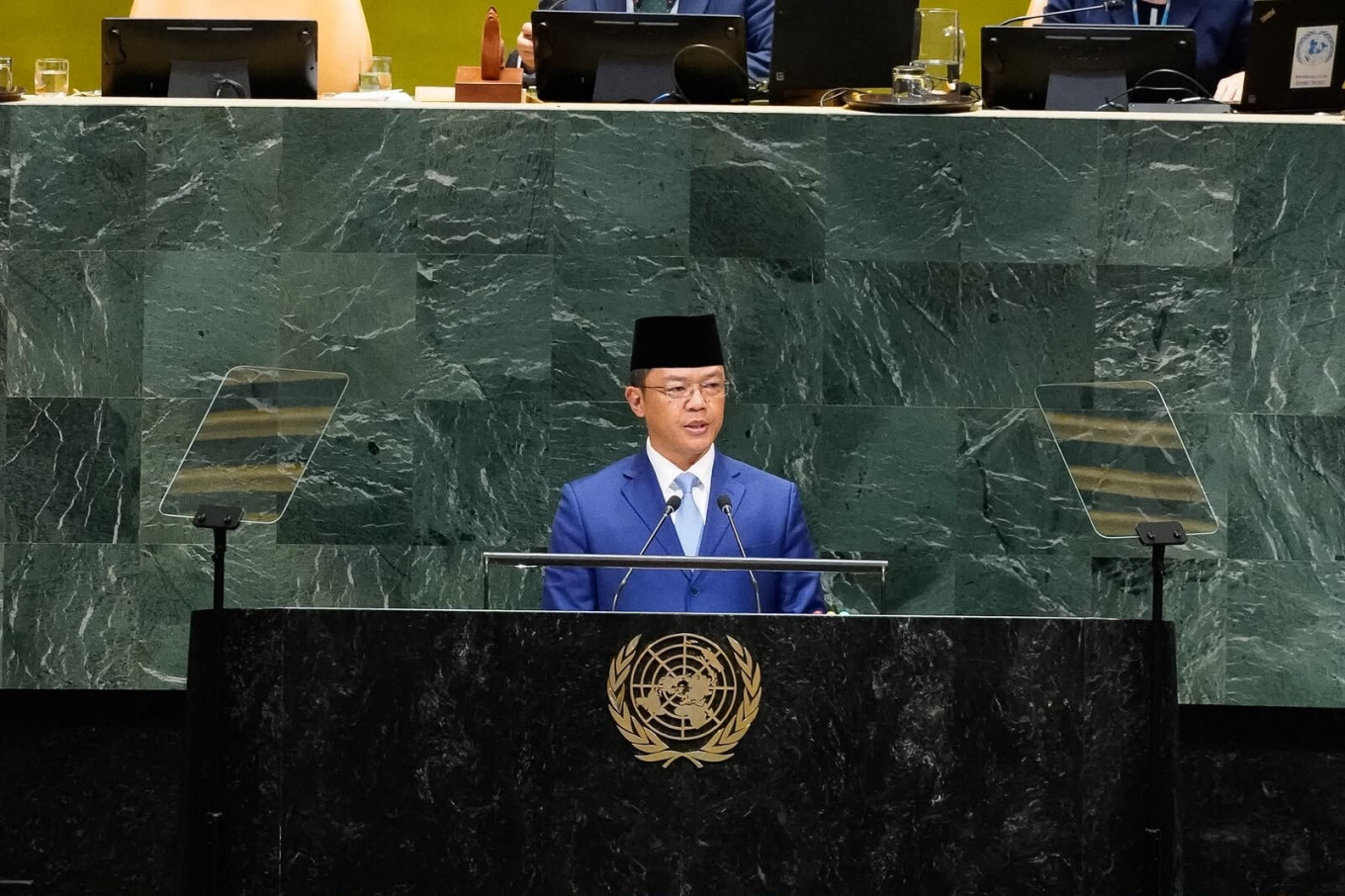 Foreign Minister Sugiono delivers a speech at the United Nations General Assembly high-level General Debate on Sept. 26, 2026, at the UN headquarters in New York City, the United States. (Handout/Foreign Ministry)
M
uch has been written about the growing influence of figures with a military background in the administration of President Prabowo Subianto. Yet few have recognized that alongside these military figures, his administration also reflects the rising influence of graduates of a particular prestigious senior high school in Magelang, Central Java: Taruna Nusantara.
At least three Taruna Nusantara graduates serve in Prabowo’s Red and White Cabinet: Cabinet Secretary Teddy Indra Wijaya, Coordinating Infrastructure Minister Agus Harimurti Yudhoyono and Coordinating Human Development Minister Sugiono. On Monday, the President nominated Sugiono as one of two vice presidential candidates to replace Gibran Rakabuming Raka, who recently resigned over the controversy surrounding his educational credentials.
Before explaining why this particular school has come to occupy such an important place in nationalist politics, it is necessary to consider the intellectual background and political context that inspired its establishment.

Taruna Nusantara was officially opened in 1990 by the chief of the Indonesian Armed Forces, Try Sutrisno. But the creation of such a school had been proposed as early as 1985, notably by Benny Moerdani, one of the most influential generals of the New Order regime.
Moerdani wanted to create an elite nationalist school capable of educating the country’s best students to produce ideal leaders to help realize the vision set out by the New Order. To realize this idea, Moerdani drew inspiration from Perguruan Taman Siswa, a school system founded in 1922 by Ki Hadjar Dewantara, a prominent, early nationalist figure who went on to become Indonesia’s first minister of education, together with colleagues from Paguyuban Selasa Kliwon, an exclusive discussion group for Javanese aristocratic nationalists.
Taman Siswa is widely regarded as a staple of Indonesia’s nationalist movement in the early independence period. Many of those associated with the institution went on to play active roles in the independence struggle and in nationalist politics during the nation’s formative years. Taman Siswa’s aspirations were different to those of modern Islamic schools, whose ideal educational model had at its heart the cultivation of Islamic values alongside modern knowledge.

By contrast, Ki Hadjar and his nationalist colleagues (whose religiosity tended toward a syncretic approach to Islam) envisioned Taman Siswa as an institution that would educate its students not only in modern knowledge but also in the traditional knowledge derived from Indonesia’s “Great Tradition”. This referred to courtly traditions whose origins can be traced to Indonesia’s pre-Islamic past, including its Hindu-Buddhist and pre-Hindu periods.
This vision was embodied in their teaching method, which sought to cultivate in students both modern knowledge that would enlighten the mind and reason as well as traditional knowledge that would strengthen their feeling (rasa) and soul. This was done through instruction in traditional arts and music, such as gamelan.
The Taman Siswa founders’ decision to establish a school capable of cultivating traditional knowledge in its students cannot be separated from the anti-colonial and revolutionary motivations that animated them. One of the most important of these was a determination to demonstrate to the European colonizers that Indonesia, too, possessed its own “great” history and knowledge.
Because the idea of Taruna Nusantara was deeply inspired by Taman Siswa, it inherited this same impulse to trace Indonesian national identity back to the Great Tradition. This is evident in its use of a Sanskrit term in its name. “Taruna” means youth in Sanskrit, while Nusantara has come to be understood to refer to Indonesia as a whole.
The name Taruna Nusantara thus signaled roots in Indonesia’s Hindu-Buddhist past. This was true also of the school’s continued use of the word pamong (derived from “among”, meaning nurturing in Javanese) to refer to its teachers.
The decision to build the school in the historic city of Magelang can likewise be interpreted as an attempt to associate it with the Great Tradition, given that Magelang is home to Mount Tidar. In traditional Javanese cosmology, Mount Tidar is believed to be the place where Semar, a mythical figure from the pre-Hindu period regarded by many as an ancestor and guardian of the Javanese people, planted a tumbal (magical talisman) that brought Java’s demonic spirits under control.

It is important to remember, however, that because the idea of Taruna Nusantara was formulated at the height of the New Order, a regime with a profound distaste for leftist politics, the revolutionary character that had once defined Taman Siswa’s identity was not adopted by Taruna Nusantara.
In the past, Taman Siswa’s revolutionary and anti-colonial character had drawn several figures associated with it into left-leaning politics. One of its Selasa Kliwon founders, Ki Soetopo Wonobojo, a close friend of communist leader Tan Malaka, is reported to have been involved in the 1948 Madiun Affair, a rebellion involving communists. Some of its former students, such as the great anti-colonial author Pramoedya Ananta Toer, went on to play leading roles in the literary wing of the Indonesian Communist Party (PKI) during the 1950s and 1960s.
Consequently, Taruna Nusantara stripped out Taman Siswa’s revolutionary character, replacing it with the disciplinary ethos of the military. This gave the school a semi-military character capable of producing graduates able to compete for entry into both military academies and the country’s most prestigious universities.
This semi-military character suited the image of the New Order perfectly: a regime that fused Western-educated technocracy and managerial professionalism with military discipline in its bureaucratic machinery. Surprisingly, the fall of the New Order’s military-bureaucratic regime at the end of the 1990s and the arrival of the democratic Reformasi (reform) era did nothing to halt the ascent of Taruna Nusantara graduates. If anything, they flourished even more.
This is particularly evident under the Prabowo administration, in which numerous Taruna Nusantara graduates occupy strategic positions, and the President himself has personally praised the contribution of the school’s graduates to his government. They range from graduates who have come from military careers, such as Teddy, Agus and Sugiono, to those who have pursued civilian careers, such as State Secretary Prasetyo Hadi, National Nutrition Agency head Sudaryono, Deputy Coordinating Infrastructure and Regional Development Minister Rachmat Kaimuddin and Deputy Finance Minister Nurkholish Ibnu Aman.
This growing influence reflects the fact that Reformasi never fully stripped away the militaristic imagery that became deeply embedded in the Indonesian conception of nationalism over the 32 years of Soeharto’s New Order rule. Thus, when Prabowo, himself a former general during the New Order, was elected president and sought to build a government in keeping with his military image, Taruna Nusantara’s semi-military character proved a natural fit for his ambitions.
Many of its graduates, such as those mentioned above, possess not only the military credentials conferred by the school’s image but also impressive academic degrees from prestigious universities both in Indonesia and abroad, signifying their technocratic professionalism. Some of its graduates have even gone on to work as scholars and intellectuals at several of the country’s most prestigious public universities.
It is not difficult to find some among them who continue to hold the school’s semi-military values, leading them to advocate the restoration of the military’s dwifungsi (dual function) role in the current democratic era.
Given Indonesian society’s well-known cult obsession with prestigious academic credentials, we can expect the influence of this prestigious high school over Indonesian politics to grow considerably stronger in the years to come.
It is no surprise that President Prabowo has nominated Sugiono, alongside Agriculture Minister Andi Amran Sulaiman, as his VP candidates to the People’s Consultative Assembly (MPR). After all, Prabowo has previously said that he personally favors vice presidential candidates who, like Sugiono, are Taruna Nusantara graduates.
---
The writer is a PhD candidate at the University of Melbourne Law School and an assistant professor in law at Trisakti University. This article is republished under a Creative Commons license.