(Courtesy of Jin Panji)
On a warm Saturday morning, A.A.G. Airlangga took in the walls where his artworks hung.
At 10 a.m., the ASHTA District 8 mall had just opened its doors, and the opening ceremony for his latest exhibition was four hours away. Still, he walked around the space, considering carefully how each piece was displayed and how visitors would interact with them.
“When I first started, I did graffiti, which many people didn’t consider as art in the first place,” the artist known as TUTU told me as we walked around the venue. “So I tried to dig deeper on the elements of art, whether they can be enjoyed, how the process unfolds, and so on. But in principle, I agree that it is art, even though it was born from the streets.”
TUTU’s latest exhibition “Constellation of Curiosity”, which ran until Nov. 22 at Spac8 in ASHTA District 8, stood as a testament to where his own curiosity has taken him: from the city’s walls to a swank mall in the central business district.
He credits that curiosity to his myriad interests, which cover music, animation and even collecting old tech paraphernalia. Indeed, alongside tagging the streets as TUTU the artist, A.A.G. Airlangga also wore the hats of animator, illustrator and music director, even landing a nomination for Best Original Score for his work on Joko Anwar’s romcom Janji Joni at the 2005 Festival Film Indonesia.
“I have many interests, which of course plays a part. I’m not the type of person who believes, let’s say, painting as an art form should be strictly bound. Like music, it grows and develops, in the same way Kanye West started out as a rapper but has now encroached on pop stardom,” he said.

Thank you!
For signing up to our newsletter.
Please check your email for your newsletter subscription.
“Because he can adapt and blend these elements, so do I try to blend. My curiosity is in creating something new, which is hopefully something better.”
 (Courtesy of Jin Panji)
Our conversation was soon joined by the exhibition’s curator Bambang “Toko” Witjaksono, a lecturer at the Indonesian Institute of the Arts (ISI) Yogyakarta’s faculty of arts and design. An artist himself, Bambang goes a long way back with TUTU, noting his humorous and playful approach to art that was noticeable even as an arts student in the Bandung Institute of Technology (ITB) in the early 1990s.
“In 2023, I was his curator at his exhibition Future Wisdom in CAN’S Gallery. We talked a lot, and as both an artist and a curator I could see that there was still something he hadn't shown in his works, which was that curiosity. Both of us collect vintage things as a hobby, but if something is broken, then for me it is what it is, but TUTU will dig in and turn that thing inside out until it’s actually fixed. That’s how big his sense of curiosity is.”
For his part, TUTU thinks the word “hobby” can be a rather vague term. People, he said, would approach him while he’s painting to make small talk, and the most common question they’d ask is whether painting is his hobby.
“In the olden days, hobbies were probably there to pass the time, but now you can make something out of them, like how being a gamer is now a viable profession. I just think that whatever form it may be, as long as we focus on gaining knowledge from our curiosity, we can make something out of it,” he said.
“In the same way that there are Indonesians being paid by Japan to stay there and research things, it all stems from curiosity and the desire to do good for the people around them. For me, that comes through my artwork.”
That sense of curiosity is very much a prominent part of the exhibition’s setup, with TUTU’s 2026 works being the first thing visitors saw when they entered the space.
 (Courtesy of Jin Panji)
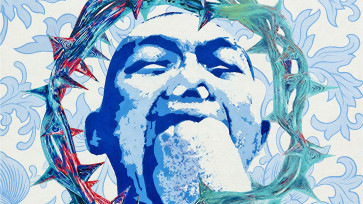
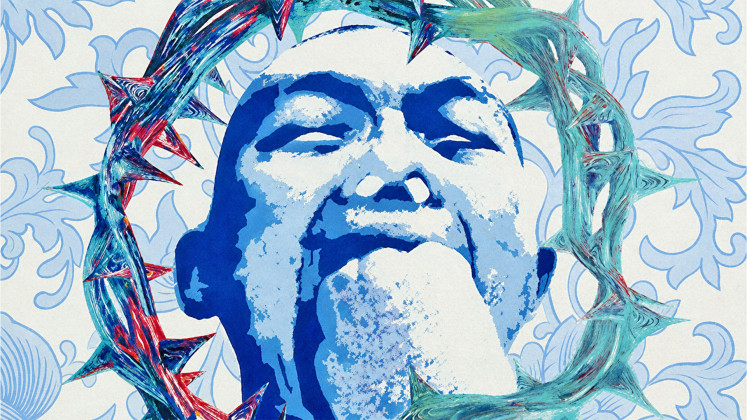
For instance, the Bibliotheque of Shapes series of six artworks is centered around understanding the world and the human pursuit of hopes, dreams and purpose. The first three works take the shape of an eye, ear and speech bubble as a metaphor for what we take in, while the remaining three depict the symbolic journey from our closest environment to wherever we ultimately find our calling.
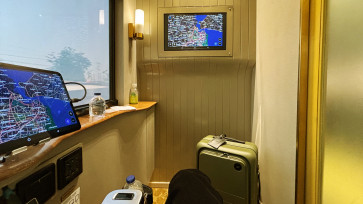
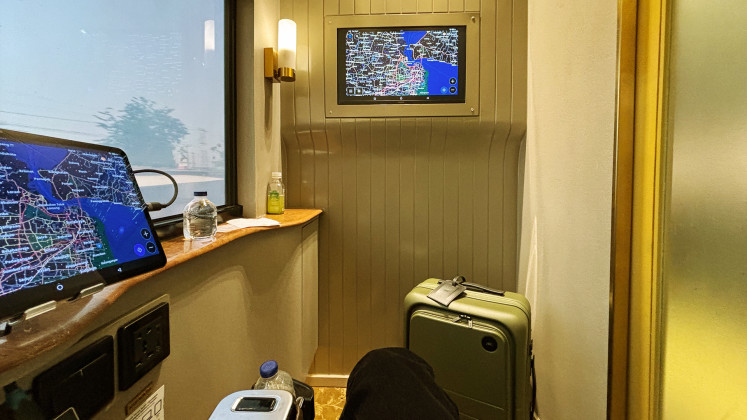
In Starlight Starbright, retro-futurist audiovisual elements combine to evoke an imaginative and interactive experience, centered on the process of planning. The work draws inspiration from old-school arcade games like pinball machines and flight simulators, with a joystick controlling a digital bell sound and a sensor-driven lamp that responds to sound. The message was quite simple, I was told: planning requires thinking about every possibility before it is carried out, a surprisingly down-to-earth tenet despite what the intergalactic audio might suggest.
“It’s a bit like launching a rocket. When a launch is delayed or even fails, scientists learn from that setback so that the rocket can actually fly instead of wallowing in that failure — everything must be taken into account and carefully considered,” TUTU said.
“I also hope that if someone becomes inspired by this exhibition and creates something new, I wouldn’t feel like that person is a competition — instead, I’d be proud that they were able to come up with that. Other people may have the thought and development, but the trigger for it must be present. Hopefully, this exhibition is that trigger.”
Josa Lukman is an editor and head of the Creative Desk at The Jakarta Post. He is also a margarita enthusiast who chases Panadol with Tolak Angin, a hoarder of former "it" bags and an iced latte slurper.