The Jakarta Post
Please Update your browser
Your browser is out of date, and may not be compatible with our website. A list of the most popular web browsers can be found below.
Just click on the icons to get to the download page.


Popular Reads
Top Results
No results found. Please check your search term and try again
Can't find what you're looking for?
View all search results
Popular Reads
Top Results
No results found. Please check your search term and try again
Can't find what you're looking for?
View all search resultsJapanese economy ekes out modest growth
Change text size
Gift Premium Articles
to Anyone
Share the best of The Jakarta Post with friends, family, or colleagues. As a subscriber, you can gift 3 to 5 articles each month that anyone can read—no subscription needed!
 Set as preferred source
 A general view shows the city skyline of Tokyo on Aug. 11, 2026. (AFP/Andrew Caballero-Reynolds)
T
he Japanese economy eked out modest growth in the second quarter despite the impact of the Iran war, official data showed Monday, but the reading fell short of market expectations.
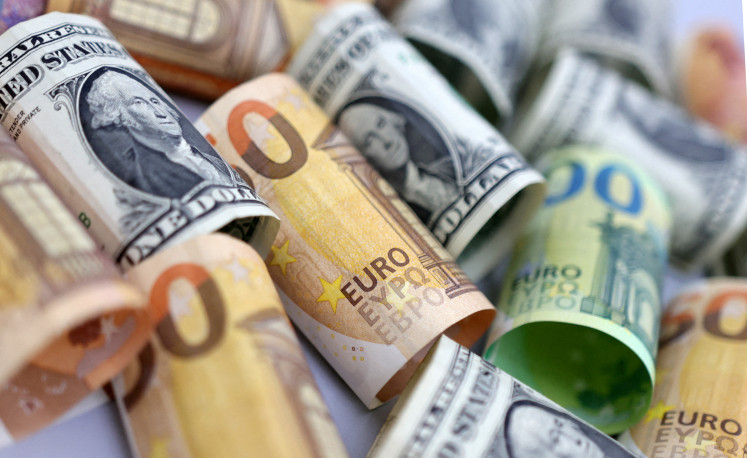
Higher oil prices have swollen Japan's import bill and led to higher prices for consumers, a situation worsened by the weak yen and eroding Prime Minister Sanae Takaichi's popularity.
Gross domestic product (GDP) grew 0.3 percent between April and June, according to seasonally adjusted preliminary data released by the Japanese cabinet office.
Economists had expected stronger growth of 0.5 percent, according to a Bloomberg News survey, after expanding by the same amount in the first quarter.
On an annualized basis, GDP expanded 1.1 percent, against market expectations of 2.0 percent and weaker than a revised 1.9 percent in the previous three months.
Before the data was released the Bank of Japan (BoJ) was expected to hike interest rates soon as inflation accelerates in the world number four economy.

A BoJ rate hike could also lift the yen.
The yen has lost ground since the historic recent joint market intervention by the United States and Japan to support the Japanese currency.
The joint operation to buy yen on the open market came after the currency slipped to a four-decade low of almost 164 per dollar.
This action initially boosted the yen to almost 155 against the greenback but it has since slid back, and on Monday was trading around 159.11.
The weak yen is a boon to big Japanese exporters like Toyota, which on Aug. 4 raised its profit forecasts.
But since many imports are priced in US dollars, in particular oil, Japan needs to shell out more yen for every barrel.
The weaker-than-expected GDP came after capital expenditure fell and missed market expectations, and flat private consumption against forecasts that it would grow.
Prime Minister Takaichi, whose two predecessors were undone by anger over inflation, has widened government support for voters.
Following a massive stimulus package adopted in late 2025 and extensive energy tax rebates, her government approved further aid earlier this year.
In late July, the government also said it would slash consumption tax on food products, lowering it from eight percent to one percent starting next April.
"The [GDP] figures are worse than expected. Both consumption and capital investment are weak," NLI Research Institute economist Taro Saito told AFP.
"The growth is not due to robust economy but due to a decline in imports, because oil imports are difficult" because of the problems transiting the Strait of Hormuz, Saito said.