The Jakarta Post
Please Update your browser
Your browser is out of date, and may not be compatible with our website. A list of the most popular web browsers can be found below.
Just click on the icons to get to the download page.


Popular Reads
Top Results
No results found. Please check your search term and try again
Can't find what you're looking for?
View all search results
Popular Reads
Top Results
No results found. Please check your search term and try again
Can't find what you're looking for?
View all search resultsThe vanishing of Indonesia from the heart of Papua
Beneath the machinery of state security and industrial extraction, Papua’s deepest resistance lives in what cannot be cleared: Its people’s ancestral bond to the land.
Change text size
Gift Premium Articles
to Anyone
Share the best of The Jakarta Post with friends, family, or colleagues. As a subscriber, you can gift 3 to 5 articles each month that anyone can read—no subscription needed!
 Set as preferred source
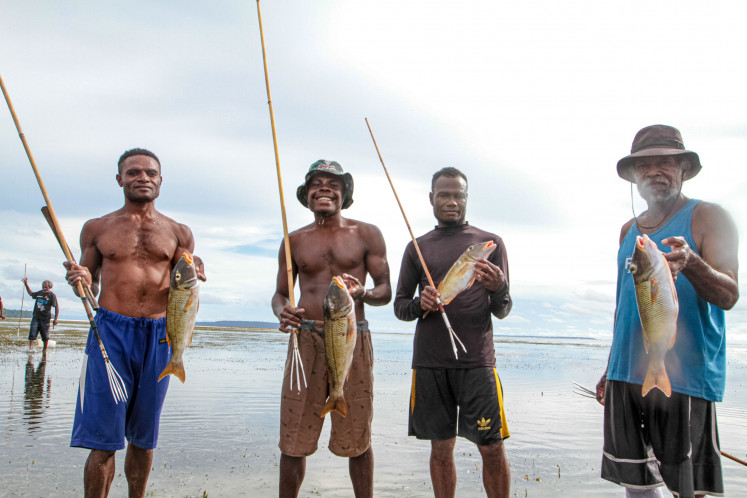
 Padaidori fishermen show their catches on a beach in the Padaido Islands, Biak Numfor regency, Papua, in this file photo published on Aug. 7, 2026. (/Image courtesy of Faizal Aziz)
E
verything, it appears, comes from Indonesia. What, then, is missing in Papua, and what actually remains there? Hundreds of thousands of hectares are transformed into vast tracts of rice, sugarcane and oil palm plantations, largely at the expense of sago, the primary staple of indigenous Papuans.
Deforestation has become synonymous with the destruction of Papua’s ecology and ancestral way of life. To enforce this transformation, dozens of army battalions have been deployed. For what purpose, and for whose benefit?
Addressing these questions, the documentary film Pesta Babi (Pig Feast) by journalist Dandhy Dwi Laksono and anthropologist Cypri Dale, screened recently in Amsterdam, poses a major challenge: Is any of this truly for the sake of the Papuan people?
Roughly 80,000 security personnel, comprising 55,000 soldiers and 26,000 police officers, are stationed to maintain "security" among a population of barely 6 million. Each soldier monitors approximately 100 citizens, while each police officer oversees 200. These ratios stand in stark contrast to the rest of Indonesia, where the average sits at roughly one soldier per 700 residents and one police officer per 600.
Under this centralized command structure, Papua was integrated into the Unitary State of the Republic of Indonesia (NKRI).
In political-economic terms, it first became an indispensable asset for mineral capital, catalyzed by Freeport-McMoRan’s expansive copper and gold mining operations at Ertsberg and Grasberg. Freeport even secured a special operating permit in 1967, two years prior to the formal enactment of the 1969 Foreign Investment Law.

This economic opening followed one of the region's most severe military campaigns in the wake of the 1965-1966 massacres in Java and Bali, beginning with the 1966 Biak operation in Papua. The path was cleared as the former Dutch territory was integrated into the republic through conflict in the early 1960s, the New York Agreement of 1962 and the contentious United Nations-supervised Act of Free Choice in 1969.