The Jakarta Post
Please Update your browser
Your browser is out of date, and may not be compatible with our website. A list of the most popular web browsers can be found below.
Just click on the icons to get to the download page.


Popular Reads
Top Results
No results found. Please check your search term and try again
Can't find what you're looking for?
View all search results
Popular Reads
Top Results
No results found. Please check your search term and try again
Can't find what you're looking for?
View all search resultsMilitarization by request: The quiet creep in Jakarta
When civilian ministries outsource governance to the barracks, democracy risks mistaking military creep for routine statecraft.
Change text size
Gift Premium Articles
to Anyone
Share the best of The Jakarta Post with friends, family, or colleagues. As a subscriber, you can gift 3 to 5 articles each month that anyone can read—no subscription needed!
 Set as preferred source
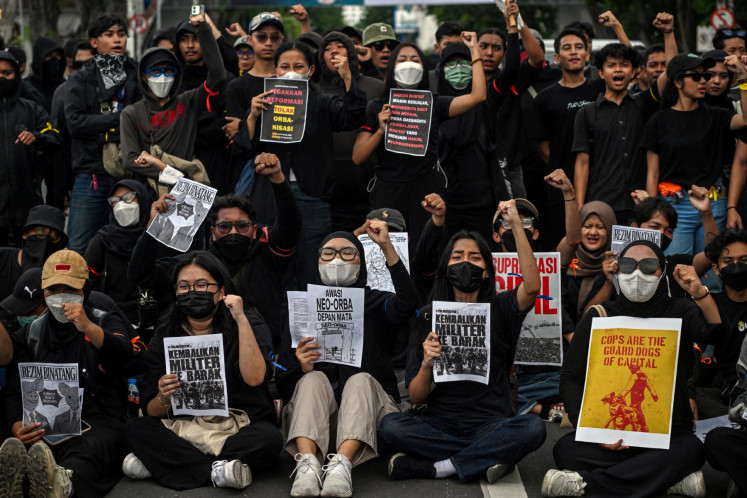
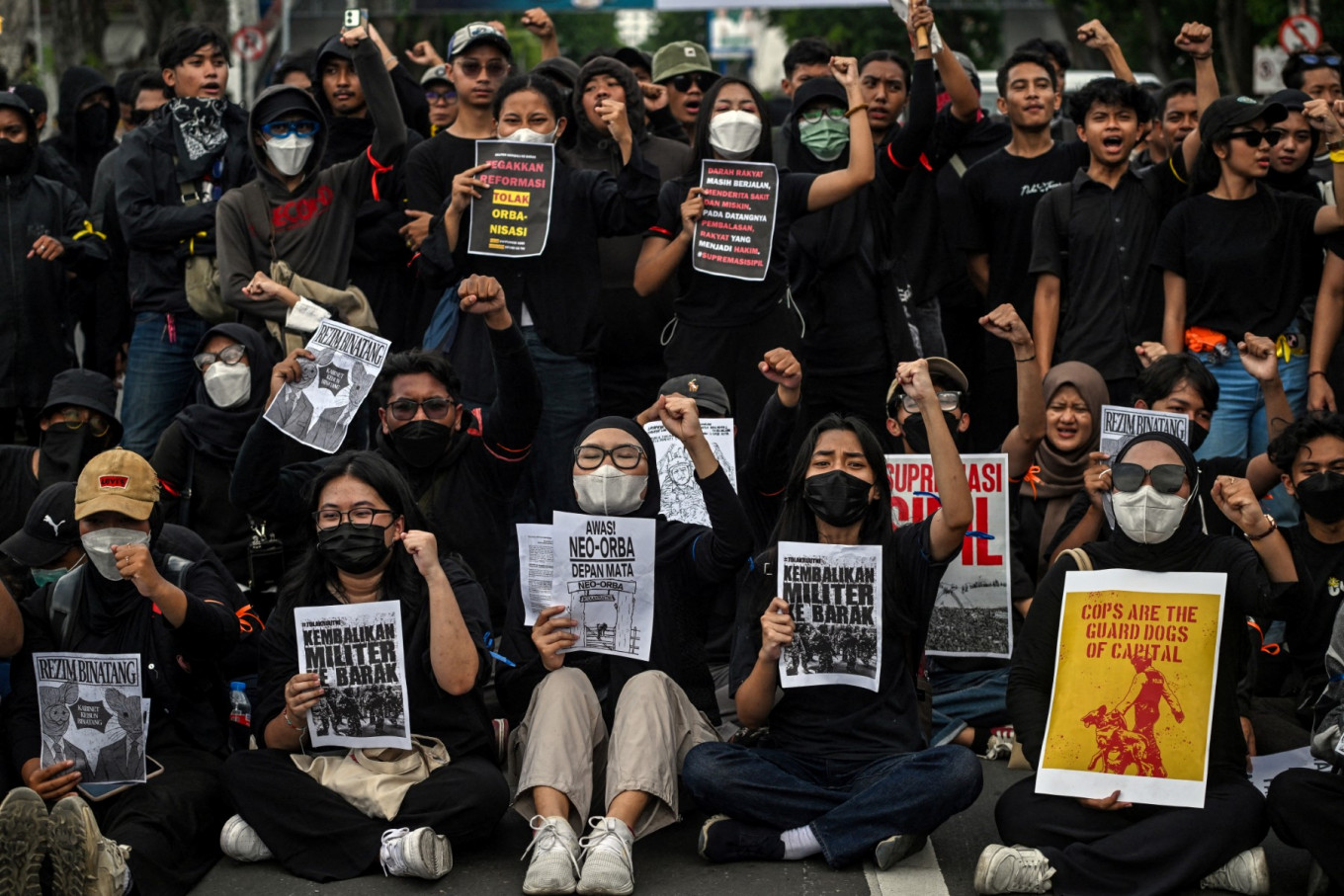 Students display placards reading “Return the soldiers to the barracks“ during a protest against a revision to the Indonesian Military (TNI) Law in Surabaya, East Java on March 24, 2025. (AFP/Juni Kriswanto)
M
ore than five decades after Ferdinand Marcos Sr. signed Proclamation No. 1081 on Sept. 21, 1972, announcing martial law to the public two days later, the Philippine experience retains urgent relevance beyond its borders.
Its significance for Indonesia does not stem from any simplistic claim that contemporary Jakarta mirrors Manila under Marcos; such an analogy would be historically imprecise. The deeper lesson concerns a classic dilemma in civil-military relations: what happens when military authority reaches beyond territorial defense and quietly normalizes within civilian governance.
The two countries traversed distinct authoritarian trajectories. Marcos consolidated extraordinary authority through martial law and an increasingly personalized autocracy. Soeharto’s New Order institutionalized military primacy through dwifungsi (dual function), codifying the armed forces’ legitimate presence not only in national security, but in daily political and social life.
Yet both histories illustrate the same structural hazard: the peril of porous boundaries between military authority and civilian administration.
The Philippines confronted genuine insurgencies and political violence in the early 1970s. Proclamation No. 1081, however, framed the security threat far beyond armed insurrection. Its inventory of subversion reached past combatants to implicate peasants, laborers, professionals, intellectuals, students, and journalists; its catalogue of propaganda swept across mainstream broadcasts, independent pamphlets and campus broadsheets alongside clandestine communist organs.
The crux of that history lies less in the declaration itself than in the elastic definition of a security problem. Once a state begins interpreting political dissent, social mobilization, organized labor and critical expression through the prism of national security, military intervention acquires an open-ended rationale to enter civilian politics.

An armed force is no ordinary state apparatus. It wields coercive instruments denied to civilian agencies, operates under strict hierarchy and command and trains specifically for existential violence. Because these capabilities are inherently exceptional, democratic orders depend on institutional firewalls between military force and civil administration. The democratic hazard begins the moment military presence outside defense ceases to feel exceptional.