The Jakarta Post
Please Update your browser
Your browser is out of date, and may not be compatible with our website. A list of the most popular web browsers can be found below.
Just click on the icons to get to the download page.


Popular Reads
Top Results
No results found. Please check your search term and try again
Can't find what you're looking for?
View all search results
Popular Reads
Top Results
No results found. Please check your search term and try again
Can't find what you're looking for?
View all search resultsAnalysis: Indonesia’s GDP ranking masks deeper economic weaknesses
Change text size
Gift Premium Articles
to Anyone
Share the best of The Jakarta Post with friends, family, or colleagues. As a subscriber, you can gift 3 to 5 articles each month that anyone can read—no subscription needed!
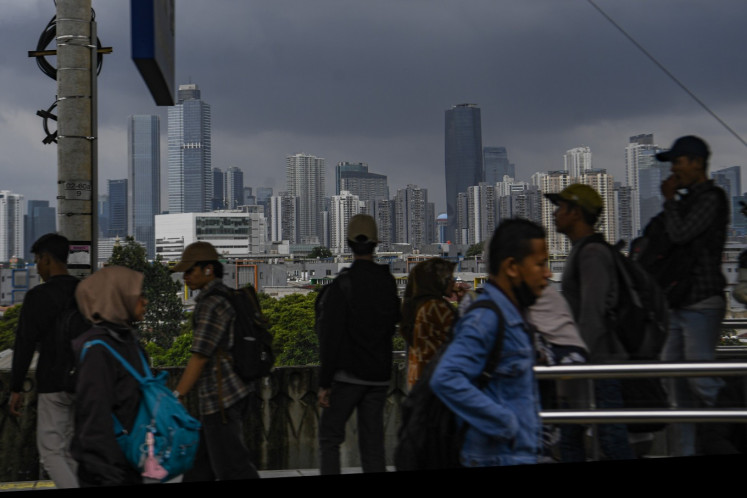
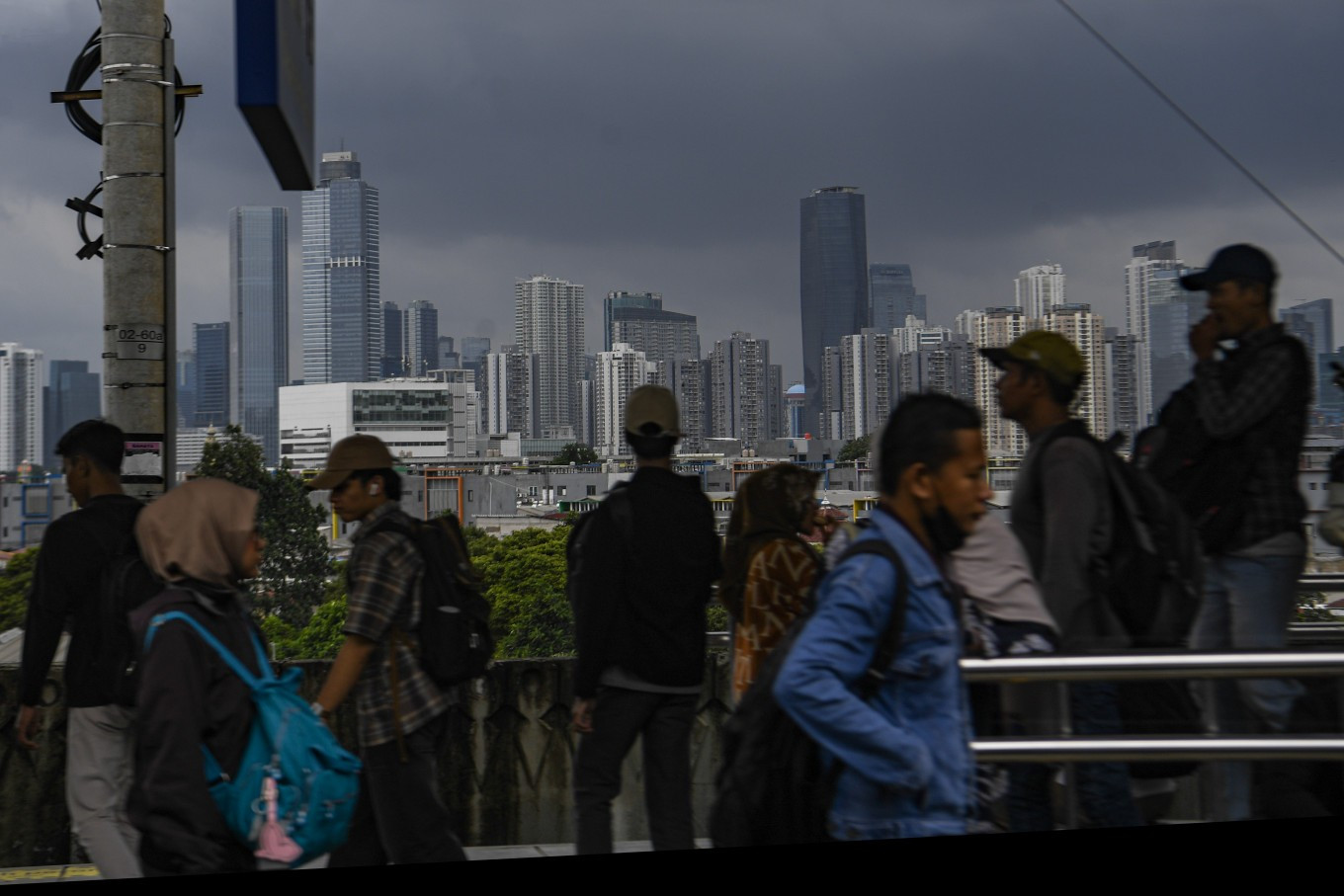 Black sky: Thick clouds cover residential areas and high-rise buildings on Jan. 23, 2026, in Jakarta. (Antara/Muhammad Adimaja)
I
ndonesia’s economy has faced considerable turbulence during President Prabowo Subianto’s administration, making its latest international economic ranking a welcome headline for the government. According to the International Monetary Fund (IMF), Indonesia remains one of the world’s largest economies when measured by gross domestic product (GDP) at purchasing power parity (PPP). The government has celebrated this position as evidence of the country’s economic strength and wealth, while acknowledging persistent inequality. Yet, while the ranking reflects Indonesia’s economic scale, interpreting it as a sign of broad-based prosperity risks obscuring deeper structural weaknesses.
President Prabowo cited the IMF’s October 2026 data, which placed Indonesia seventh globally by GDP at PPP, at US$5.48 trillion, ahead of Brazil, the United Kingdom and France. He described Indonesia as a strong and wealthy country. However, Coordinating Economy Minister Airlangga Hartarto offered a more nuanced picture, noting that Indonesia ranked 17th by nominal GDP, at $1.48 trillion. The disparity becomes more pronounced at the individual level: Indonesia’s GDP per capita stood at $19,091 in PPP terms, ranking 104th globally, while nominal GDP per capita was only $5,150, far below levels in developed economies.
The distinction matters because aggregate GDP measures the size of an economy, not how its output or income is distributed among its people. Statistics Indonesia (BPS) data for March 2026 showed that average monthly per capita expenditure reached Rp 1.66 million. Yet, households in the bottom 20 percent spent just Rp 650,000 per person per month, compared with Rp 3.76 million among the top 20 percent. For the poorest households, food accounted for 64 percent of expenditure, leaving limited room for education, healthcare and other essential needs.
Persistent inequality is compounded by rising living costs. A survey by the Decent Wage Committee covering 135 workers across seven sectors in eight cities and regencies found that nearly 40 percent of workers’ wages went toward food alone. Among palm oil workers, the share reached 73.60 percent. Rising commodity prices have also forced some workers to reduce their protein intake, highlighting the pressure on household nutrition. Meanwhile, Manpower Minister Yassierli said the government was recalculating decent living needs to inform the 2027 provincial minimum wage calculations, which are due by Nov. 21.
Beyond household welfare, Indonesia’s declining competitiveness raises further questions about the foundations of its economic strength. The country fell eight places to 48th among 70 economies in the IMD World Competitiveness Ranking 2026, following a 13-place drop in 2025. Business efficiency plunged 24 places to 50th, infrastructure remained a major weakness at 58th, and government efficiency slipped to 38th. Economic performance, by contrast, held at 24th. These results point to structural constraints in infrastructure, institutional effectiveness and human capital. Concerns over the diversion of education funding toward the free nutritious meals (MBG) program further underscore the trade-offs policymakers face between immediate social spending and long-term investment in productivity.
Fiscal pressures add another layer of vulnerability. Global oil prices have remained above $100 per barrel since early October 2026, roughly $30 above the state budget assumption, while Indonesia imports around 1 million barrels of oil per day. In September, the Indonesian crude price (ICP) averaged $91.90 per barrel, while oil lifting reached only 573,900 barrels per day, below the budget assumption of 610,000 barrels. The projected fiscal deficit of 2.85 percent of GDP assumes an average ICP of $83 per barrel. If prices average $92, the deficit could widen to 3.1 percent of GDP without measures to contain spending or offset the additional costs, leaving the government with more limited fiscal room to maneuver.

The outlook for global energy prices could intensify these risks into 2027. Indonesia remains exposed to higher fuel costs because imported energy is essential to agriculture, transportation and industry. The IMF has warned that the ongoing conflict in the Middle East has disrupted crude oil supply chains, while tighter supplies of refined fuels and higher refining margins have increased transportation and agricultural costs. More expensive imported fertilizer could further raise production costs, reduce agricultural yields and push food prices higher. In response, the IMF has called for stronger fiscal buffers, adherence to the 3 percent-of-GDP fiscal deficit ceiling, tighter monetary policy, a credible medium-term fiscal framework, and targeted, measured subsidies. Despite these risks, the IMF projected Indonesia’s economy to grow by 5.1 percent year-on-year in 2026.