The Jakarta Post
Please Update your browser
Your browser is out of date, and may not be compatible with our website. A list of the most popular web browsers can be found below.
Just click on the icons to get to the download page.


Popular Reads
Top Results
No results found. Please check your search term and try again
Can't find what you're looking for?
View all search results
Popular Reads
Top Results
No results found. Please check your search term and try again
Can't find what you're looking for?
View all search resultsThe twilight of RSPO: A multistakeholder sustainability forum
As the EUDR exposes the structural limits of private voluntary certification, the RSPO’s decades-long monopoly is giving way to a new era of sovereign regulation and legal parity.
Change text size
Gift Premium Articles
to Anyone
Share the best of The Jakarta Post with friends, family, or colleagues. As a subscriber, you can gift 3 to 5 articles each month that anyone can read—no subscription needed!
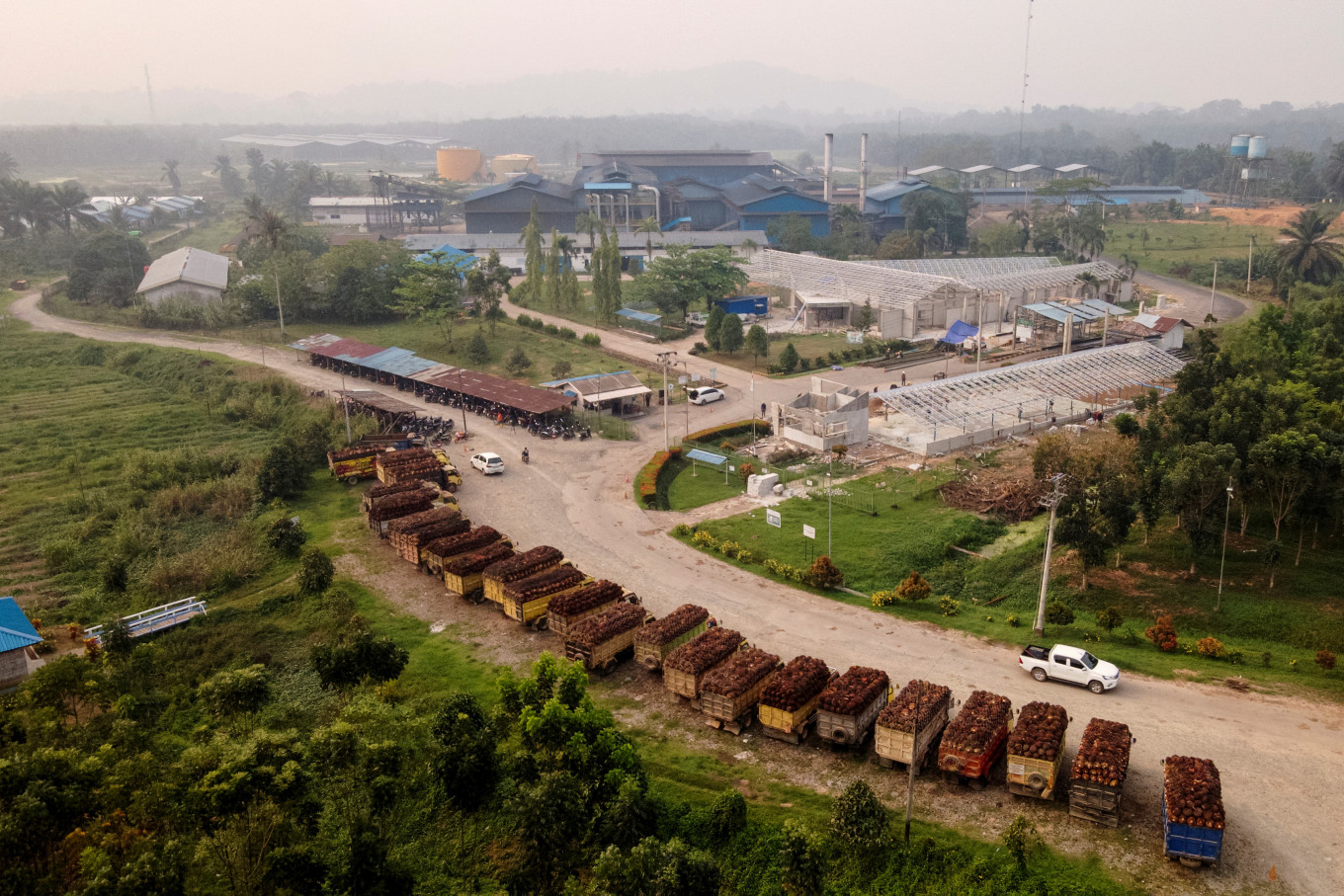 Trucks loaded with oil palm fruit bunches park outside the Multi Prima Entakai (MPE) palm oil mill in Sanggau, West Kalimantan, on Oct. 2, 2026. (Reuters/Soepriyadi Gunawan)
T
he annual meeting of the Roundtable on Sustainable Palm Oil (RSPO), held on Tuesday and Wednesday at Pantai Indah Kapuk in North Jakarta, presented a stark contrast to previous years. The muted engagement and flat dynamics of the sessions signaled a waning momentum, reinforcing signs of industry-wide fatigue toward a certification scheme that once dominated the sector.
This loss of traction stems from deeper structural fractures in global commodity governance. Discussions surrounding sustainable trade often cling to the romanticized notion that environmental integrity is forged primarily at the negotiating tables of private multi-stakeholder initiatives.
Two decades ago, the RSPO emerged to bridge market demands and pressure from nongovernmental organizations (NGOs) seeking to define sustainable production standards. Built upon a private voluntary framework, the organization went on to capture nearly one-fifth of the global palm oil market, spanning millions of certified hectares.
Today, however, that model has entered its twilight. When the European Union enacted the EU Deforestation Regulation (EUDR), under Regulation (EU) 2023/1115, which mandates plot-level geolocation traceability for commodities produced after the Dec. 31, 2020 cut-off date, the premise that private multilateral bodies could serve as self-sufficient regulatory bulwarks collapsed.
Brussels has established unequivocally that private voluntary certifications do not equate to statutory due diligence. This shift is a decisive wake-up call: the architecture of global commodity governance must be rebuilt on legal certainty, regulatory sovereignty and mutual parity.
Historically, the RSPO arose not from producer-led initiatives, but from coercive pressures exerted by Western consumer markets and environmental NGOs. Developing-nation growers had little choice but to comply or face exclusion from premium supply chains. While the RSPO successfully institutionalized itself as the primary international benchmark, producing nations responded by introducing their own legally binding frameworks, such as the Indonesian Sustainable Palm Oil (ISPO) and Malaysian Sustainable Palm Oil (MSPO). Despite this, consumer markets long favored the RSPO, regarding it as the more progressive mechanism.

Yet institutions dependent on market coercion are inherently fragile when regulatory paradigms shift. The RSPO now finds itself at an institutional impasse. While positioned as an environmental vanguard, it has struggled to decisively address deforestation and peatland fires across member concessions, frequently leaving it vulnerable to persistent NGO critique. Simultaneously, it has failed to offer members adequate protection against unsubstantiated allegations, just as it has neglected to build deep, institutional partnerships with regulatory authorities in producing countries.