The Jakarta Post
Please Update your browser
Your browser is out of date, and may not be compatible with our website. A list of the most popular web browsers can be found below.
Just click on the icons to get to the download page.


Popular Reads
Top Results
No results found. Please check your search term and try again
Can't find what you're looking for?
View all search results
Popular Reads
Top Results
No results found. Please check your search term and try again
Can't find what you're looking for?
View all search resultsAnwar's Rohingya gamble
Anwar Ibrahim's high-stakes gamble to normalize ties with Myanmar's junta chief may win cheap points at home, but it threatens to shatter ASEAN's united front and abandon the Rohingya to peril.
Change text size
Gift Premium Articles
to Anyone
Share the best of The Jakarta Post with friends, family, or colleagues. As a subscriber, you can gift 3 to 5 articles each month that anyone can read—no subscription needed!
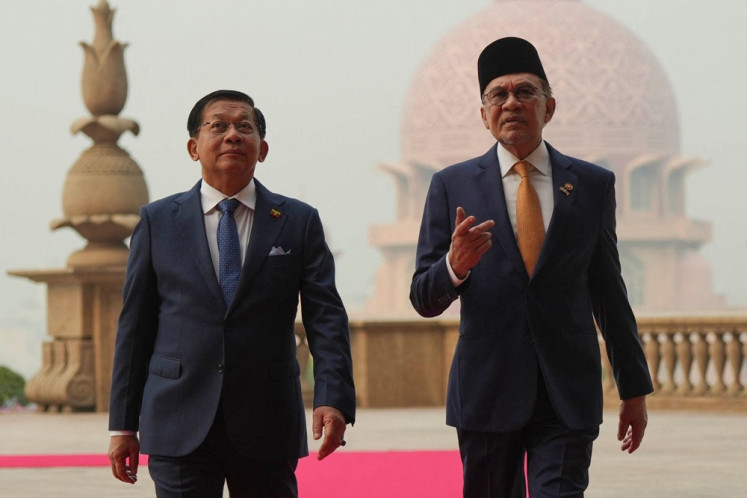
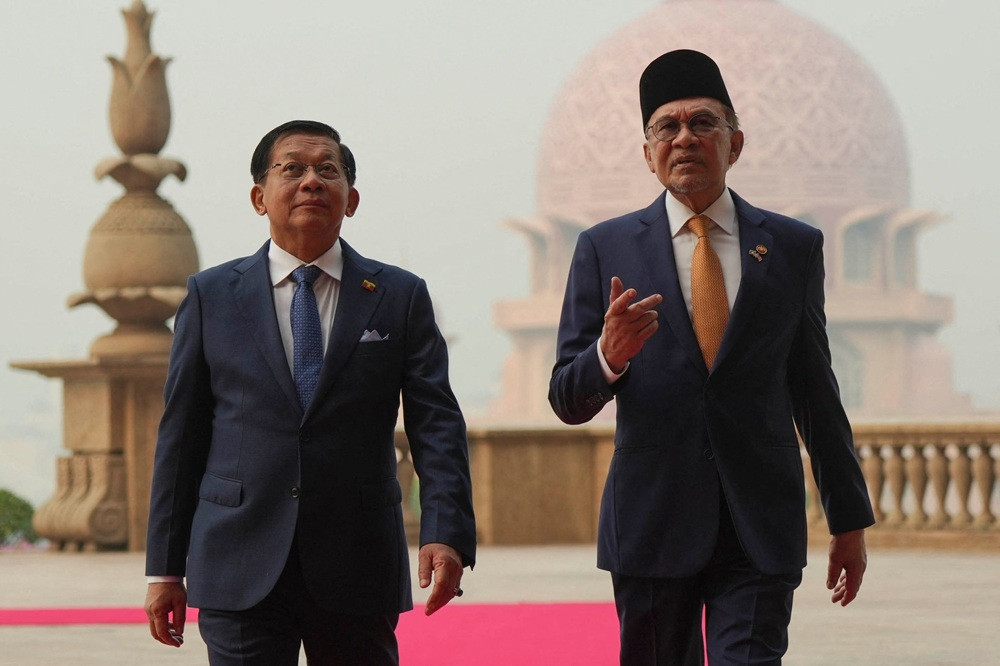 Myanmar leader Min Aung Hlaing (left) walks with Malaysia’s Prime Minister Anwar Ibrahim during a welcome ceremony on Oct. 8 at the prime minister’s office in Putrajaya, Malaysia. (AFP)
M
alaysian Prime Minister Anwar Ibrahim hosted Myanmar junta chief Min Aung Hlaing in Putrajaya on Oct. 8, following the general’s assurances regarding the safety of thousands of Rohingya refugees currently in Malaysia. Facing mounting domestic headwinds, Anwar appears to have executed this sharp policy pivot in a bid to shore up public confidence at home. But will this domestic gamble fracture ASEAN’s united front?
At first glance, Anwar appears to have brokered a diplomatic breakthrough, given that predominantly Buddhist Myanmar has long denied citizenship to the Muslim ethnic minority. Yet, considering Min Aung Hlaing’s failure to honor his pledges to ASEAN five years ago, putting faith in his latest commitments seems deeply misguided.
ASEAN cannot afford to be duped once again. Naypyidaw must first demonstrate that any repatriated Rohingya will be accorded full legal equality and fundamental rights—a process that would take years to verify, given entrenched resistance not only within the military establishment but also among segments of the population in Myanmar.
Min Aung Hlaing returned home from Putrajaya triumphant, having secured Anwar’s pledge to actively lobby fellow ASEAN leaders to end the regime’s diplomatic isolation, in place since 2021 following the military’s coup against a democratically elected government. Time will tell whether Anwar’s high-stakes wager pays off, but there is strong reason to doubt he will secure either the repatriation guarantees he seeks or political redemption among disgruntled Malaysian voters.
ASEAN leaders must hold the line when Anwar lobbies for Min Aung Hlaing’s participation in the upcoming Nov. 16–18 leaders summit in Manila. Extending an invitation to the junta chief would constitute an egregious betrayal of the millions of Myanmar citizens enduring ongoing atrocities under military rule. At most, ASEAN should maintain its current threshold: permitting only non-political, senior bureaucratic representation.
The United Nations High Commission on Refugee, Human Rights Watch and regional civil society groups have raised alarm over proposed repatriations, warning that returnees would be cast back into active conflict, institutionalized persecution and violent subjugation. Ever since the Myanmar military launched its brutal 2017 campaign that drove hundreds of thousands across the border, Naypyidaw has shown zero intent to recognize or protect this population. Anwar claims he secured firm guarantees that returnees will face no coercion, abuse or rights violations—an extraordinarily naive expectation to place on a regime known for its disrespect for the five-point-consensus to end the Myanmar crisis.

It is unlikely Anwar acted in complete isolation from key counterparts, particularly Indonesian President Prabowo Subianto, Singaporean Prime Minister Lawrence Wong and Philippine President Ferdinand Marcos Jr., who will host next month’s summit.