The Jakarta Post
Please Update your browser
Your browser is out of date, and may not be compatible with our website. A list of the most popular web browsers can be found below.
Just click on the icons to get to the download page.


Popular Reads
Top Results
No results found. Please check your search term and try again
Can't find what you're looking for?
View all search results
Popular Reads
Top Results
No results found. Please check your search term and try again
Can't find what you're looking for?
View all search resultsMaking police reform work
From high-profile killings and protest crackdowns to election interference, a string of scandals has pushed public trust in the National Police to a breaking point.
Change text size
Gift Premium Articles
to Anyone
Share the best of The Jakarta Post with friends, family, or colleagues. As a subscriber, you can gift 3 to 5 articles each month that anyone can read—no subscription needed!
 Set as preferred source
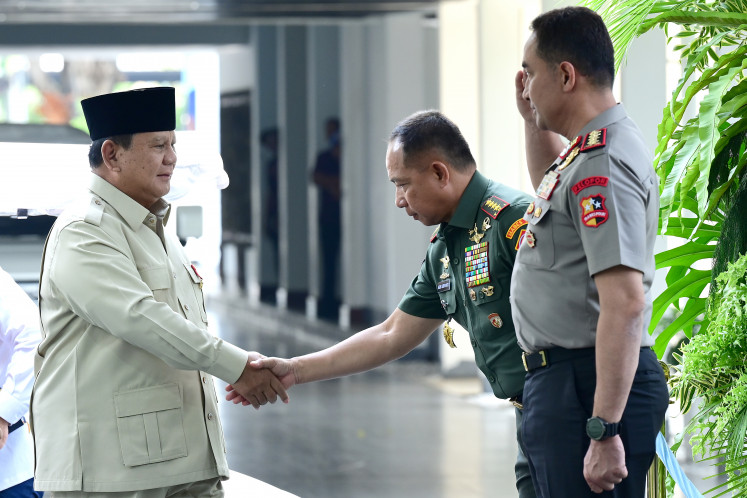
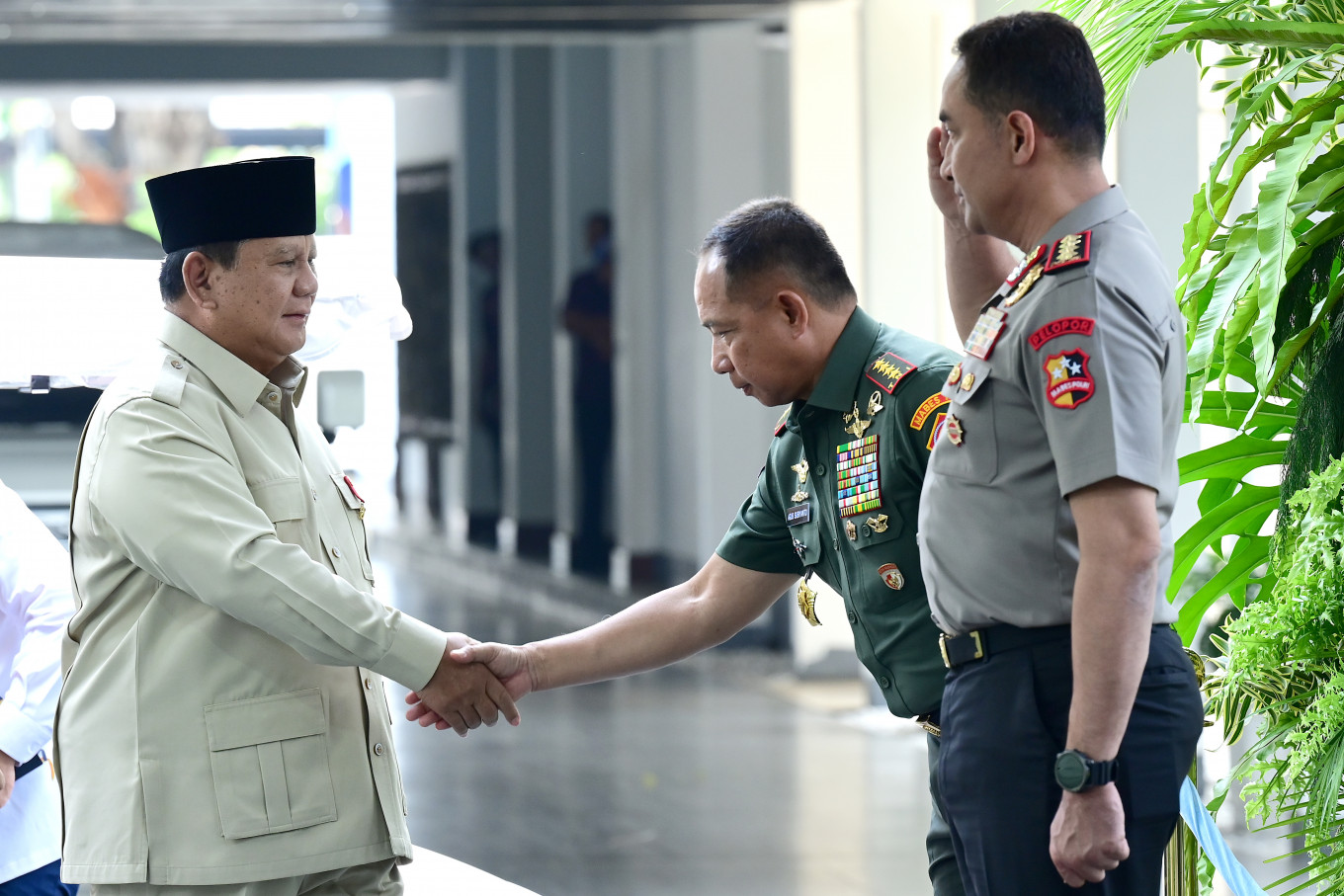 President Prabowo Subianto (left) shakes hands with Indonesian Military (TNI) commander Gen.
Agus Subiyanto as newly appointed National Police chief Gen. Suyudi Ario Seto salutes the
President on Wednesday before Prabowo briefed 800 high-ranking TNI and National Police
officers at the Presidential Palace complex in Central Jakarta. (Presidential Secretariat/Muchlis Jr)
President Prabowo Subianto (left) shakes hands with Indonesian Military (TNI) commander Gen.
Agus Subiyanto as newly appointed National Police chief Gen. Suyudi Ario Seto salutes the
President on Wednesday before Prabowo briefed 800 high-ranking TNI and National Police
officers at the Presidential Palace complex in Central Jakarta. (Presidential Secretariat/Muchlis Jr)
A
fter five years and eight months and a string of events that led to a decline in public trust within that span, we have finally seen a change of guard in the National Police. It is only natural that we hope the pledge by newly sworn-in National Police chief Gen. Suyudi Ario Seto to enforce strict meritocracy across recruitment, placements and promotions will not dissolve into another empty institutional promise.
Sworn in by President Prabowo Subianto on Oct. 1 to succeed Gen. Listyo Sigit Prabowo, the 53-year-old police chief quickly launched a major internal reshuffle that included replacement of 22 provincial police chiefs within the first 10 days in office. But personnel redeployments and consolidation are merely an opening gesture; what the public demands is an accountable, transparent force stripped of systemic abuse.
If executed without compromise, this push would mark a watershed moment for the National Police. For decades, it has been an open secret, even within the ranks, that recruitment and advancement are hobbled by corruption, collusion and nepotism. Lucrative postings and rapid promotions frequently hinge on financial payoffs and dynastic ties to senior brass rather than professional competence.
The police would do well to emulate the civil service, which over the past two decades has established a demonstrably transparent, standardized hiring apparatus.
Suyudi inherits an institution widely distrusted as an entrenched, self-serving "superbody". Despite past pledges of reform, the force remains prone to militaristic policing, arbitrary levies and periodic territorial clashes with the Indonesian Military (TNI), friction frequently stoked by turf battles over illicit revenue.
A series of troubling incidents in recent years has drawn severe public scrutiny of the National Police. Key among them are the 2022 murder case involving former Internal Affairs chief Ferdy Sambo, the October 2022 stampede at Kanjuruhan Stadium in Malang, East Java, which claimed 135 lives, the August 2025 death of ride-hailing driver Affan Kurniawan after being run over by a Mobile Brigade (Brimob) tactical vehicle, and the arrests of thousands of protesters between August 2025 and August this year. These incidents have been further exacerbated by allegations of police partisanship during the 2024 presidential election.

On paper, Suyudi, who stands a good chance of serving for seven years, possesses the regulatory framework to force change. His mandate derives from the May recommendations of the Commission for the Acceleration of Police Reform (KPRP) and the revised Police Law passed in June. Prabowo has backed this road map, which encompasses structural overhauls and 32 supporting regulations.
Digital transformation is another important pillar of the plan. The road map emphasizes a total digital shift through "One INP Data" and a unified "INP Super App" for public reporting, services and accountability tracking.
One INP Data is a unified database system proposed by the commission to integrate and streamline police data, public services and law enforcement tracking.
Yet Indonesia has never suffered from a shortage of reform plans, consultative bodies or legislative amendments. It simply suffers from an inability to sustain them once public scrutiny wanes. The real test of Suyudi’s leadership will therefore be unyielding enforcement.
New recruitment codes, anti-extortion edicts and strict promotion requirements mean nothing unless applied equally to well-connected insiders and ordinary candidates alike, with swift, public sanctions for violators, irrespective of rank.
Transparency cannot remain discretionary. Publishing recruitment criteria, real-time testing scores and promotion rosters, while welcoming independent oversight from civil society and the press, is the only way to replace institutional suspicion with verifiable trust.
A merit-based police force is not a concession to the public. Rather, it is the baseline requirement of a constitutional state governed by the law. Suyudi has staked his tenure on this promise. The nation will be watching to see if he delivers.