The Jakarta Post
Please Update your browser
Your browser is out of date, and may not be compatible with our website. A list of the most popular web browsers can be found below.
Just click on the icons to get to the download page.


Popular Reads
Top Results
No results found. Please check your search term and try again
Can't find what you're looking for?
View all search results
Popular Reads
Top Results
No results found. Please check your search term and try again
Can't find what you're looking for?
View all search resultsWhy the Asia-Pacific needs stronger development finance institutions
Indonesia’s journey, and PT SMI’s contribution to it, is but one part of a broader regional narrative. What I carried home from Colombo was a profound sense of optimism that our development finance institutions are becoming more than financiers of growth; we are becoming a community of practice, united by a shared purpose and enriched by the exchange of ideas and experience.
Change text size
Gift Premium Articles
to Anyone
Share the best of The Jakarta Post with friends, family, or colleagues. As a subscriber, you can gift 3 to 5 articles each month that anyone can read—no subscription needed!
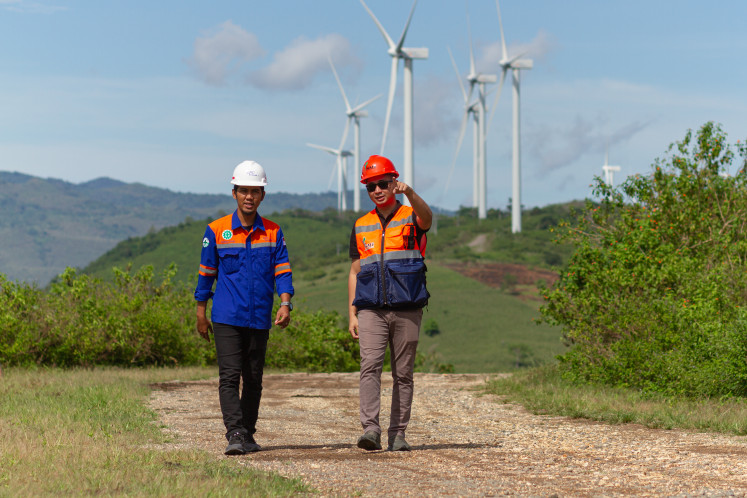
 A wind power plant (PLTB), financed by PT SMI, is pictured in Sidrap, South Sulawesi. (Courtesy of PT Sarana Multi Infrastruktur)
I
have just returned from Colombo, Sri Lanka, where I joined fellow leaders of Development Finance Institutions (DFIs) from across Asia and the Pacific for the 49th ADFIAP Annual Meeting. Over three days of formal sessions and informal conversations, one theme kept resurfacing: The infrastructure gap facing our region is too large for any single government, or any single institution, to close alone.
Several fellow members asked how PT Sarana Multi Infrastruktur (Persero) (PT SMI) brings financing, advisory and blended finance together under one institution, a combination few DFIs in the region currently operate. It was a useful reminder that Indonesia’s development finance institution has as much to offer this community as it must absorb from it.
The scale of the challenge we are all working against is sobering. The Asian Development Bank (ADB) has estimated that developing Asia needs roughly US$1.7 trillion a year in infrastructure investment through 2030. Indonesia is a case in point. Our own projections show infrastructure investment needs of around US$625 billion between 2025 and 2029, against which central and regional government budgets can cover only about 40 percent.
The fundamental challenge is not simply one of raising more capital but of directing capital toward outcomes that advance sustainable development. It is in addressing this challenge that DFIs derive their relevance and mandate. PT SMI, a state-owned nonbank financial institution operating under the Ministry of Finance of the Republic of Indonesia, was established not to compete as a conventional lender but to play a catalytic role in the development ecosystem. We exist to bridge gaps, mitigate risks and crowd in investment, enabling participation and unlocking opportunities in sectors and projects where private capital alone may be hesitant to engage. The practical realization of this mandate is reflected in the often underappreciated but indispensable process of project preparation, which helps unlock viable opportunities for financing and development.
Through our Project Development Facility, PT SMI has advised on 35 projects worth close to US$44 billion across eleven infrastructure sectors since 2011, helping them move from promising ideas toward bankability and, ultimately, financial close. Our experience with blended finance, through platforms such as SDG Indonesia One and our role as Country Platform Manager for Indonesia’s Energy Transition Mechanism, reflects the same lesson: Capital flows more easily when different institutions and instruments work together rather than in parallel.
Financial innovation, though, is not the whole story, and I think this is where the conversation among ADFIAP members can keep growing. As Asia-Pacific’s DFIs look to be seen as trusted partners by governments, multilateral institutions and global capital markets, it helps when financial innovation is paired with equally steady governance. Compliance, transparency and sound institutional procedure are never just formalities, they are often the quiet difference between an institution that is innovative and one that is also, over time, trusted.

The same principle applies to the associations that bring our institutions together. Regional bodies of development finance institutions carry a particular kind of influence: They convene, set standards and speak on behalf of their members to governments, multilateral lenders and global investors. That influence rests on credibility, and credibility rests in large part on how these associations govern themselves. ADFIAP, which traces its roots to 1976 and was established under the auspices of the Asian Development Bank, is a good example of both the opportunity and the expectation. Half a century on, many of its members see in it the potential to represent Asia-Pacific’s development finance community on a wider, more international stage.
Realizing that potential will depend as much on how the association works as on what it sets out to achieve. Clear and consistently applied procedures, timely and open communication with members and decision-making that reflects the views of the wider membership are what allow an organization to speak with authority on others behalf. They are also the same standards of governance, transparency and accountability that DFIs are asked to uphold with their own shareholders, regulators and partners. An association that champions these standards across the region is at its most persuasive when it visibly practices them at home. For ADFIAP, continuing to strengthen these foundations is perhaps the surest way to earn the international recognition its members hope for and to remain an organization they are proud to belong to.
Every member institution has a part to play in that journey, including PT SMI. Our own experience of operating within a public sector governance and oversight framework, as well as combining financing, advisory and blended finance under one roof, has taught us how much institutional discipline matters to the trust of partners and investors. We would be glad to share those lessons and to contribute actively, alongside fellow members, to strengthening ADFIAP’s governance and openness. A well-governed, transparent and accountable association is one that serves all its members well, and one the wider world is more likely to take seriously.
Indonesia’s journey, and PT SMI’s contribution to it, is but one part of a broader regional narrative. What I carried home from Colombo was a profound sense of optimism that our development finance institutions are becoming more than financiers of growth; we are becoming a community of practice, united by a shared purpose and enriched by the exchange of ideas and experience. The infrastructure that will shape our region’s future will be built one bankable project at a time. Equally, the trust, cooperation and solidarity that will sustain that future are built through steady collaboration, institution by institution, partnership by partnership. Both require patience, vision and commitment. Above all, both are achievements that no single institution can realize alone, but those we can accomplish together.