The Jakarta Post
Please Update your browser
Your browser is out of date, and may not be compatible with our website. A list of the most popular web browsers can be found below.
Just click on the icons to get to the download page.


Popular Reads
Top Results
No results found. Please check your search term and try again
Can't find what you're looking for?
View all search results
Popular Reads
Top Results
No results found. Please check your search term and try again
Can't find what you're looking for?
View all search resultsDiversification, not alignment: Reading Indonesia's Russia tilt
By courting Vladimir Putin as a strategic counterweight to Beijing, President Prabowo Subianto is reviving Indonesia’s non-aligned doctrine—hedging against Chinese dominance by adding a risky, sanctions-heavy third pole to Jakarta's geopolitical chessboard.
Change text size
Gift Premium Articles
to Anyone
Share the best of The Jakarta Post with friends, family, or colleagues. As a subscriber, you can gift 3 to 5 articles each month that anyone can read—no subscription needed!
 Set as preferred source
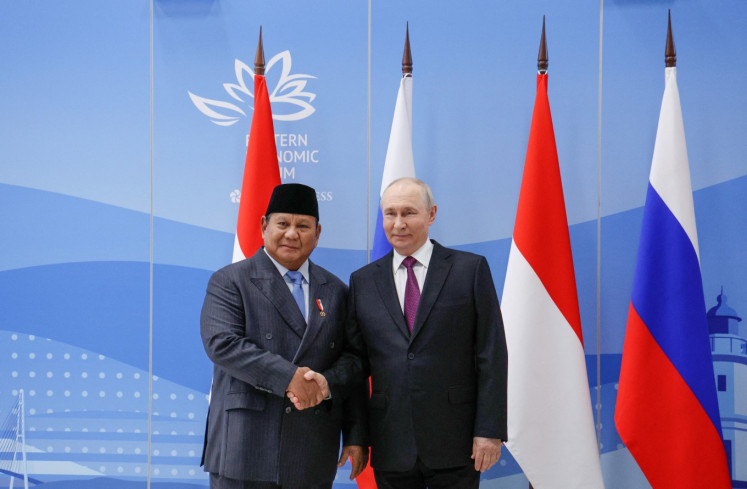
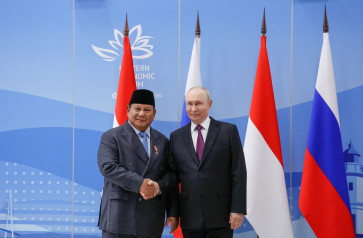
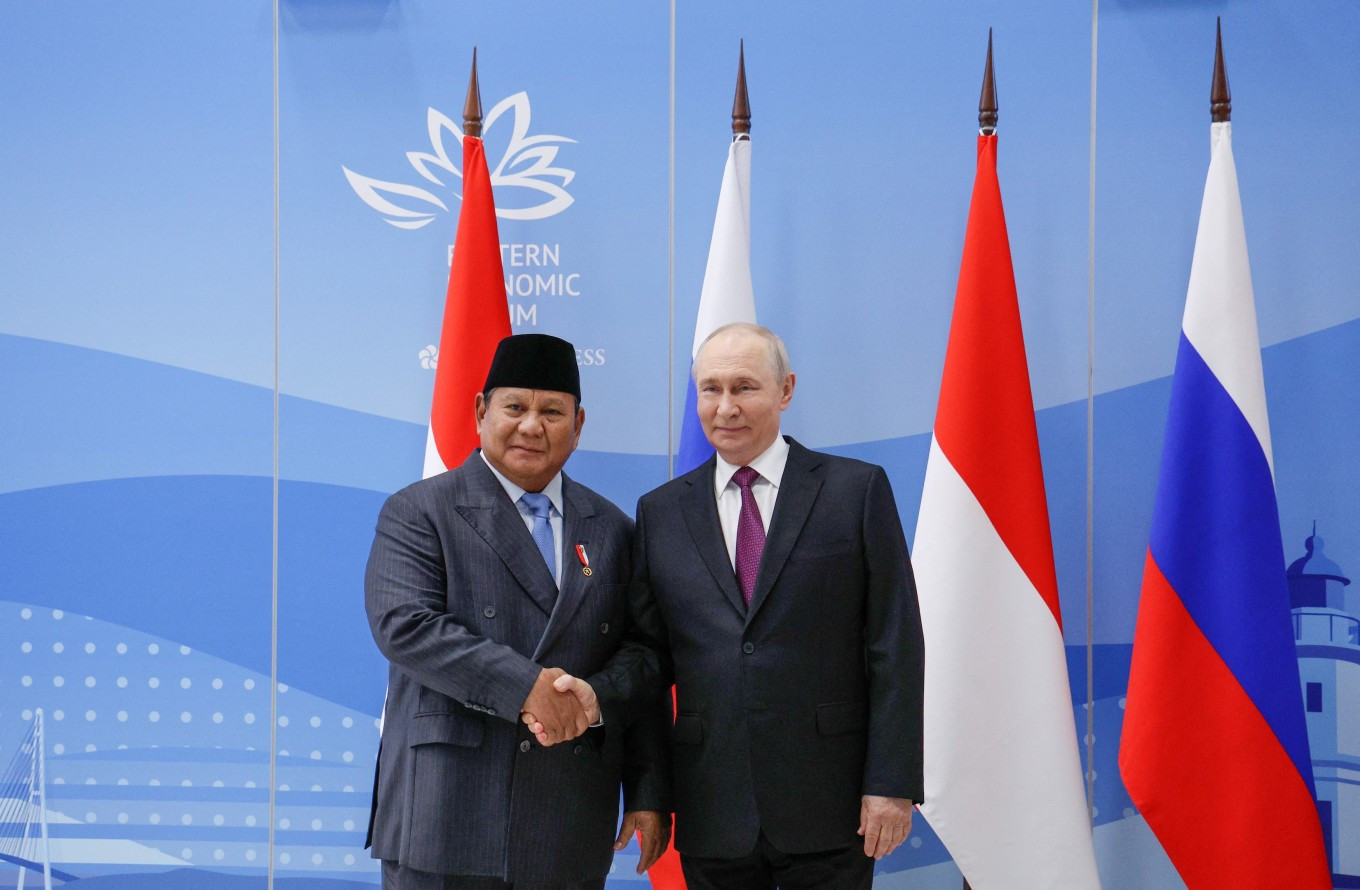 President Prabowo Subianto and Russia's President Vladimir Putin shake hands ahead of a meeting on Thursday on the sidelines of the Eastern Economic Forum in Vladivostok, Russia. (AFP/ Pool/Vyacheslav Prokofyev)
W
hen President Prabowo Subianto met his Russian counterpart Vladimir Putin in Vladivostok early this month, it was their fifth meeting in two years — an unusual frequency given Russia accounts for under 1 percent of Indonesia's total trade. That frequency is a signal, not an accident.
Indonesia's bebas-aktif (free and active) foreign policy has drifted toward de facto economic alignment with Beijing over the past decade. China is Indonesia's largest trading partner (over US$167 billion), its top source of imports, a dominant nickel-smelter investor and builder of the Jakarta-Bandung high-speed rail line.
When Beijing slows or Washington imposes tariffs, Jakarta's usual hedge has been to lean further toward China. Prabowo's Vladivostok visit — as principal guest of honor at the Eastern Economic Forum, reprising his role at St. Petersburg in June 2025 — flips that logic, putting Russia back into the bebas-aktif mix as a third pole.
Four concrete moves, one direction signaled drifting away from China.
First, trade. The Indonesia-Eurasian Economic Union FTA, signed December 2025, covers nearly 12,000 tariff lines and over 90 percent of goods — Indonesia's first FTA with northern Eurasia. Jakarta has ratified it and is pressing Armenia, Belarus, Kazakhstan, Kyrgyzstan and Russia to do the same so it can take effect in early 2027. Bilateral trade hit roughly $4.8–5 billion in 2025 (up 21.7 percent), and the FTA could double that within 3–5 years — modest in absolute terms, but preferential access to a 180-million-person market outside China's orbit.
Second, fertilizer and food. State fertilizer company Pupuk Indonesia signed a joint study with Russian partners for a urea plant in Vladivostok. The logic: Vladivostok faces the Pacific market Indonesian fertilizer needs, and Russia holds gas feedstock China increasingly controls. Russia is also the world's top wheat exporter, offering Indonesia an alternative to Australia and Ukraine.

Third, aluminum. Prabowo announced Rusal is "coming in a big way", developing a refinery with Indonesian partners — reviving a long-discussed $2 billion West Kalimantan bauxite-alumina project, now more viable thanks to Indonesia's 2023 bauxite export ban. A 1–1.8 million ton/year refinery would cut reliance on Australian alumina and Chinese smelter technology.