The Jakarta Post
Please Update your browser
Your browser is out of date, and may not be compatible with our website. A list of the most popular web browsers can be found below.
Just click on the icons to get to the download page.


Popular Reads
Top Results
No results found. Please check your search term and try again
Can't find what you're looking for?
View all search results
Popular Reads
Top Results
No results found. Please check your search term and try again
Can't find what you're looking for?
View all search resultsMaking the legislative threshold adaptive and democratic
We must stop treating the parliamentary threshold as an arbitrary political horse trade and replace static cutoffs with an adaptive, evidence-based mechanism that protects voter representation.
Change text size
Gift Premium Articles
to Anyone
Share the best of The Jakarta Post with friends, family, or colleagues. As a subscriber, you can gift 3 to 5 articles each month that anyone can read—no subscription needed!
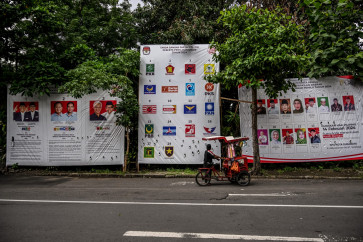
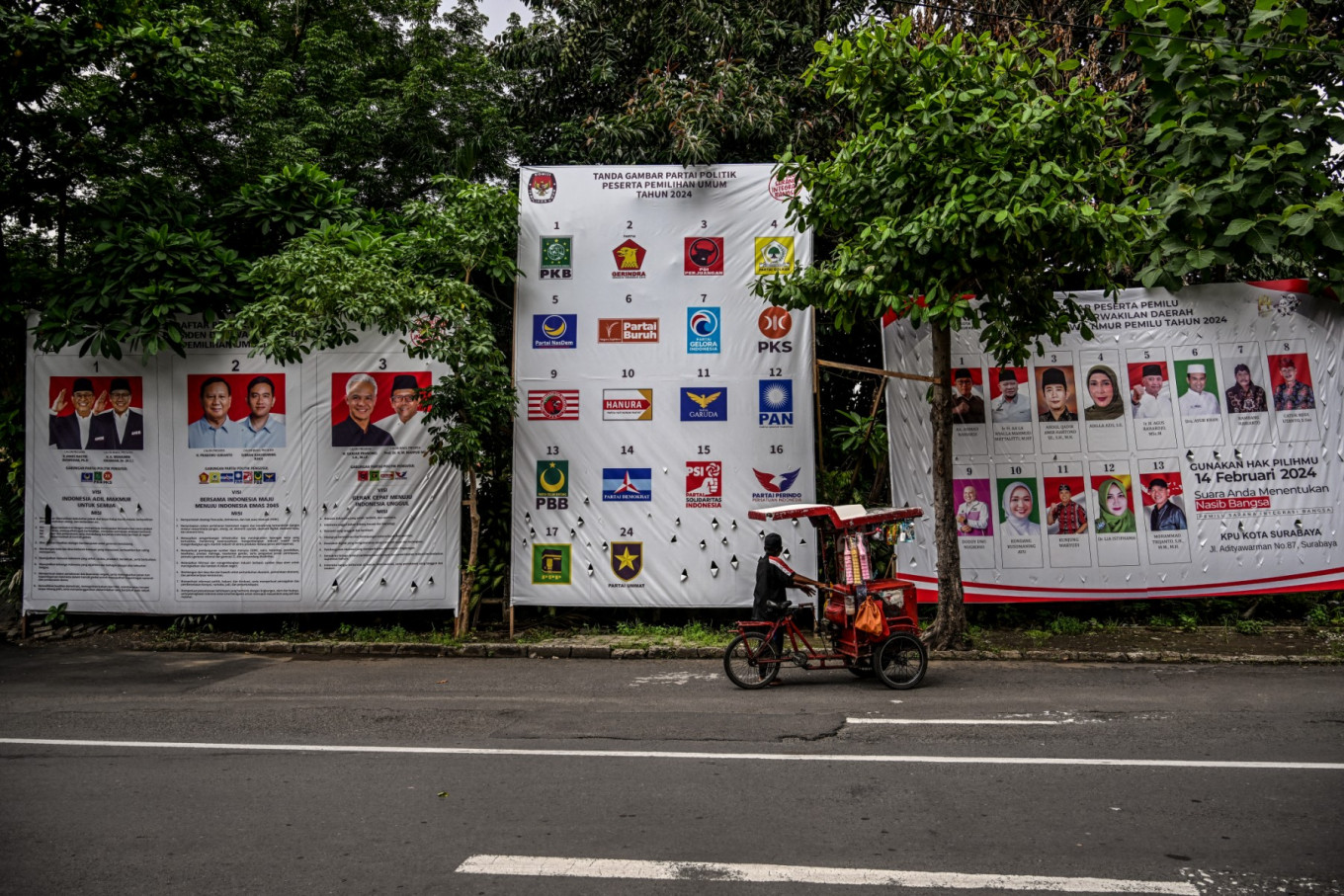 An ice cream vendor looks at banners showing candidates for the 2024 presidential and regional legislative elections on Feb. 3 in Surabaya, East Java. (AFP/Juni Kriswanto)
L
eaders and faction heads in the House of Representatives have agreed to initiate limited deliberations on the election bill. While the House acknowledged that public consultations, notably with nonlegislative parties, remained incomplete, the bill stood firm as a strategic priority for Commission II through late August. This momentum arrives at a pivotal juncture as the institutional framework for the 2029 general election takes shape.
The urgency stems directly from Constitutional Court Ruling No. 116/PUU-XXI/2023, which ordered lawmakers to revise both the norm and magnitude of the legislative threshold ahead of 2029. Simply defending the current 4 percent bar without fresh empirical backing is no longer a viable option. Reformulating the threshold has transitioned from a routine legislative chore into a constitutional obligation and an opportunity to rethink its fundamental design.
Proposals across the political spectrum vary widely. Some groups advocate lowering or discarding the threshold altogether. The Gema Bangsa Party, for instance, last month proposed capping it at 2.5 percent. Conversely, the National Democratic (NasDem) Party floated a 7 percent target alongside a tiered model just a month earlier, in July.
Yet these contrasting positions provoke a fundamental question: Does an aggressively high threshold genuinely simplify the party system or deliver more effective governance?
Simulations based on the 2024 general election challenge that assumption. Testing thresholds of 4, 5 and 7 percent yields identical compositions: eight parties cross into the House, stranding 11.40 percent of the electorate’s ballots as unrepresented, "wasted votes". Lowering the threshold to 3.5 percent yields nine qualifying parties with 7.53 percent of unrepresented votes, while a 2.5 percent threshold admits 10 parties and cuts wasted ballots to 4.72 percent.
Wasted votes are not abstract figures on a ledger. They represent millions of legitimate ballots cast by citizens whose preferences are entirely excluded from seat allocation. Any push to consolidate the party system must balance legislative streamlining against this steep cost to democratic representation.

An optimal threshold is rarely the highest one available; it is the one that delivers structural stability without disproportionately silencing voters.