The Jakarta Post
Please Update your browser
Your browser is out of date, and may not be compatible with our website. A list of the most popular web browsers can be found below.
Just click on the icons to get to the download page.


Popular Reads
Top Results
No results found. Please check your search term and try again
Can't find what you're looking for?
View all search results
Popular Reads
Top Results
No results found. Please check your search term and try again
Can't find what you're looking for?
View all search resultsThe river does not forget
Nature remains unpredictable and largely indifferent to human attempts to intervene in its course.
Change text size
Gift Premium Articles
to Anyone
Share the best of The Jakarta Post with friends, family, or colleagues. As a subscriber, you can gift 3 to 5 articles each month that anyone can read—no subscription needed!
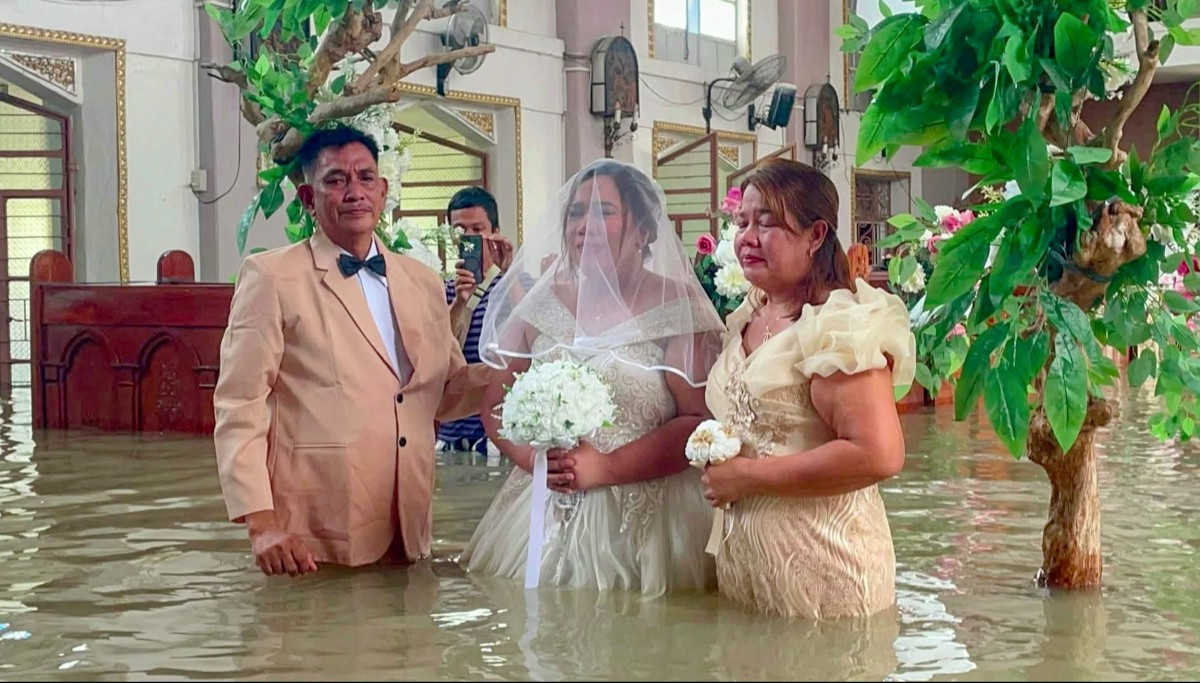 Bride Lhiane Galang (center) walks down the aisle at the St. John the Baptist Parish church during her wedding ceremony in a flooded church in Hagonoy town, Bulacan, the Philippines, on Sept. 1, 2026. (AFP/Ang Tinig – St. John the Baptist Parish Hagonoy, Bulacan)
C
an Nature talk? If it could, what might it be telling us? Such talk may reveal less about Nature’s meanings than about the helplessness we feel in the face of extreme weather, flash floods, landslides, storm surges, glacier collapse.
We may have learned to talk to machines, but we have yet to find a way to communicate directly with the natural environment. Nature remains unpredictable and largely indifferent to human attempts to intervene in its course.
Therefore, we cannot talk to the environment in any meaningful sense; we can only talk about it. And only in the language we already have, that is, as matters of law, money, political blame, or scientific measurement. Each of these accounts is partial, and none can stand substitute for the others. A court cannot calculate the path of a storm, nor can an engineer rule on the validity of a land title. That is why our responses are rarely proportionate to the event. We are reacting to our own descriptions, not to the floodwaters themselves.
We have long realized that our memories are short, and that Nature follows a different clock. A river may meander, but it does not forget its old path and its original banks. The sea may recede from its ancient shores, but it does not forget these despite centuries of land accretion. Time and again, rivers and seas tend to return to their old moorings. Ancient cultures honored these spaces by creating taboos against human incursion and settlement, a practice that carried little information but kept its spell across generations. Modern zoning carries far better information but keeps no memory at all, because the authority that draws the line can be persuaded to redraw it.
And so limits are redrawn. The no-build zones have retained little of their mystical quality. Despite laws prohibiting the building of permanent structures on protected zones, we find ways of redrawing and freeing these for private possession. In this manner are countless waterways erased from the map and built upon as alienable ground, many of them becoming high-end residential communities with a good view of the ocean or a majestic river.
Such encroachments are difficult to regard as blatant violations of tradition or of modern law, because leaving these valuable lands uncommercialized seems, at first glance, irrational. I think of the reclamation projects along multiple points of Manila Bay. Or of the so-called “land development” in the flood plains of Bulacan to make way for the San Miguel-led Aerocity project around a new Manila International Airport — a vast area of grasslands, mangroves and fishponds that had been absorbing the changing tides of the bay. As I write, dozens of Bulacan barangays (villages) have been under water for most of this month.

Elsewhere, such land is deliberately left alone. In September 2019, I spent a morning with a local group of birdwatchers who have appointed themselves guardians of the 254-hectare Wajiro tidal flat in Higashi-ku, Fukuoka. Downtown Fukuoka City stands in plain view, just a couple of kilometers away. There were no private resorts or even coffee shops on this piece of real estate — only a trail and a sign asking visitors to mind their footsteps. The locals regard the area as a “waystation for migratory birds that come from afar and need a place to eat and rest for the long journey ahead.”
I used to read that billboard as a premodern belief that other creatures are equally entitled to their own sacred space on earth. I am less sure now. Every piece of ground carries more than one account of what it is for, and the account that prevails is not the true one but the one with keepers. Wajiro is a sanctuary because the bird account got there first and acquired a steward, a designation in law, perhaps a budget, and volunteers who show up.
I have seen places like this in my country. The 920-hectare Olango Island wildlife sanctuary in Lapu-Lapu City, Cebu comes to mind. More than 20 years have passed since my visit, and I don’t know what has happened to the tidal flats and mangroves that once teemed with fish and migratory shorebirds. But I was, even then, concerned that the area was ripe for “development” — the one word we throw at a place to preempt every other account of what it is for.
And so, having recently watched the apocalyptic surge of deadly floodwaters unleashed by the dual action of glacier collapse and rockslide along the busy border crossing between Nepal and Tibet, I couldn’t help wondering what the river was saying when it rose nine meters above its usual level in half an hour, dragging buildings, bridges and highways along its path. If only Nature could speak. But of course it was saying nothing.
A river dammed by falling ice and rocks will break through whatever stands below it. Everything that made this a catastrophe was human: the road, the settlements, the passport control office. Whatever message there is, it is one we ourselves sent, in the fragmented way that modern society has placed at our disposal.
---
The writer is a columnist at the Philippine Daily Inquirer.