The Jakarta Post
Please Update your browser
Your browser is out of date, and may not be compatible with our website. A list of the most popular web browsers can be found below.
Just click on the icons to get to the download page.


Popular Reads
Top Results
No results found. Please check your search term and try again
Can't find what you're looking for?
View all search results
Popular Reads
Top Results
No results found. Please check your search term and try again
Can't find what you're looking for?
View all search resultsAnalysis: When Independence Day meets a nation’s discontent
Change text size
Gift Premium Articles
to Anyone
Share the best of The Jakarta Post with friends, family, or colleagues. As a subscriber, you can gift 3 to 5 articles each month that anyone can read—no subscription needed!
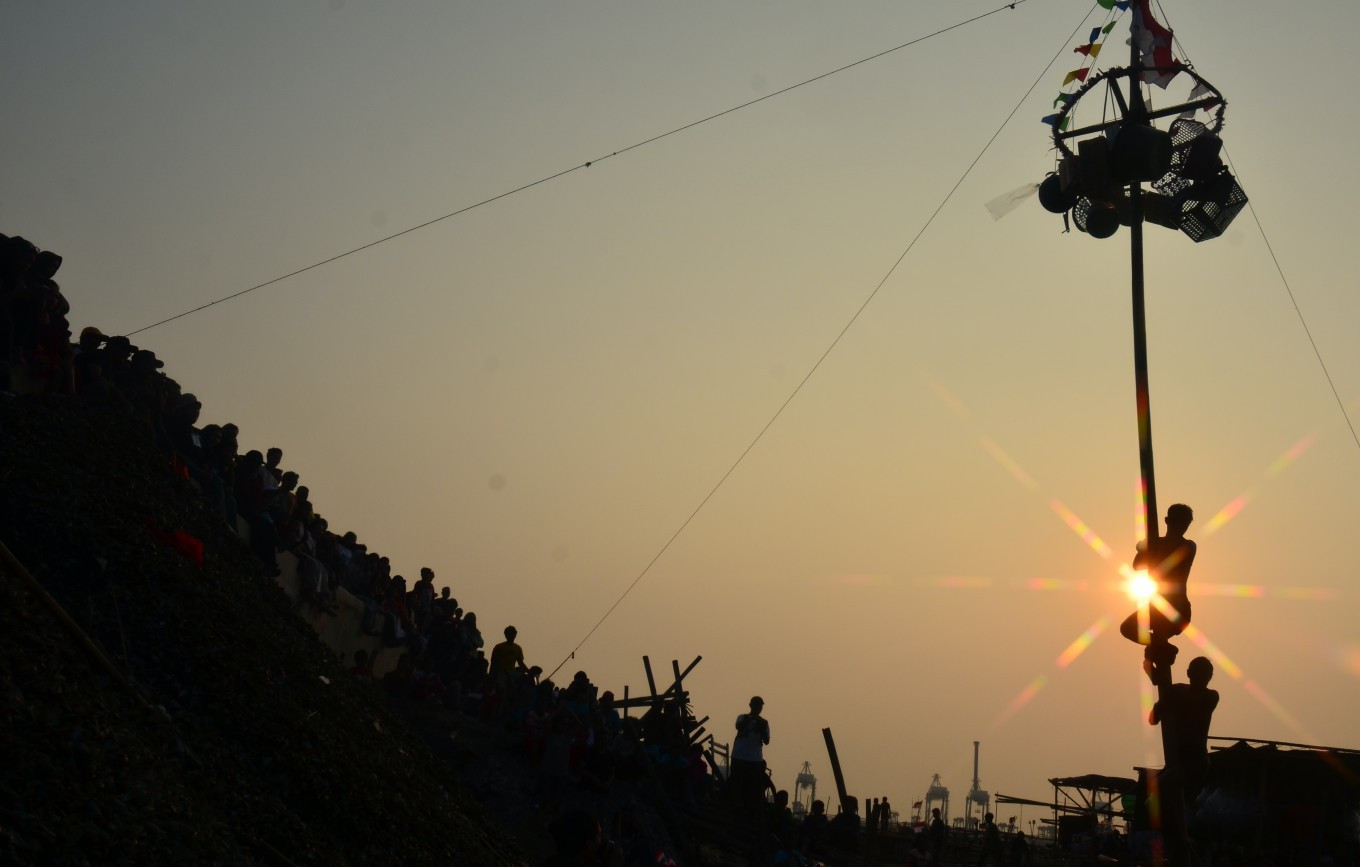 A silhouette of participants attempting to reach the top of a greased pole on Aug. 17, 2026, during an annual traditional pole-climbing competition held to mark Indonesia’s Independence Day in the Cilincing area of North Jakarta. (JP/Iqro Rinaldi)
I
ndonesia’s 81st Independence Day arrived with all the familiar trappings of patriotism, from polished state ceremonies to spirited neighborhood fun games. Yet beneath the celebratory veneer lay an uneasy reality. Punctuated by sharp political satire, street protests, a devastating earthquake in Flores, and ongoing violence in Papua, the occasion prompted a nagging question: Who is actually experiencing the promise of independence?
The official commemoration took place on Aug. 17 at the Merdeka Palace in Jakarta. While dignitaries and state officials filled the stands, everyday citizens vied for seats through a high-stakes "war ticket" system. Demand was fierce, the State Secretariat offered 5,500 public slots, drawing roughly 336,000 registrations. This enthusiasm showed that the state ceremony still resonates well beyond elite circles.
Even so, the contrast between the choreographed spectacle at the Palace and life across the archipelago was impossible to ignore. While many neighborhoods hung red-and-white bunting and cheered on traditional community contests, others seized the holiday as a platform to voice mounting frustration.
In Pati, Central Java, a grassroots coalition of farmers, residents, and civil society groups, including representatives from the Shadow Cabinet, Conference of the Republic, the Interdisciplinary Intellectual Forum (FIAD), and New Indonesia Cooperative, rallied to demand structural reform after more than eight decades of self-rule.
In the digital world, political satire captured that same disillusionment. One viral visual of the "81" logo replaced the "8" with a well-fed caricature of President Prabowo Subianto and the "1" with a frail, emaciated figure representing ordinary citizens. In a single image, a token of national pride was turned into a biting critique of the wealth and welfare divide separating the political class from the public.
Disquiet even pierced the official program. During the state ceremony, Religious Affairs Minister Nasaruddin Umar raised eyebrows by citing a 77.85 percent religious harmony index, framing it as an all-time high. The figure felt jarring alongside persistent threats to religious freedom on the ground, such as the recent pushback against a church build in Citraland, Surabaya, and SETARA Institute’s tally of 221 freedom-of-religion violations over the past year.

A parachuting exhibition drew further scrutiny when Indonesian Military (TNI) skydivers descended from 10,000 feet carrying a massive banner of Prabowo’s portrait. While framed as festive entertainment, the stunt triggered debate over personality-driven state symbolism and the blurring line between the presidency, the military, and the nation itself.