The Jakarta Post
Please Update your browser
Your browser is out of date, and may not be compatible with our website. A list of the most popular web browsers can be found below.
Just click on the icons to get to the download page.


Popular Reads
Top Results
No results found. Please check your search term and try again
Can't find what you're looking for?
View all search results
Popular Reads
Top Results
No results found. Please check your search term and try again
Can't find what you're looking for?
View all search resultsThe limits of Asia's two major growth models
What is the most reliable development path for an increasingly fragmented global economy? China and India represent different answers. But can other countries emulate them?
Change text size
Gift Premium Articles
to Anyone
Share the best of The Jakarta Post with friends, family, or colleagues. As a subscriber, you can gift 3 to 5 articles each month that anyone can read—no subscription needed!
 Set as preferred source
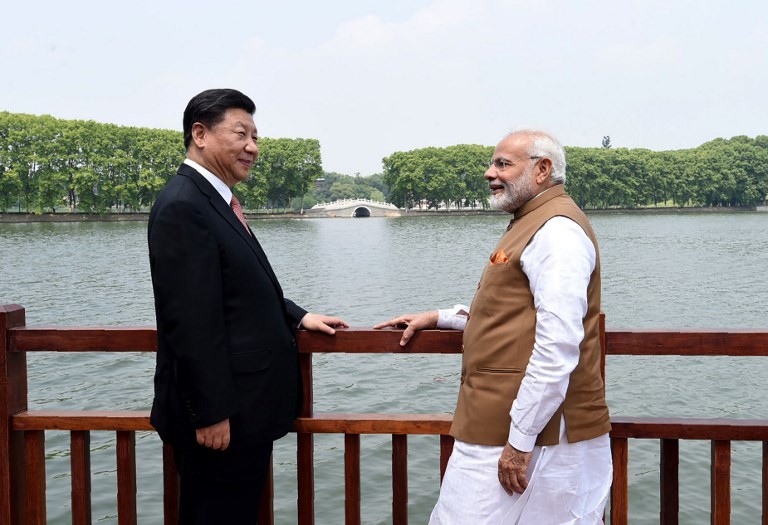 This handout photograph released by India's Press Information Bureau (PIB) on April 28, 2018, shows India's Prime Minister Narendra Modi (right) and Chinese President Xi Jinping looking on along the East Lake, in Wuhan. (AFP/Handout)
W
hat is the most reliable development path for an increasingly fragmented global economy? China and India, the world’s two most populous countries, each represent a different answer. But can other countries emulate them?
With its traditional manufacturing-first development model, China has sought to keep manufacturing’s share of GDP at nearly twice the advanced-economy benchmark, whereas India has leapfrogged into a services-led growth model, eschewing a manufacturing base. Yet a side-by-side comparison based on a decade of data from the OECD’s Trade in Value-Added database is sobering. Neither approach, it seems, is a plug-and-play solution. Each contains structural weaknesses that contemporary developing countries must anticipate.
China and India entered the 2012–22 decade at opposite extremes. China was the world’s dominant exporter of manufactured goods, with manufacturing accounting for roughly 32 percent of its GDP, more than twice that of advanced European economies. Services, meanwhile, accounted for 44 percent of GDP, an unusually small share given China’s income level.
In India, by contrast, services already generated about half of GDP, owing to the country’s internationally competitive information-technology and software exports. Manufacturing, at 18 percent of GDP, was small and shrinking, and half of India’s workforce remained in low-productivity agriculture. Public infrastructure remained underfunded, and reforms were highly contested.
Both governments pursued deliberate development strategies during this decade. The “Made in China 2025” program, launched in 2015, poured hundreds of billions of dollars into 10 strategic industries to sustain China’s high share of manufacturing output and upgrade the economy’s technological capabilities. India tried something more difficult: reviving manufacturing through the 2014 Make in India campaign and, from 2020, providing US$26 billion in production-linked incentive payments across 14 sectors.

A decade on, the results complicate both official narratives. China did stabilize manufacturing’s share of output at around 29 percent of GDP, but automation severed the old link between industrial output and employment. As displaced factory workers moved overwhelmingly into services, that sector grew to half of GDP and roughly 48 percent of employment. Yet most of the new jobs were in low-productivity retail, hospitality and personal services rather than in knowledge-intensive activities.