The Jakarta Post
Please Update your browser
Your browser is out of date, and may not be compatible with our website. A list of the most popular web browsers can be found below.
Just click on the icons to get to the download page.


Popular Reads
Top Results
No results found. Please check your search term and try again
Can't find what you're looking for?
View all search results
Popular Reads
Top Results
No results found. Please check your search term and try again
Can't find what you're looking for?
View all search resultsAnalysis: KDMP, the great cooperative gamble
Change text size
Gift Premium Articles
to Anyone
Share the best of The Jakarta Post with friends, family, or colleagues. As a subscriber, you can gift 3 to 5 articles each month that anyone can read—no subscription needed!
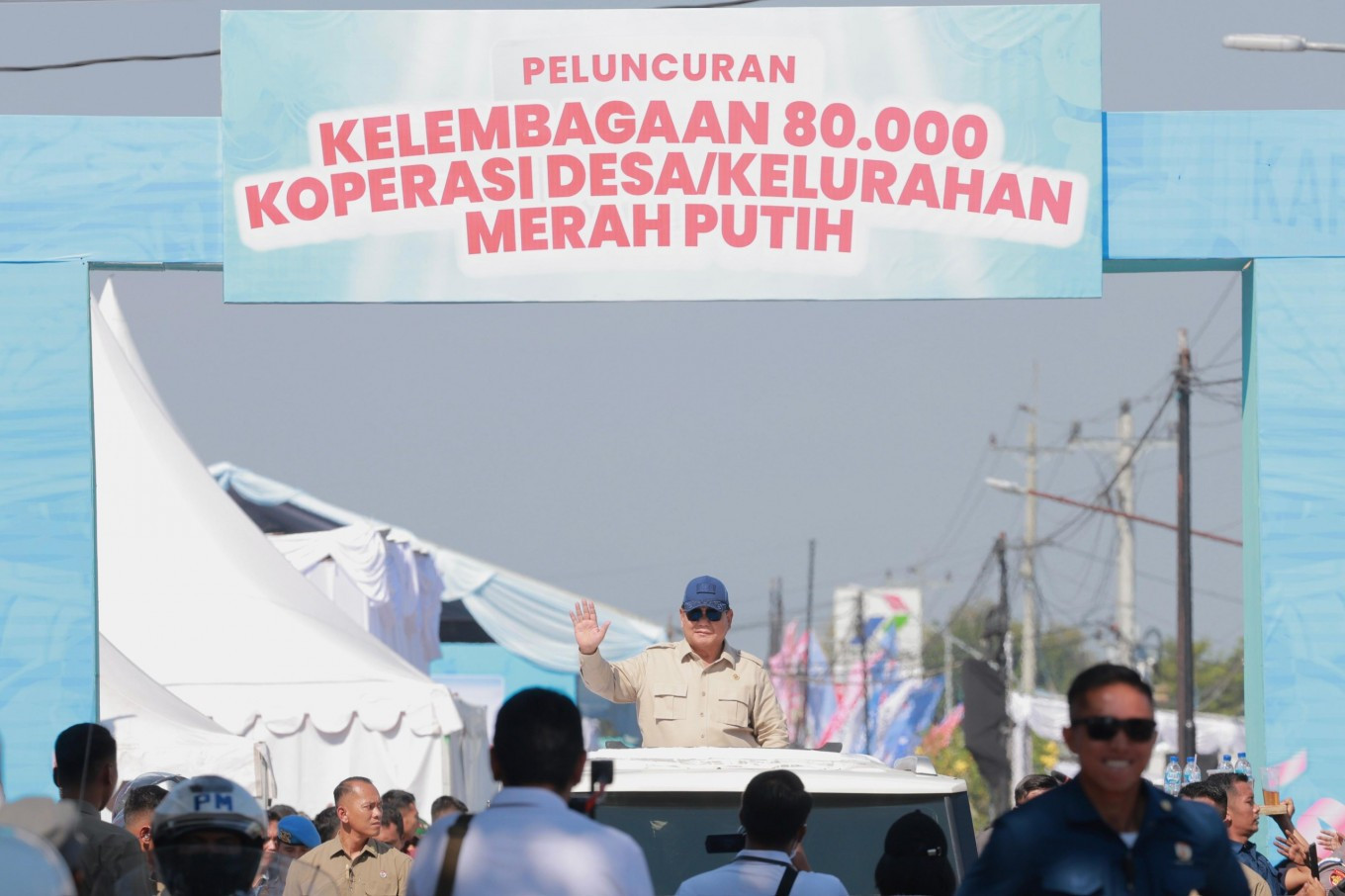 President Prabowo Subianto salutes the crowd from his vehicle on Monday, July 21, 2025, ahead of inaugurating the establishment of 80,081 cooperatives under the Red and White Village Cooperatives (KMP) initiative in a national rollout ceremony held in Bentangan village, Klaten, Central Java. (Courtesy of/BPMI Setpres) (Courtesy of/BPMI Setpres)
F
ourteen months after President Prabowo Subianto unveiled the Red and White Cooperatives (KDMP) program as a vehicle for rural economic empowerment, the initiative increasingly resembles not a grassroots cooperative movement but a large-scale fiscal and governance experiment whose long-term sustainability remains uncertain.
The program's financing model has become one of its biggest sources of concern. The government has tasked state-owned banks with providing Rp 3 billion (US$184,000) in loans to each cooperative. Of that amount, Rp 1.4 billion is allocated for operational expenses, including staff salaries, while the remainder is intended as working capital.
Revisions to the financing framework have removed the dedicated salary allocation previously provided through the state budget, leaving the remuneration of around 30,000 cooperative managers uncertain. Current estimates suggest the Rp 1.4 billion allocation could translate into monthly salaries of only around Rp 690,000, raising broader concerns about whether the program can attract qualified personnel and remain operationally sustainable once construction spending is exhausted.
As implementation has progressed, attention has shifted from construction targets to the program's operational viability. Although more than 15,800 cooperatives had been completed by mid-July 2026, early performance has been uneven. Several cooperatives reported daily revenue of only Rp 100,000 to Rp 300,000, while a pilot cooperative in Melawai, Jakarta, with capital of Rp 3 billion, generated a profit of just Rp 78,000 over six months.
Research by the National Research and Innovation Agency (BRIN) paints a similarly mixed picture. Among 34 districts with poverty rates above 25 percent, 33 recorded no cooperative transactions, while cooperatives in the wealthiest districts generated transaction values roughly six times higher than those in the poorest areas. These findings suggest that the program's success depends not only on the number of cooperatives established but also on local market conditions and economic readiness.
This, in turn, raises questions about the cooperatives' ability to repay their loans to state-owned banks. Finance Minister Purbaya Yudhi Sadewa has sought to reassure lenders, saying the loans will be repaid over six years using village funds, with around two-thirds of those funds earmarked for debt repayment.

Yet financial sustainability is only one part of the challenge. Questions are also emerging over how the program is being implemented, governed and monitored on the ground. The government's decision to assign state-owned PT Agrinas Pangan Nusantara to rapidly construct cooperative offices and stores across participating villages has itself attracted criticism.