The Jakarta Post
Please Update your browser
Your browser is out of date, and may not be compatible with our website. A list of the most popular web browsers can be found below.
Just click on the icons to get to the download page.


Popular Reads
Top Results
No results found. Please check your search term and try again
Can't find what you're looking for?
View all search results
Popular Reads
Top Results
No results found. Please check your search term and try again
Can't find what you're looking for?
View all search resultsNo short-cut for 100 GW renewable ambition
The main constraint is not the lack of capital available to fund the projects; it is the regulation.
Change text size
Gift Premium Articles
to Anyone
Share the best of The Jakarta Post with friends, family, or colleagues. As a subscriber, you can gift 3 to 5 articles each month that anyone can read—no subscription needed!
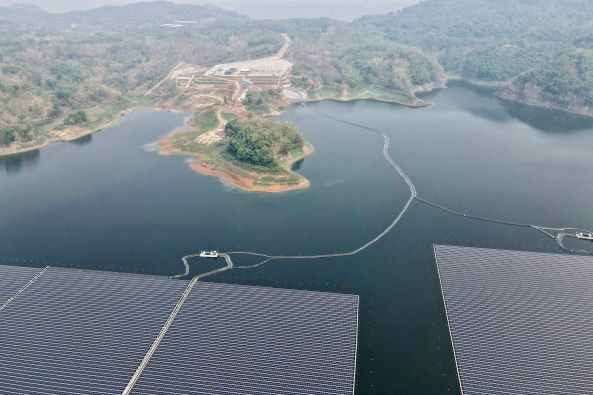 Hilly terrain forms a backdrop on Nov. 9, 2023 against the Cirata Floating Solar Power Plant at Cirata Reservoir in Purwakarta, West Java, the largest energy facility of its kind in Southeast Asia that was developed jointly by the Indonesian government and Abu Dhabi-owned renewable company Masdar of the United Arab Emirates. (AFP/Bay Ismoyo)
S
ince May, Indonesia has been rattled by a string of power outages across Java and Sumatra, exposing just how fragile its coal-dependent national energy security is.
Earlier this year, President Prabowo Subianto announced a rather ambitious plan of developing 100 gigawatts of solar power capacity in an attempt to move away from fossil fuels, and particularly away from coal. The timing has made the announcement feel like an urgent response to a power system that has already been flawed.
But beyond energy security, this move also serves as an economic response to domestic and international pressures for cleaner energy in Indonesia. Global climate policies, such as the European Union’s Carbon Border Adjustment Mechanism (CBAM), which penalizes carbon-intensive exports, are making renewable energy power a decisive competitive factor for Indonesia’s export value.
If Indonesia is still holding on to the ambition to become a major supplier in the EVs ecosystem, critical minerals and green manufacturing, then complying with its carbon requirements is a must. In that sense, building out renewable energy has become the key not just to cutting emissions, but to achieving genuine energy independence.
At the same time, the energy transition agenda also requires coal retirement. At least 15 gigawatts of coal plants need to be retired in order to achieve the long-journey of 100 gigawatts renewable energy. Without a genuine commitment to phasing out coal, the 100 gigawatts target will change little, and new solar capacity will simply be layered on top of an already coal-heavy grid rather than replacing it.
On the other hand, realizing the full 100 gigawatts plan in one stroke is an impossible act. Hence why policymakers have scaled the ambition down to an initial 17 gigawatts of solar photovoltaics, targeted for completion within the next two years.

This first phase functions as a proof of concept, testing whether Indonesia can coordinate across ministries, state utility PLN and state asset fund Danantara, and whether it can attract bankable financing needed to sustain the broader 100 gigawatts vision.