The Jakarta Post
Please Update your browser
Your browser is out of date, and may not be compatible with our website. A list of the most popular web browsers can be found below.
Just click on the icons to get to the download page.


Popular Reads
Top Results
No results found. Please check your search term and try again
Can't find what you're looking for?
View all search results
Popular Reads
Top Results
No results found. Please check your search term and try again
Can't find what you're looking for?
View all search resultsIndonesia’s economy is starting to lose the confidence game
Faced with a plummeting rupiah and shifting global markets, Indonesia must halt its erratic policymaking and institutional erosion before it permanently loses the vital game of investor confidence.
Change text size
Gift Premium Articles
to Anyone
Share the best of The Jakarta Post with friends, family, or colleagues. As a subscriber, you can gift 3 to 5 articles each month that anyone can read—no subscription needed!
 Set as preferred source
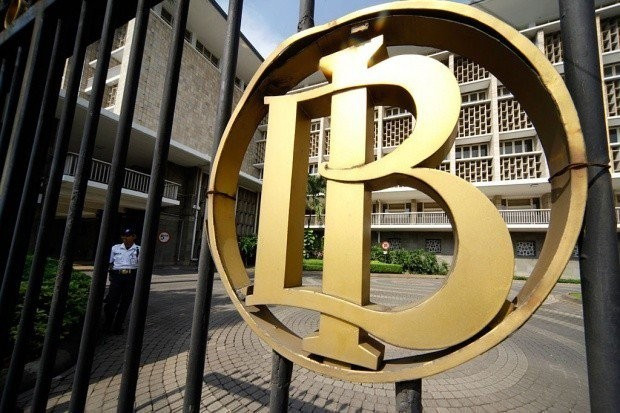 The Bank Indonesia logo adorns the gate of the central bank's headquarters in Jakarta in this undated photograph. (Antara/File)
B
ank Indonesia (BI) has aggressively increased its benchmark interest rate recently to contain the fall of the rupiah, which has been under severe pressure since conflict broke out in the Middle East. Within a single month, BI raised its rate by 100 basis points to 5.75 percent.
However, the currency has continued its downward trajectory against the United States dollar. When BI initiated this tightening cycle on May 20, the rupiah stood at 17,685 per dollar; it has since breached and hovered above the psychological threshold of 18,000 per dollar.
This exceptionally sharp slide over the past two months points to something far more severe than typical market volatility: an extreme overshooting phenomenon. The currency’s collapse no longer reflects underlying purchasing power fundamentals, but rather a market disequilibrium driven by panic, massive capital flight and an acute shortage of dollar liquidity in the domestic spot market.
Investor expectations play a pivotal role in dictating exchange rates. If market participants believe the rupiah will continue to weaken, they will preemptively sell the currency to buy dollars, creating a self-reinforcing downward spiral. Under such circumstances, even a large interest rate hike by the central bank cannot arrest the depreciation.
As a tool for currency stabilization, monetary tightening has distinct structural limits. While higher rates can theoretically attract capital, they also choke off domestic economic growth, which is precisely why BI cannot raise rates indefinitely.
Looking back at the 1997–1998 Asian Financial Crisis sheds light on the delicate relationship between BI’s policy rates and the rupiah. During that crisis, the currency collapsed from approximately Rp 2,400 per US dollar in mid-1997 to nearly Rp 17,000 in January 1998. BI raised rates repeatedly; by early 1998, its benchmark rate exceeded 40 percent, while overnight interbank rates skyrocketed to 100 percent.

Compared with pre-crisis levels, effective short-term interest rates surged by roughly 60 percentage points. This painful monetary tightening caused the economy to contract by 13.1 percent in 1998, resulting in one of the deepest recessions in the nation's history.









Your Opinion Matters
Share your experiences, suggestions, and any issues you've encountered on The Jakarta Post. We're here to listen.
Enter at least 30 characters
0
/ 30
Thank you
Thank you for sharing your thoughts. We appreciate your feedback.