The Jakarta Post
Please Update your browser
Your browser is out of date, and may not be compatible with our website. A list of the most popular web browsers can be found below.
Just click on the icons to get to the download page.


Popular Reads
Top Results
No results found. Please check your search term and try again
Can't find what you're looking for?
View all search results
Popular Reads
Top Results
No results found. Please check your search term and try again
Can't find what you're looking for?
View all search resultsA strategic case for the Indonesia-Canada trade pact
ICA-CEPA offers Indonesia a source of resilience and strategic autonomy in a time of heightened geopolitical uncertainty, supply chain disruption and economic fragmentation.
Change text size
Gift Premium Articles
to Anyone
Share the best of The Jakarta Post with friends, family, or colleagues. As a subscriber, you can gift 3 to 5 articles each month that anyone can read—no subscription needed!
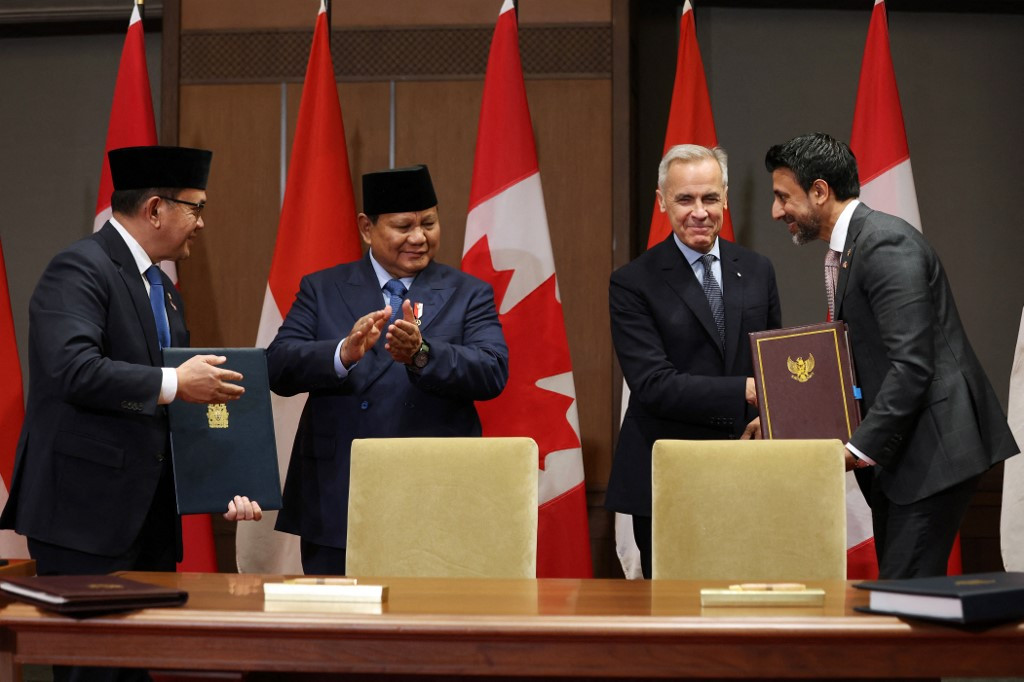 Canadian Prime Minister Mark Carney (second right) shakes hands with Canadian Minister of International Trade Maninder Sidhu (right) as President Prabowo Subianto (second left) and Trade Minister Budi Santoso look on during the signing of the Indonesia-Canada Comprehensive Economic Partnership Agreement (ICA-CEPA) on Sept. 24, 2025, on Parliament Hill in Ottawa. (AFP/Dave Chan)
L
ast year, Indonesia and Canada signed the Indonesia-Canada Comprehensive Economic Partnership Agreement (ICA-CEPA), a landmark agreement with the potential to deliver meaningful economic gains for both countries.
Analysis by the Office of the Chief Economist at Global Affairs Canada estimates that the agreement could add CA$226 million (US$160.64 million) to Canada’s economy, while Indonesia’s GDP is projected to gain around CA$234 million ($166.35 million) immediately, with further economic benefits expected to continue over time.
Yet, the significance of ICA-CEPA goes above and beyond economic metrics. The groundbreaking agreement between the two countries also offers Indonesia a source of resilience and strategic autonomy in a time of heightened geopolitical uncertainty, supply chain disruption and economic fragmentation.
The agreement is especially relevant today, when the foundations of our global trading system have come under increasing strain. Pandemic-era supply chain disruptions, rising protectionism and intensifying geopolitical rivalries have laid bare the risks of excessive dependence on any single market, supplier or economic bloc. At the same time, as the conflict in the Middle East has shown, our world remains deeply interconnected, and distant conflicts can still quickly affect trade flows, energy prices and economic stability across the world.
For Indonesia, the challenge is to remain open while reducing vulnerabilities arising from concentrated economic dependencies. This is the logic behind strategic diversification, a concept recently advanced by researchers from the Centre for Strategic and International Studies.
Strategic diversification is about expanding Indonesia’s portfolio of economic relationships, creating alternative channels for trade, investment, technology and cooperation, and ensuring that no single relationship becomes a constraint on the country’s economic security or strategic decision-making.

In many respects, strategic diversification is the economic expression of Indonesia’s principle of bebas aktif (independent and active) foreign policy. Just as Indonesia seeks to preserve diplomatic flexibility by engaging constructively with multiple partners, it must also cultivate a diverse network of economic relationships that allows it to pursue its national interests under changing global conditions.