The Jakarta Post
Please Update your browser
Your browser is out of date, and may not be compatible with our website. A list of the most popular web browsers can be found below.
Just click on the icons to get to the download page.


Popular Reads
Top Results
No results found. Please check your search term and try again
Can't find what you're looking for?
View all search results
Popular Reads
Top Results
No results found. Please check your search term and try again
Can't find what you're looking for?
View all search resultsWhy Indonesia’s revolving door of corruption keeps spinning
Indonesia’s economy can no longer rely on cheap labor and raw resources. If the country wants to compete globally, it must finally jam the corrupt "revolving door" that trades public office for private profit.
Change text size
Gift Premium Articles
to Anyone
Share the best of The Jakarta Post with friends, family, or colleagues. As a subscriber, you can gift 3 to 5 articles each month that anyone can read—no subscription needed!
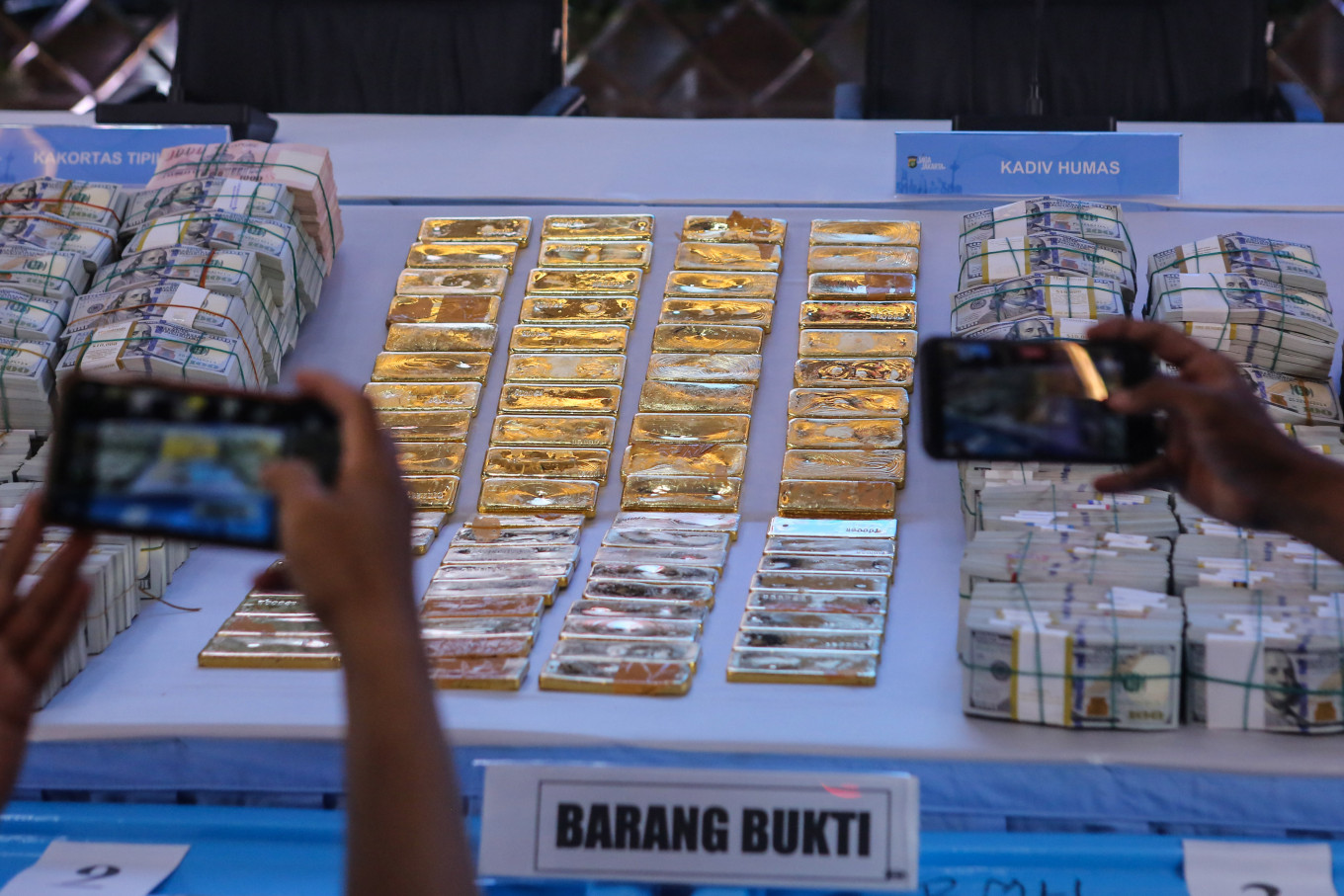 Journalists photograph gold and cash displayed as evidence during a news conference on July 10 at the Jakarta Police headquarters. Police said investigators are continuing to examine evidence collected during searches at 13 locations as part of a joint investigation into three alleged cases involving corruption, bribery, gratuities and money laundering. (Antara/Asprilla Dwi Adha)
C
orruption continues to dominate national headlines. Recent high-profile scandals—spanning coal supply disruptions that led to power blackouts, embezzlement within the PT Asabri and PT Jiwasraya state insurance funds and systemic debt at a subsidiary of PT Krakatau Steel—are estimated to have cost the state hundreds of trillions of rupiah. These crises persist long after the reform era promised to root out deep-seated graft.
Yet, rather than merely asking who the corrupt individuals are, we must examine why the system consistently produces them. The answer lies in what political science terms the "revolving door" phenomenon: a structural mechanism that transforms public office into a gateway for private gain.
The movement of professionals between government agencies, regulatory bodies, state-owned enterprises and the private sector can theoretically inject valuable expertise into governance. However, when checks, balances and accountability measures are weak, this revolving door turns public service into a stepping stone for corporate profit. Conflicts of interest become institutionalized. The boundary between public responsibility and private influence blurs, effectively dismantling accountability.
In Indonesia, the revolving door is not an aberration; it is a structural feature of the political economy and a primary driver of corruption. The state maintains a heavy hand in economic decision-making, as seen in sweeping initiatives like the free nutritious meal program and the Red and White Cooperatives (KDMP). Meanwhile, prohibitively expensive election campaigns tightly bind the political class to commercial interests. Over time, these networks calcify into state and regulatory capture, allowing powerful private entities to systematically reshape public institutions and policy directives to their advantage.
Corruption, therefore, is not merely a collection of isolated illegal acts. In an environment defined by excessive influence and minimal oversight, it becomes an inevitability. The root problem is not just the greed of a few individuals, but an institutional architecture that prioritizes insider access over integrity.
For decades, weak governance was treated as Indonesia’s internal affair. That era is over. Today, global buyers, institutional investors and international financial institutions evaluate governance quality with the same rigor they apply to labor standards, environmental performance and climate pledges. Before allocating capital or sourcing commodities, global markets now ask: Does this country possess the transparent, accountable institutions necessary to protect both its people and the planet?

Institutional integrity has evolved from a purely political value into a critical economic asset. Good governance is now a core competitive advantage. Conversely, weak governance signals prohibitive risk, and high risk repels capital.