The Jakarta Post
Please Update your browser
Your browser is out of date, and may not be compatible with our website. A list of the most popular web browsers can be found below.
Just click on the icons to get to the download page.


Popular Reads
Top Results
No results found. Please check your search term and try again
Can't find what you're looking for?
View all search results
Popular Reads
Top Results
No results found. Please check your search term and try again
Can't find what you're looking for?
View all search resultsWhat Indonesia can learn from Thailand’s disease tracking
Thailand’s integrated approach has successfully strengthened the country’s preparedness for future public health emergencies, something Indonesia should learn from to broaden its public health access.
Change text size
Gift Premium Articles
to Anyone
Share the best of The Jakarta Post with friends, family, or colleagues. As a subscriber, you can gift 3 to 5 articles each month that anyone can read—no subscription needed!
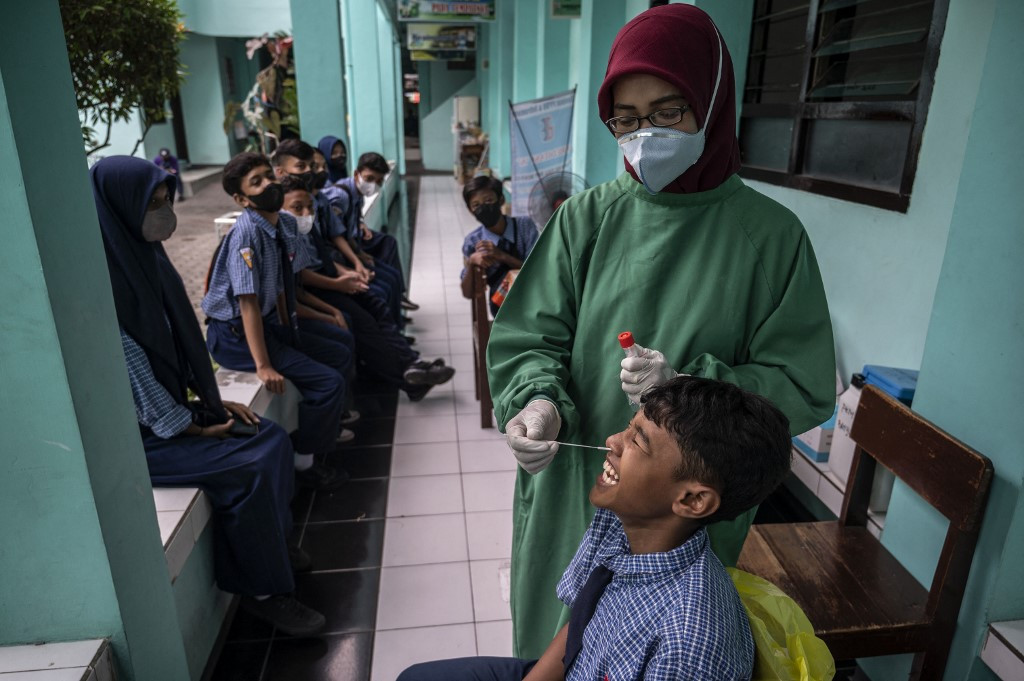 A health worker conducts an antigen test for COVID-19 for students on June 9, 2022, at a junior high school in Surabaya, East Java. (AFP/Juni Kriswanto)
The COVID‑19 pandemic accelerated investment in health infrastructure across Southeast Asia, including Indonesia and Thailand.
Indonesia built over 600 COVID-19 testing labs between 2020 and 2021, expanded telehealth services and introduced digital platforms to monitor diseases. However, these improvements were concentrated in urban areas, while many remote regions remained underdeveloped.
Thailand took a different approach. Alongside establishing more than 10,000 COVID-19 labs, it developed an integrated healthcare system that monitors disease outbreaks nationwide, including among migrant workers.
Research suggests that Thailand’s integrated approach has successfully strengthened the country’s preparedness for future public health emergencies, something Indonesia should learn from to broaden its public health access across the archipelago.
Thailand successfully detected and tracked a new COVID‑19 wave in mid‑2025, which recorded around 374,000 cases and 84 deaths.
The country had already demonstrated its capacity during the first wave in 2020. Among the first nations to detect COVID-19, Thailand contained the outbreak in less than six months. Of 3,195 confirmed infections, 3,072 patients recovered, resulting in an impressive 96 percent recovery rate.

Two factors explain this success.
First, the Thai Ministry of Public Health quickly established the Centre for COVID-19 Situation Administration (CCSA), which coordinated responses across ministries and delivered consistent public communication.
Second, public compliance with health measures was exceptionally high, particularly compared to Indonesia.
A 2020 survey by Imperial College London found Thailand had the highest adherence to preventive measures in ASEAN, with 89–98 percent of respondents regularly wearing masks, washing hands and following health guidelines.
This combination of good governance and public trust strengthened the country’s disease surveillance system.
Thailand’s disease monitoring system links local and central governments through nationwide digital networks.
Health data are collected in real time using everyday devices such as smartphones and computers. Two mobile applications play a central role.
MorChana uses GPS and Bluetooth to identify close contacts and people entering high-risk areas, allowing authorities to detect potential infections quickly.
Mohpromt manages digital vaccination records and electronic health records, enabling hospitals to access patients’ medical records instantly.
Together, the applications have around 36 million users, which is nearly half of Thailand’s population, including migrant workers, and are connected to Thailand’s broader digital disease surveillance system.
Test results from hospitals and clinics are uploaded within seconds, while residents can easily access their own health records.
Indonesia illustrates the challenges of building an integrated health system across a vast archipelago.
During the pandemic, the Indonesian government developed at least seven health apps, including the national SatuSehat platform, which now integrates platforms such as e-HAC and SIRANAP.
However, many local governments also created their own apps, like Pikobar in West Java, Sawarna in Bandung, and PaPa Sulbar in West Sulawesi, which often cannot connect with the national platform.
This fragmentation, combined with geographical barriers and uneven internet access, limits nationwide disease surveillance and reduces the effectiveness of digital health services.
Thailand addressed these challenges by expanding digital connectivity. Through the Net Pracharat project, the government installed broadband networks and free Wi-Fi hotspots in thousands of villages, allowing low-income households to access digital public services, including healthcare.
Thailand also strengthened healthcare access through its tax-funded Universal Coverage Scheme, which provides basic health services for all Thai citizens and increasingly for migrant workers.
In remote villages, trained health workers and volunteers regularly visit households to conduct health checks and deliver basic medical care.
Thailand’s actions highlight that building laboratories and digital platforms alone is not enough.
Indonesia still needs to strengthen internet connectivity, improve integration between national and regional health systems and expand healthcare access in underserved areas.
Most importantly, an effective disease surveillance system depends on public trust. Without confidence that the government can protect the health of all residents, even significant investments in health infrastructure and digital technology will not achieve their full potential.
---
 Mutiara Indriani is a PhD scholar at Australian National University, Canberra. Naruemon Thabchumpon is an associate professor in politics at Chulalongkorn University, Bangkok. This article is republished under a Creative Commons license.