The Jakarta Post
Please Update your browser
Your browser is out of date, and may not be compatible with our website. A list of the most popular web browsers can be found below.
Just click on the icons to get to the download page.


Popular Reads
Top Results
No results found. Please check your search term and try again
Can't find what you're looking for?
View all search results
Popular Reads
Top Results
No results found. Please check your search term and try again
Can't find what you're looking for?
View all search resultsPrinciple or pragmatism? ASEAN’s risky recalibration on Myanmar
By offering the Myanmar junta an informal seat at the table without demanding accountability, ASEAN risks trading its diplomatic leverage for the hollow illusion of progress.
Change text size
Gift Premium Articles
to Anyone
Share the best of The Jakarta Post with friends, family, or colleagues. As a subscriber, you can gift 3 to 5 articles each month that anyone can read—no subscription needed!
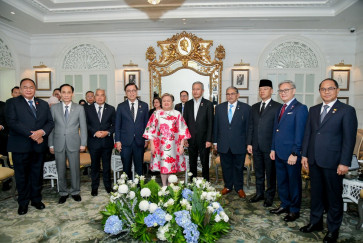
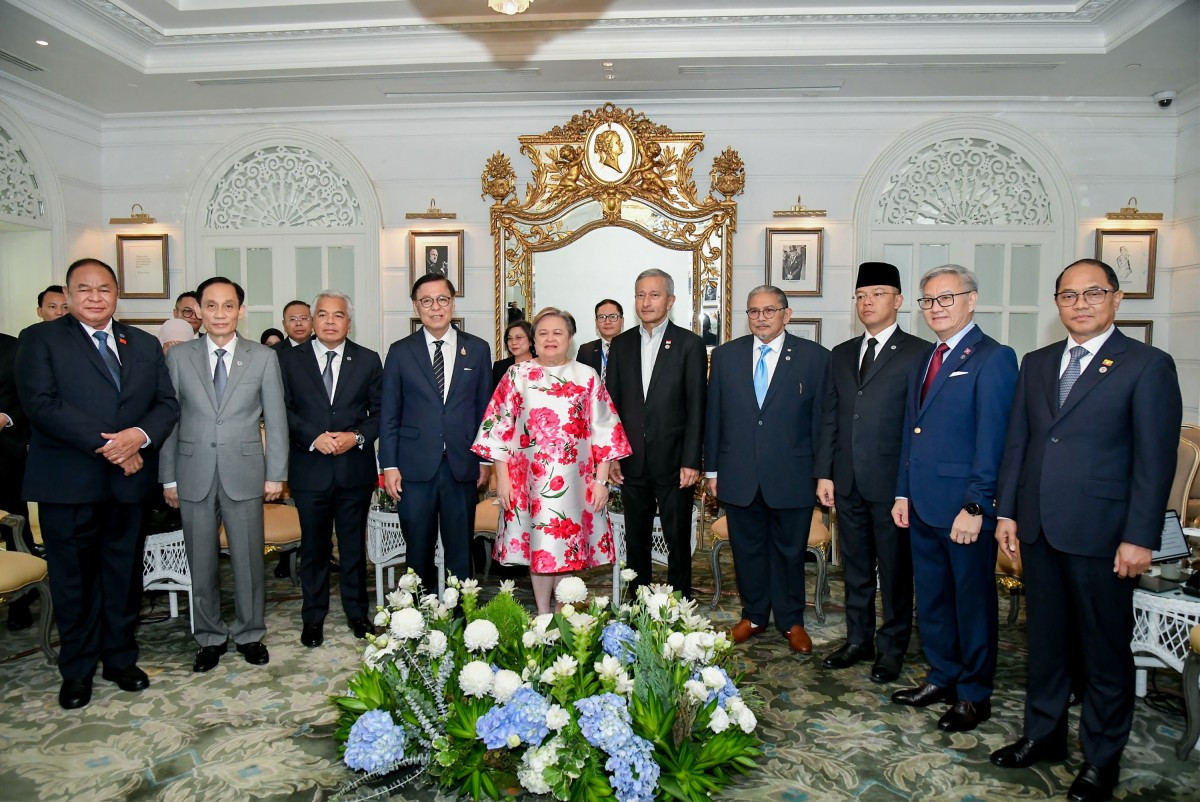 This handout photo taken and released by Thailand's Ministry of Foreign Affairs on July 12 shows (from left to right) Timor-Leste's Foreign Minister Bendito dos Santos Freitas, Vietnam's Foreign Minister Le Hoai Trung, Malaysia's Chief Secretary Shamsul Azri Abu Bakar, Thailand's Foreign Minister Sihasak Phuangketkeow, Philippines' Foreign Minister Maria Theresa Lazaro, Singapore's Foreign Minister Vivian Balakrishnan, Brunei's Foreign Minister Erywan Yusof, Indonesia's Foreign Minister Sugiono, Laos' Foreign Minister Thongsavanh Phomvihane and Myanmar's Foreign Minister U Tin Maung Swe posing for a photo during an informal meeting with ASEAN Foreign Ministers in Bangkok. (AFP/Thailand's Foreign Ministry/handout)
A
bout a week before the 59th ASEAN Foreign Ministers’ Meeting (AMM) in Manila, Thailand hosted an informal consultation between ASEAN foreign ministers and Myanmar’s junta-appointed Foreign Minister, U Tin Maung Swe. Held in Bangkok on July 12, the meeting marked the first face-to-face engagement between ASEAN foreign ministers and Myanmar’s top diplomat since the bloc excluded junta leaders from high-level meetings following the 2021 coup of a democratically elected government.
Although Thailand hosted the consultation, the meeting was convened by the Philippines in its capacity as the 2026 ASEAN chair. Manila has sought to frame the process as an ASEAN-led effort to revive the stalled Five-Point Consensus (5PC), while Thailand has positioned itself as a diplomatic facilitator rather than the driver of a policy shift.
Yet, the meeting represents a troubling turn in ASEAN’s Myanmar policy: a gradual shift from withholding political recognition toward cautious re-engagement, despite minimal evidence that Myanmar’s military authorities have fulfilled the commitments required under the bloc's own peace framework.
Diplomatic terminology cannot obscure political reality. By granting Myanmar’s foreign minister direct access to his ASEAN counterparts, the bloc has provided Naypyidaw with the very diplomatic opening it has sought since its exclusion. The "informal" label allows ASEAN to maintain that its formal restrictions remain intact, but this distinction is becoming increasingly difficult to sustain.
The 5PC was built on a clear principle: political engagement would follow meaningful behavioral change. It called for an immediate cessation of violence, inclusive dialogue, the delivery of humanitarian assistance, and full cooperation with the ASEAN Special Envoy. Yet, more than five years after the coup, these commitments remain largely unmet.
Violence continues to escalate across Myanmar, highlighted by military airstrikes against civilian areas. Humanitarian access remains severely restricted, and the authorities have repeatedly resisted ASEAN’s efforts to engage all relevant stakeholders. Most recently, Myanmar rejected the ASEAN special envoy’s request to meet with Aung San Suu Kyi, reinforcing concerns about Naypyidaw's unwillingness to support genuine dialogue.

Myanmar’s democratic political stakeholders have warned that expanding high-level engagement with the military authorities—while limiting engagement with other actors—risks undermining ASEAN’s own framework. These concerns intensified after Myanmar’s military-controlled parliament formally rejected the 5PC on July 9, 2026. Democratic stakeholders argued that this was not merely a failure to implement ASEAN’s framework, but an explicit repudiation of it by the very actors now receiving renewed diplomatic access.