The Jakarta Post
Please Update your browser
Your browser is out of date, and may not be compatible with our website. A list of the most popular web browsers can be found below.
Just click on the icons to get to the download page.


Popular Reads
Top Results
No results found. Please check your search term and try again
Can't find what you're looking for?
View all search results
Popular Reads
Top Results
No results found. Please check your search term and try again
Can't find what you're looking for?
View all search resultsAnalysis: Cooking up energy security: CNG or induction stoves?
Change text size
Gift Premium Articles
to Anyone
Share the best of The Jakarta Post with friends, family, or colleagues. As a subscriber, you can gift 3 to 5 articles each month that anyone can read—no subscription needed!
 Set as preferred source
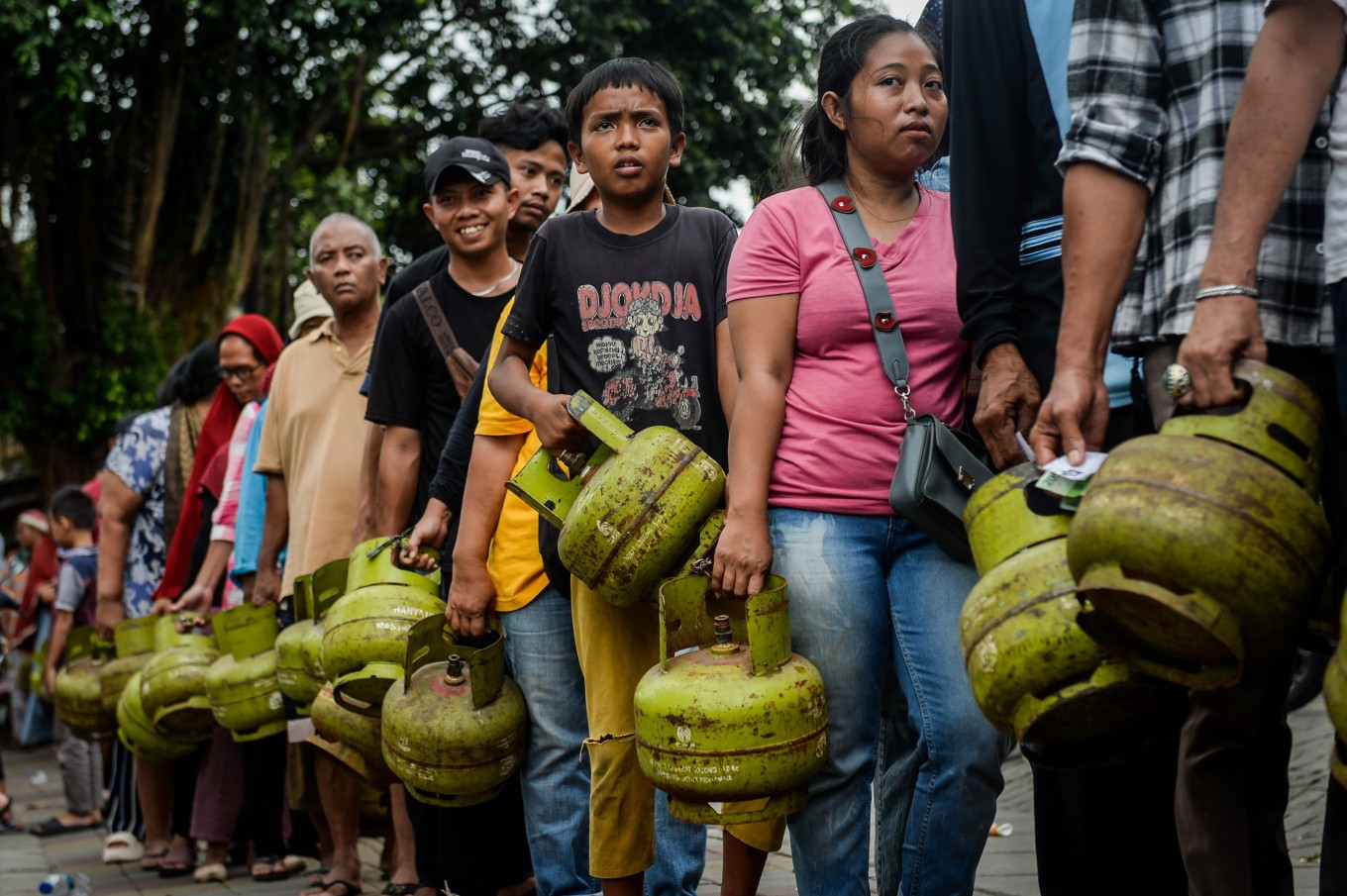 Residents line up to exchange 3-kilogram liquefied petroleum gas (LPG) canisters in Cibodas, Tangerang city, Banten on Feb. 3, 2025. (Antara Foto/Putra M. Akbar)
A
mid rising geopolitical tensions and growing concerns over energy security, the government is considering phasing out liquefied petroleum gas (LPG) for cooking—around 80 percent of which is imported—by reviving a nationwide induction (electric) stove program. At the same time, policymakers are also exploring the replacement of subsidized LPG with compressed natural gas (CNG) canisters. Yet beyond the promise of reducing import dependence, the question remains: Who stands to benefit from these policy shifts?
Indonesia’s dependence on imported LPG is not new. The household conversion program from kerosene to LPG has been running for nearly 19 years, yet the country never built the domestic production base needed to match the demand it created. Imports accounted for 80.58 percent of national LPG consumption in 2025 and rose further to 83.97 percent in early 2026. The supply chain is also highly concentrated, with the United States supplying 70.07 percent of Indonesia’s LPG imports, and the United Arab Emirates and Qatar supplying the rest.
That concentration represents the country’s greatest vulnerability. Most of the LPG used by Indonesian households travels thousands of kilometers by tanker through geopolitical chokepoints beyond Indonesia’s control, exposing consumers to supply disruptions and price volatility while simultaneously increasing the fiscal burden of subsidies. Indonesia spends around Rp 137 trillion (US$7.6 billion) annually on LPG imports, while subsidies exceed Rp 80 trillion each year, placing an increasing burden on the state budget.
Against this backdrop, the government’s decision to revive its previously abandoned household electrification program is seen as a way to reduce LPG consumption and dependence on imported fuel. It is also a logical option given Indonesia’s abundant coal reserves and growing renewable energy potential.
To support the initiative, Energy and Mineral Resources Minister Bahlil Lahadalia has proposed allocating Rp 815.5 billion (US$45.7 million) in the 2027 state budget for a nationwide rollout of electric cooking stoves. According to the minister, the initial phase would prioritize induction stoves compatible with households connected to 900-VA electricity services.
However, the government’s policy direction has become less clear following the minister’s simultaneous proposal to replace subsidized 3 kg LPG cylinders with CNG canisters. Bahlil said the government has completed the third stage of testing for 3 kg CNG canisters to ensure their safety. He acknowledged that CNG operates at pressures roughly 20 times higher than LPG, making safety considerations a top priority.

This raises a more fundamental question: Why CNG, and who stands to benefit from the transition? The minister argues that Indonesia possesses abundant natural gas reserves, making CNG a viable alternative cooking fuel.