The Jakarta Post
Please Update your browser
Your browser is out of date, and may not be compatible with our website. A list of the most popular web browsers can be found below.
Just click on the icons to get to the download page.


Popular Reads
Top Results
No results found. Please check your search term and try again
Can't find what you're looking for?
View all search results
Popular Reads
Top Results
No results found. Please check your search term and try again
Can't find what you're looking for?
View all search resultsCan Asia-Pacific democracies reclaim the moral high ground?
To effectively counter authoritarian models, regional powers like India and Japan must stop sidelining human rights and integrate democratic values into their foreign policies.
Change text size
Gift Premium Articles
to Anyone
Share the best of The Jakarta Post with friends, family, or colleagues. As a subscriber, you can gift 3 to 5 articles each month that anyone can read—no subscription needed!
 Set as preferred source
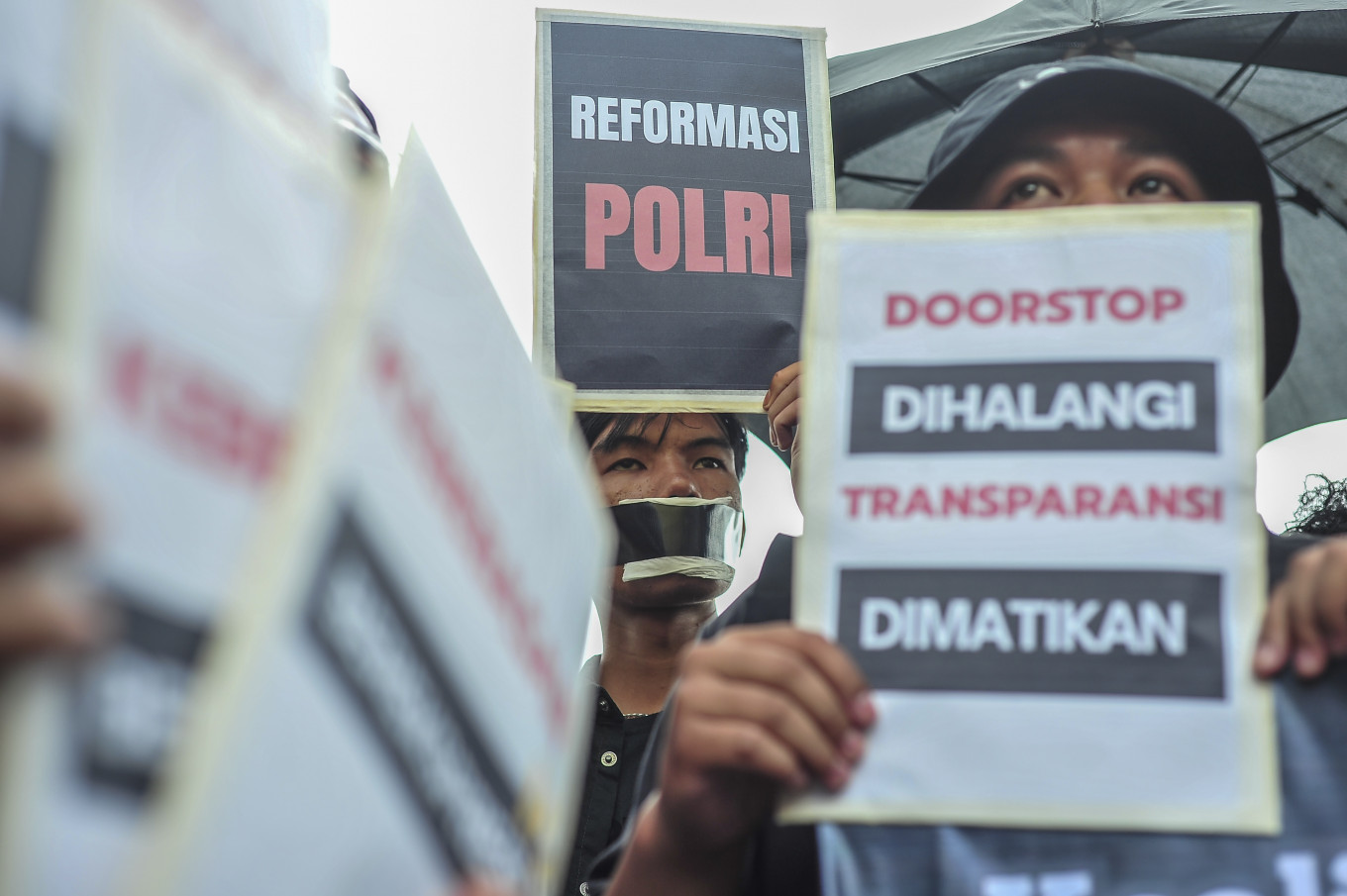 Hear our voice: Journalists, student press members and members of the Koalisi Anti Pembungkaman Demokrasi civil movement hold a silent protest on Wednesday while carrying posters emblazoned with pro-democracy messages at the Jambi Police headquarters in Jambi. Members of press organizations, including the Indonesian Photojournalists (PFI) Jambi, the Alliance of Independent Journalists (AJI) Jambi and the Indone- sian Television Journalists Association (IJTI) Jambi participated in the demonstration. They called for the prosecution of police officers who reportedly attempted to prevent press workers from carrying out their journalistic duties in recent mass protests. (Antara/Wahdi Septiawan)
O
n Sunday evening, just a day after the United States celebrated its 250th anniversary, I spent considerable time watching a series of podcasts on the state of American democracy. Gloomy as the current status of civil liberties in the US may be under a president exhibiting authoritarian tendencies, listening to journalists, authors, and academics openly criticizing the administration of US President Donald Trump was reassuring.
The civic fabric of American society, on both sides of the political aisle, remains vibrant. Democracy, despite its imperfections and struggles to meet public expectations, remains the most vital intangible enabler capable of turning passive voters into engaged citizens who own the political process. However, democracy must consistently reform itself by injecting elements of deliberation, particularly by involving citizens in assemblies where actual decision-making occurs.
At the same time, certain nations boast of "behind-the-scenes" democratic systems that supposedly allow citizens to provide feedback quietly. Yet, if such methods were genuine, it remains difficult to explain why these self-defined democratic societies maintain a high number of citizens in jail simply for expressing their opinions or peacefully dissenting.
In the Asia-Pacific region, a widespread belief persists that democracy, along with human rights and a just rule of law, can be sacrificed in the name of development, prioritizing the top-down implementation of policies instead.
There are also pluralistic democratic nations whose democratic credentials are in decline. Even in the best cases where democracy still flourishes, it appears nearly impossible to place these principles at the center of foreign policy.
India, the largest democracy in the world, currently chairs the International Institute for Democracy and Electoral Assistance (International IDEA). Under Prime Minister Narendra Modi, India has ambitiously risen on the global stage, correctly claiming to represent the Global South and offering a counterbalance to China’s strategic support to developing nations through massive infrastructure projects.

Yet, India’s own commitment to democracy is unravelling, marked by a visible deterioration of human rights. Currently, the most concerning case is that of Umar Khalid and Sharjeel Imam, who have been jailed for six years awaiting trial related to the Delhi communal violence of 2020. This detention has met with widespread condemnation and international uproar, yet it has had no impact on what activists consider an unjust imprisonment. Admiration for Prime Minister Modi’s global trajectory cannot temper deep concern for India's internal realities.