The Jakarta Post
Please Update your browser
Your browser is out of date, and may not be compatible with our website. A list of the most popular web browsers can be found below.
Just click on the icons to get to the download page.


Popular Reads
Top Results
No results found. Please check your search term and try again
Can't find what you're looking for?
View all search results
Popular Reads
Top Results
No results found. Please check your search term and try again
Can't find what you're looking for?
View all search resultsStrategic misstep: Maritime state, continental mindset
Placing military officers in civilian positions without adequate competence constitutes a misuse of human resources and may undermine the effectiveness of the bureaucracy.
Change text size
Gift Premium Articles
to Anyone
Share the best of The Jakarta Post with friends, family, or colleagues. As a subscriber, you can gift 3 to 5 articles each month that anyone can read—no subscription needed!
 Set as preferred source
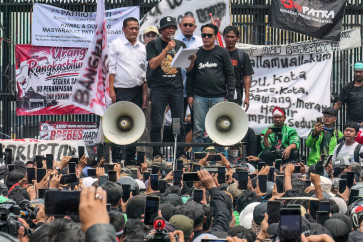
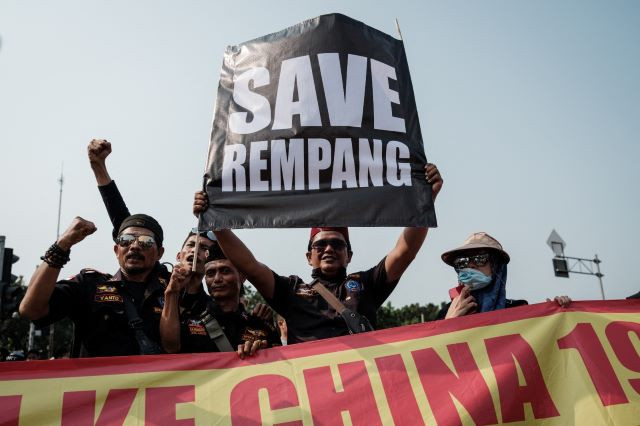
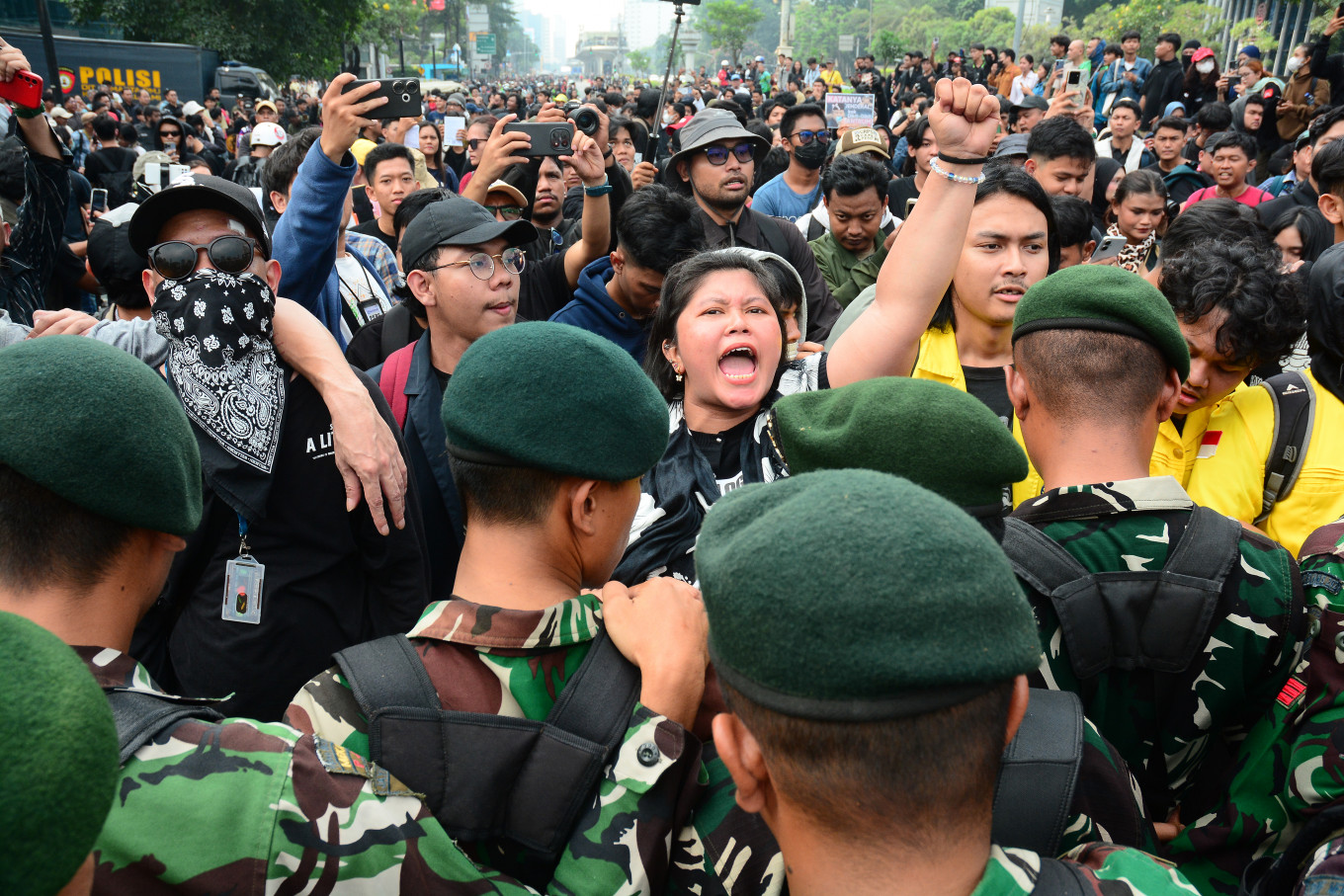 Protesters react after Indonesian military personnel blocked a road during a student protest on June 12 in Jakarta. Demonstrators criticized state budget spending, fuel prices, the free meals program, and the expanded role of the military in civilian affairs. (JP/Iqro Rinaldi)
D
iscourse about placing active-duty Indonesian Military (TNI) officers in civilian positions and expanding the territorial apparatus has recently resurfaced, with the revision of Law No. 34/2004 on TNI allowing active military personnel to occupy a number of positions in civilian ministries and state institutions.
This policy has triggered public debate because Indonesia has, since the reform era of 1998, moved away from the practice of the dual function of the armed forces.
Let us critically examine the dangers of such a policy by emphasizing two fundamental issues. The first concerns the essential character of Indonesia as a maritime state, not a continental one. The second concerns the growing demand for specific competence in an era of rapid technological advancement, where professionalism must be based on proper educational background, expertise and institutional authority.
The provision that allows active-duty soldiers to occupy positions in sixteen ministries and state institutions, including the Attorney General’s Office and the Supreme Court, represents a significant departure from the previous arrangement, which required soldiers to resign or retire before assuming civilian office.
Several members of the House of Representatives have stated that the placement of TNI officers in civilian positions must be conducted selectively and only when the individuals concerned possess the capability required by the position. They have emphasized that officers whose background is limited to military academy education, without specific professional expertise, should not be assigned to positions that require specialized competence, such as ministries dealing with food, mining, agriculture or logistics.
Constitutional law experts have even argued that the placement of officers in certain state-owned enterprises violates the law, because such enterprises are not included in the list of civilian positions that may be occupied by active military personnel. This shows that certain practices may already be moving beyond the legal corridor that should govern civil-military relations.

The plan to expand the territorial apparatus also deserves serious attention. Academic studies have noted that the territorial command system has long been considered inefficient and financially burdensome, consuming a large portion of the defense budget, while only a relatively small number of personnel are actually assigned to combat units.