The Jakarta Post
Please Update your browser
Your browser is out of date, and may not be compatible with our website. A list of the most popular web browsers can be found below.
Just click on the icons to get to the download page.


Popular Reads
Top Results
No results found. Please check your search term and try again
Can't find what you're looking for?
View all search results
Popular Reads
Top Results
No results found. Please check your search term and try again
Can't find what you're looking for?
View all search resultsWhen science is rewriting Global South diplomacy
By leveraging data-driven frameworks like the Tropical Forest Forever Facility, Brazil and Indonesia are proving that the Global South can ditch traditional geopolitical competition and use science diplomacy to protect the world's most vulnerable ecosystems.
Change text size
Gift Premium Articles
to Anyone
Share the best of The Jakarta Post with friends, family, or colleagues. As a subscriber, you can gift 3 to 5 articles each month that anyone can read—no subscription needed!
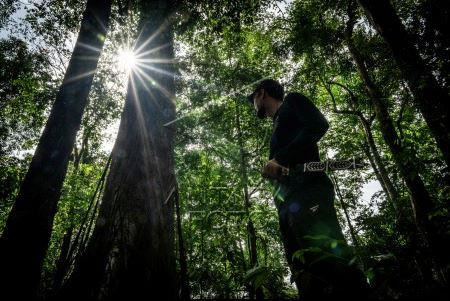 A resident of Belangian village stands on Aug. 21, 2024 next to a tall benuang laki (Duabanga moluccana blume), a native evergreen species, in the Kahung tropical rain forest of Banjar regency, South Kalimantan. (Antara/Bayu Pratama S)
A
cross the Global South, the concept of science in diplomacy remains vastly underrepresented. When people picture diplomacy, they often imagine diplomats in tailored suits attending formal state receptions, not scientists stepping out of laboratories to shape international relations.
Yet, science diplomacy has always existed in one form or another, bringing scientific experts and diplomats together to build multi-perspective solutions and advance national interests. It is a vital instrument of soft power, the means by which nations cultivate influence through collaborative, unifying fields rather than coercion.
Despite its value, countries in the Global South are still less likely to possess formal frameworks dedicated to integrating science and technology into statecraft.
However, the Global South possesses a unique geopolitical advantage: shared experiences. Developing nations frequently navigate similar climates, socioeconomic realities and developmental hurdles. Consequently, they inherently understand one another's ground realities.
Because the scientific and policy approaches required to address these issues must be tailored to these specific contexts, cross-border knowledge sharing among developing countries is uniquely valuable. This is exactly where a robust science diplomacy framework becomes essential.
By weaving scientific cooperation directly into foreign policy, the Global South can solidify alliances and streamline technology transfers to address emerging global crises.

As urgent regional challenges have evolved, global foreign policy has had to adapt alongside the technologies designed to solve them. Today, the impact of science diplomacy is most pronounced in fields like global health, artificial intelligence, integrated circuits and the energy transition. It also holds the key to confronting one of the most pressing environmental crises facing the Global South: deforestation.