The Jakarta Post
Please Update your browser
Your browser is out of date, and may not be compatible with our website. A list of the most popular web browsers can be found below.
Just click on the icons to get to the download page.


Popular Reads
Top Results
No results found. Please check your search term and try again
Can't find what you're looking for?
View all search results
Popular Reads
Top Results
No results found. Please check your search term and try again
Can't find what you're looking for?
View all search resultsThe fewer trips, the better
As public scrutiny mounts over President Prabowo’s 51 overseas trips, the administration’s defensive reaction has failed to mask a stark reality: the resulting diplomatic promises have yet to translate into real economic gains.
Change text size
Gift Premium Articles
to Anyone
Share the best of The Jakarta Post with friends, family, or colleagues. As a subscriber, you can gift 3 to 5 articles each month that anyone can read—no subscription needed!
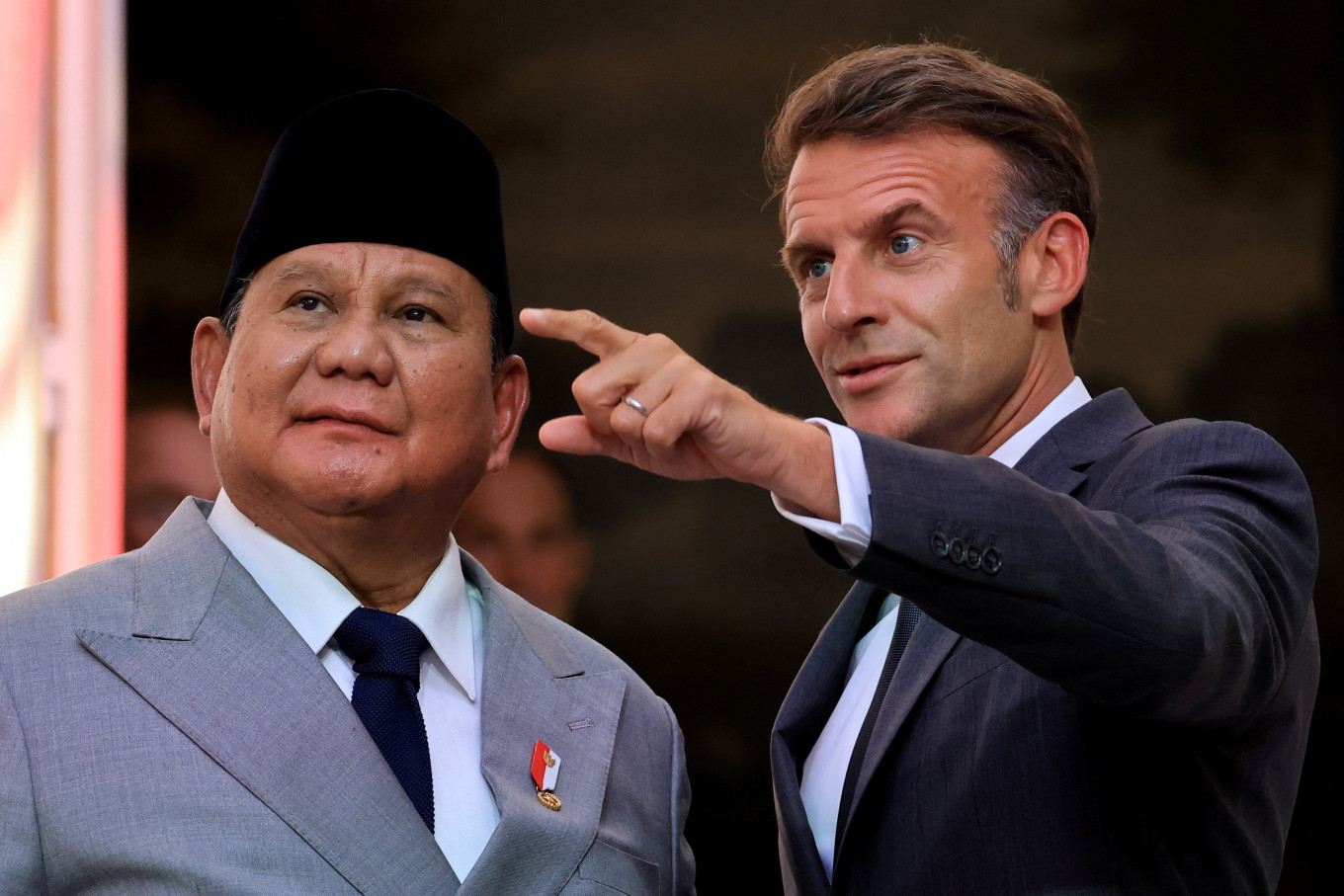 French President Emmanuel Macron gestures on May 28, 2026, during a joint press statement with President Prabowo Subianto at the Élysée Palace in Paris. (Reuters via Pool/Ludovic Marin)
P
resident Prabowo Subianto’s active diplomacy, as manifested in more than 50 foreign trips over his first 19 months in office, is under heavy scrutiny. Unfortunately, the government’s response has failed to settle the grumbling, only sparked more questions and criticism.
In his rebuttal to public censure of these frequent trips from Dino Patti Djalal, a widely respected veteran diplomat, Cabinet Secretary Teddy Indra Wijaya regrettably made the matter personal. In a video statement released on Monday, he pointedly referred to Dino as a great diplomat who nevertheless served in government “for three months only”. He also taunted Dino, who was deputy foreign minister during the presidency of Susilo Bambang Yudhoyono, by claiming that Susilo had traveled with a much larger entourage.
In an attempt to deflect criticism, Teddy also insisted that the President had personally covered some of the costs of his overseas trips: a move that actually violates state regulations.
The cabinet secretary should address the substance of the criticisms instead of taking a defensive posture and responding emotionally. While Dino may have criticized the frequency of the President’s trips, he also offered constructive suggestions to tackle the underlying issues, mirroring the concerns of the public at large.
Teddy also said the 51 foreign trips to 36 countries Prabowo had taken since assuming power October 2024 had generated investments worth Rp 2.43 quadrillion (US$140 billion), including Rp 575 trillion from his visits to Japan and South Korea alone.
Yet the public will be convinced about the necessity of the President’s nation-hopping diplomacy only when the administration backs those claims with new factories and jobs, proving that capital has actually poured into Indonesia and turned promises into reality.

While President Prabowo has witnessed the signing of probably hundreds of memorandums of understanding (MoUs), these documents are not legally binding commitments, even for schemes involving state-owned enterprises. They merely outline mutual intent for future cooperation, and their actual realization relies almost entirely on private companies and international market mechanisms.