The Jakarta Post
Please Update your browser
Your browser is out of date, and may not be compatible with our website. A list of the most popular web browsers can be found below.
Just click on the icons to get to the download page.


Popular Reads
Top Results
No results found. Please check your search term and try again
Can't find what you're looking for?
View all search results
Popular Reads
Top Results
No results found. Please check your search term and try again
Can't find what you're looking for?
View all search resultsQuad FMs set tone of continuity in New Delhi
The Quad is evolving from a politically symbolic coalition into a functional strategic mechanism.
Change text size
Gift Premium Articles
to Anyone
Share the best of The Jakarta Post with friends, family, or colleagues. As a subscriber, you can gift 3 to 5 articles each month that anyone can read—no subscription needed!
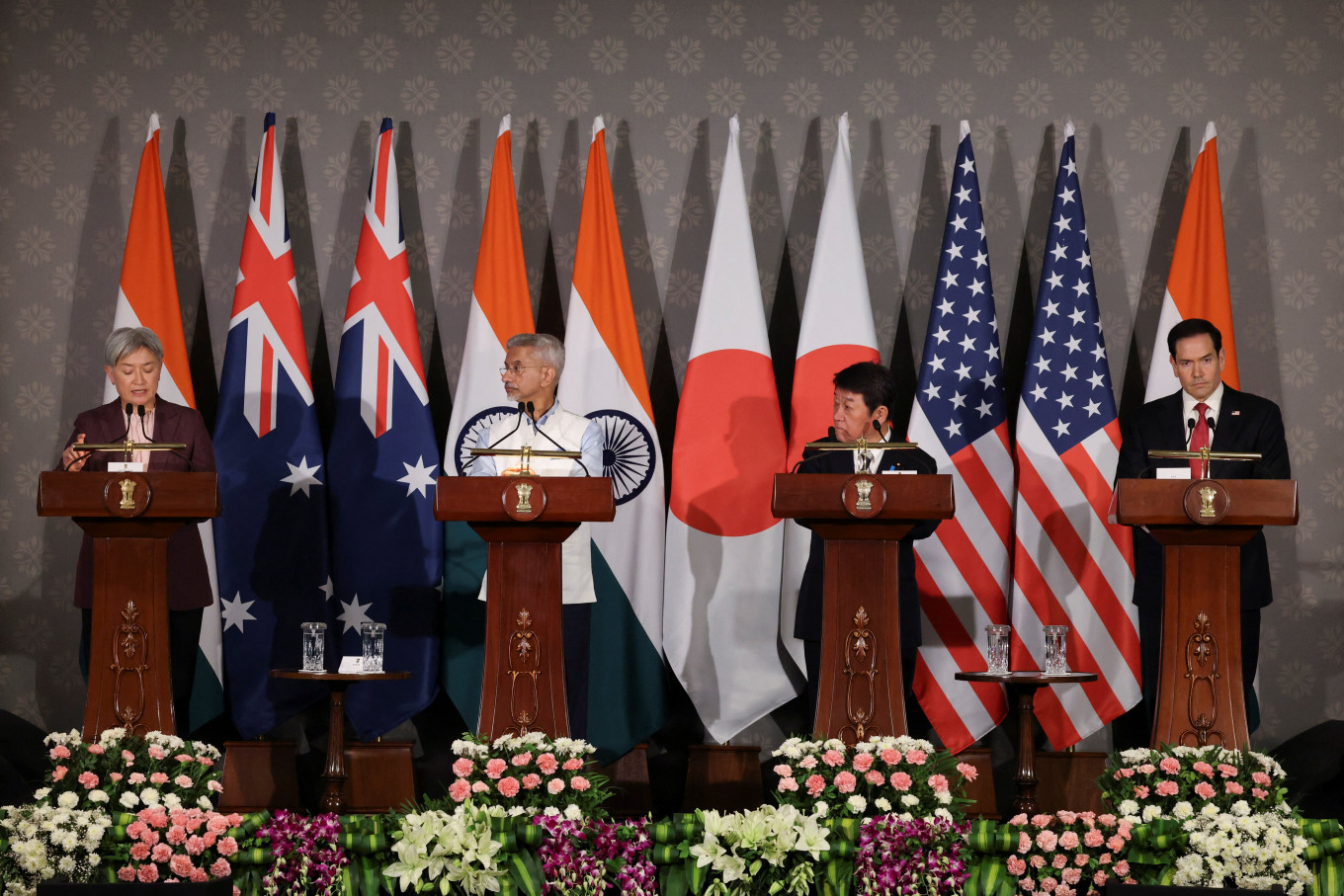 US Secretary of State Marco Rubio, Australian Foreign Minister Penny Wong, Japanese Foreign Minister Toshimitsu Motegi and Indian Foreign Minister Subrahmanyam Jaishankar attend a joint press conference after attending the Quad Foreign Ministers' meeting on May 26 at Hyderabad House in New Delhi..
(Reuters/Adnan Abidi)
US Secretary of State Marco Rubio, Australian Foreign Minister Penny Wong, Japanese Foreign Minister Toshimitsu Motegi and Indian Foreign Minister Subrahmanyam Jaishankar attend a joint press conference after attending the Quad Foreign Ministers' meeting on May 26 at Hyderabad House in New Delhi..
(Reuters/Adnan Abidi)
T
he Quad Foreign Ministers’ Meeting in New Delhi on May 26 marked an important, carefully calibrated effort to restore strategic momentum when doubts about its cohesion were emerging.
The skepticism preceding the meeting was substantial. The absence of a Quad leaders’ summit in 2025, uncertainty over United States President Donald Trump administration’s Indo-Pacific commitment, tensions in India-US ties over tariffs and strategic divergences and signs of a limited US appetite for high-visibility multilateralism had generated speculation that the Quad was stagnating.
The New Delhi meeting was significant for its attempt to institutionalize cooperation in practical sectors. The outcomes demonstrated that the Quad is evolving from a politically symbolic coalition into a functional strategic mechanism.
A notable feature was the shift toward economic-security integration. The Quad Critical Minerals Initiative Framework represented the clearest acknowledgement yet that Indo-Pacific competition is no longer merely military but increasingly industrial and technological. The Quad committed to cooperate across mining, processing, recycling and supply chain resilience for critical minerals. This is consequential as China dominates global processing capacities for rare earths and inputs essential for semiconductors, batteries, renewable energy systems and defense technologies.
For India, this initiative carries major strategic implications as despite its ambitions in electronics manufacturing, clean energy and defense production, it remains dependent on Chinese-controlled mineral supply chains. The framework could enable India to connect Australian mineral resources, Japanese technology and US financing into a diversified ecosystem. The Quad is beginning to function as a geoeconomic balancing mechanism against Chinese industrial leverage.
The Quad Statement on Indo-Pacific Energy Security reflected the impact of the worsening global geopolitical climate, especially the disruptions linked to the Iran conflict and maritime insecurity around key chokepoints. Discussions reportedly focused on energy flows, fertilizer availability, supply-chain vulnerabilities and connectivity bottlenecks. The emphasis on energy resilience signaled that the Quad increasingly sees economic stability and maritime security as inseparable.

The proposal for an Indo-Pacific Maritime Surveillance Initiative and efforts toward a “Common Operating Picture” indicate that the Quad is steadily deepening operational coordination at sea. Rather than forming a formal military alliance, it appears to be pursuing interoperability.