The Jakarta Post
Please Update your browser
Your browser is out of date, and may not be compatible with our website. A list of the most popular web browsers can be found below.
Just click on the icons to get to the download page.


Popular Reads
Top Results
No results found. Please check your search term and try again
Can't find what you're looking for?
View all search results
Popular Reads
Top Results
No results found. Please check your search term and try again
Can't find what you're looking for?
View all search resultsHow the US-China reset recasts the Quad
With the shift in US-China relations, India is emerging as the strategic cog in the American wheel, Pakistan as a tactical partner, NATO as the anchor of the Atlantic alliance and Quad countries as a tool to serve the Indo‑Pacific.
Change text size
Gift Premium Articles
to Anyone
Share the best of The Jakarta Post with friends, family, or colleagues. As a subscriber, you can gift 3 to 5 articles each month that anyone can read—no subscription needed!
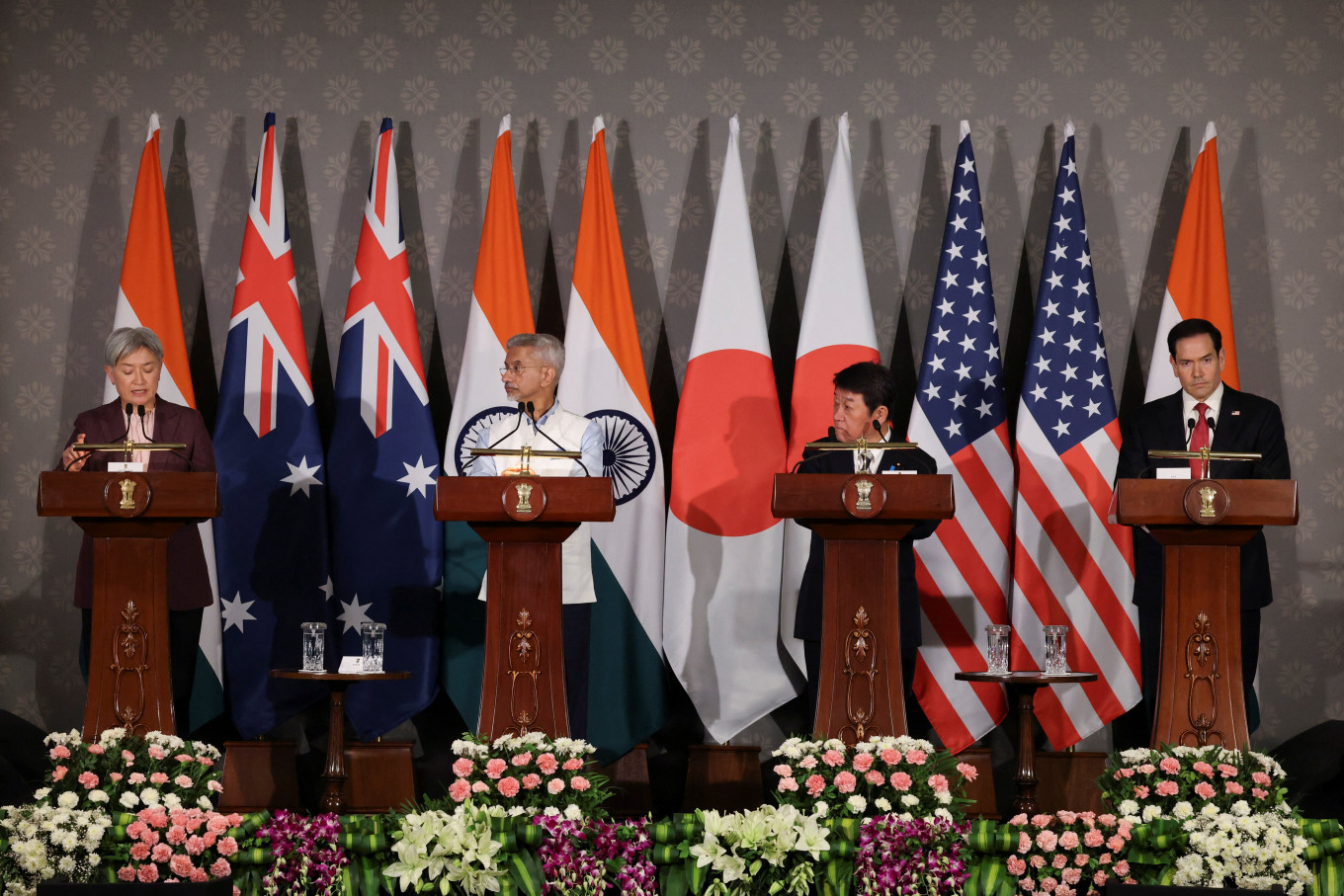 Australian Foreign Minister Penny Wong (left) addresses a joint press conference alongside Indian Foreign Minister Subrahmanyam Jaishankar (second left), Japanese Foreign Minister Toshimitsu Motegi (second right) and United States State Secretary Marco Rubio on May 26, 2026, following the Quad Foreign Ministers' Meeting at Hyderabad House in New Delhi. (Reuters/Adnan Abidi)
O
n May 16, United States President Donald Trump and Chinese President Xi Jinping formally acknowledged what has long been in motion: a paradigm shift in US-China relations. Beijing frames it as “constructive strategic stability”, while US Secretary of State Marco Rubio calls it a “strategic stability point.”
For the first time in decades, the US concedes that China now matches it in both economic and military weight, an equilibrium no other nation has achieved since the Cold War. This recognition cements US-China ties as the axis of global order and international security. It also signals a new deterrent reality: China can now enforce its red lines, especially on Taiwan, curbing unilateral US moves. Confrontations have cooled for now, ushering in a phase of managed competition across the Indo-Pacific.
In this context, the Quadrilateral Security Dialogue (Quad) formed in 2007 by Australia, India, Japan and the US with the intent of countering Chinese power, is being given a secondary role.
The role envisaged for the Quad was dictated by Rubio in the Quad Foreign Ministers’ Meeting in New Delhi on May 26: The US wants the Quad members to assist with access to critical minerals, enhance US energy sales and help boost maritime surveillance and port infrastructure across the Indo-Pacific. Yet this functional repositioning comes against the backdrop of a larger strategic shift.
While Washington and Beijing have declared a new phase of “strategic stability,” fundamental differences remain. The US continues to seek dominance while China insists on parity. Washington has floated the idea of a Group of Two arrangement, spheres of influence within a bipolar order, but Beijing has repeatedly rejected it.
Instead, China remains committed to a multipolar global system anchored by major powers within BRICS, a stance reinforced in the joint China-Russia declaration of May 20 following Trump’s visit to Beijing.

The US is restructuring its foreign policy, shifting its primary security theater from Europe to the Asia-Pacific: a process set in motion with former president Barrack Obama’s “Pivot to Asia” and now fully evident in the Trump administration’s tensions with NATO allies.
Structural changes mark a departure from the traditional hub-and-spoke alliance model: Allies are graded by utility to US interests, with diversification beyond NATO. At the top tier are the “most favored nations” such as Australia, Japan and South Korea, with which Washington is building a denser, networked security architecture.
Japan is the lynchpin. Prime Minister Sanae Takaichi has pledged Japan’s readiness for a kinetic war in defense of Taiwan, positioning the country as a proxy, much like Ukraine in Europe. Tokyo operates across alliance structures, minilateral groupings like the Quad and defense-industrial partnerships. Under the October 2025 US-Japan bilateral agreement, Japan is not merely a host for US bases but a defense supplier and geopolitical connector in the Indo-Pacific.
South Korea is envisioned similarly. Leveraging Seoul’s security anxieties over North Korea, Washington extracted a US$150 billion commitment to bolster the US shipping industry at the expense of South Korea’s. This underscores the transactional nature of the new grading system.
Its third security partner in the Indo-Pacific is Australia (as usual) and the fourth is the Philippines, with expanded logistics and basing agreements to support US operations.
These partners form the basic structure of the new Asia-Pacific strategy of the US.
In its drive for global domination under the “Make America Great Again” banner, Washington is leveraging allies like India, Brazil and the United Arab Emirates for distinct purposes. The US builds on regional security anxieties to sustain arms sales, secure supply chains and deepen economic integration.
India’s pledge to invest $500 billion in the US economy, a move the Financial Times termed “bizarre”, illustrates how Delhi is being integrated as the “back office” for American technology firms and water-intensive AI plants.
Across the board, the common denominator for US allies is production capacity, rare earth minerals and energy flows, particularly sales of US oil: all vital to American industry and financial interests.
Within this paradigm shift, both India and the Quad have been relegated to secondary positions. India had long pressed for a Quad summit and a Trump meeting, finally securing one, but Washington’s priorities lie elsewhere: China, the Gulf conflict and regime change agendas in Latin America.
More tellingly, the US prioritized a major defense agreement with Indonesia on April 14. The strategic logic is clear: the Strait of Malacca, just 2.8-kilometer wide, carries 70 percent of China’s oil imports daily and accounts for 24 percent of global seaborne trade. Control of this choke point underscores Washington’s focus on constraining China’s lifelines rather than elevating India or the Quad.
Rubio has tried to smoothen some ruffled Indian feathers but has remained firm on US interests that keep India in an asymmetrical position and lower grade. India will buy US weapons, more oil from the US and countries directed by the US, such as the UAE and Venezuela, while the US will decide when and how India can buy cheaper oil from Russia or Iran.
India will bend to the US tariffs and sanctions regime and go slow on the International North-South Transport Corridor, on which it has invested millions of dollars. Moreover, India will consider the US sensitivities in the important BRICS meeting, which India chairs and will host in September 2026.
The US has shifted to economic nationalism and recognizes its codependency with China. It sees Russia as a European military power with access to the Arctic and leverage with the South. On this geopolitical chessboard, the US retains the security threat rhetoric about Russia and China, a narrative that keeps its allies in Europe and Asia together.
In this new framework, India is seen as a strategic cog in the US wheel and Pakistan as a “tactical” partner; NATO is the primary instrument for US Atlantic agendas, even as the Quad countries serve US interests in the Indo-Pacific.
---
The writer is an adjunct professor at O.P. Jindal Global University. This article is republished under a Creative Commons license.