The Jakarta Post
Please Update your browser
Your browser is out of date, and may not be compatible with our website. A list of the most popular web browsers can be found below.
Just click on the icons to get to the download page.


Popular Reads
Top Results
No results found. Please check your search term and try again
Can't find what you're looking for?
View all search results
Popular Reads
Top Results
No results found. Please check your search term and try again
Can't find what you're looking for?
View all search resultsIndonesia's planned copyright law puts Google, AI platforms on notice
If passed, Indonesia could become the first country in Southeast Asia to incorporate AI in its copyright law, as governments globally grapple with the impact of the technology on copyright rules, including the use of work created by humans to train AI models.
Change text size
Gift Premium Articles
to Anyone
Share the best of The Jakarta Post with friends, family, or colleagues. As a subscriber, you can gift 3 to 5 articles each month that anyone can read—no subscription needed!
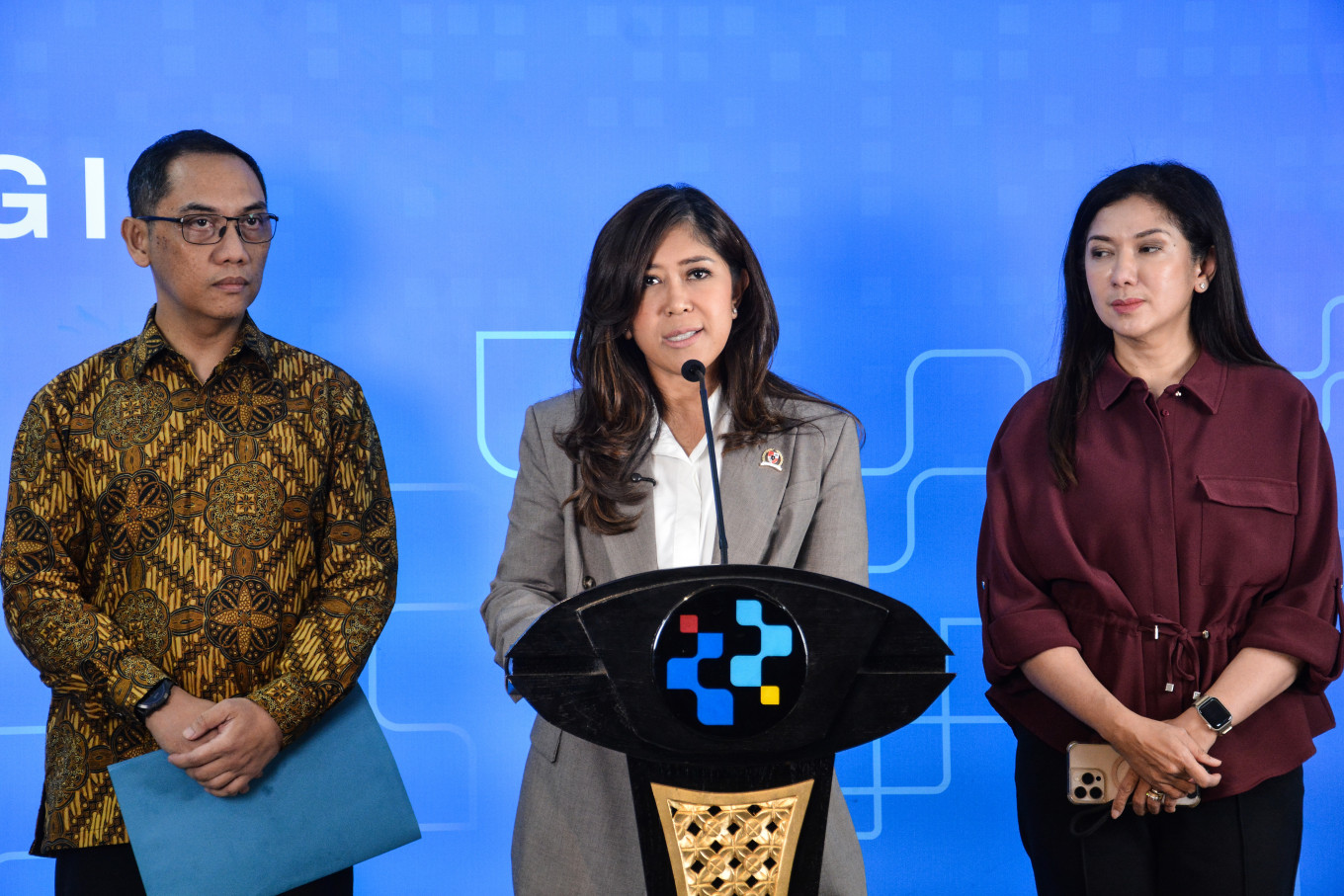 Indonesia’s Minister of Communication and Digital Affairs Meutya Viada Hafid (center), accompanied by Director General of Digital Space Oversight Alexander Sabar (left) and Director General of Public Communication and Media Fifi Aleyda Yahya (right), delivers a press statement on the implementation of Government Regulation No. 17 of 2025 on Electronic System Governance for Child Protection, known as PP Tunas, in Jakarta, Indonesia, on Thursday, April 9, 2026.
The Ministry of Communication and Digital Affairs imposed sanctions on Google after its platform YouTube failed to comply with the provisions outlined in the regulation. (Antara/Ahmad Naufal Oktavian)
Indonesia’s Minister of Communication and Digital Affairs Meutya Viada Hafid (center), accompanied by Director General of Digital Space Oversight Alexander Sabar (left) and Director General of Public Communication and Media Fifi Aleyda Yahya (right), delivers a press statement on the implementation of Government Regulation No. 17 of 2025 on Electronic System Governance for Child Protection, known as PP Tunas, in Jakarta, Indonesia, on Thursday, April 9, 2026.
The Ministry of Communication and Digital Affairs imposed sanctions on Google after its platform YouTube failed to comply with the provisions outlined in the regulation. (Antara/Ahmad Naufal Oktavian)
T
he government is preparing sweeping changes to its copyright law, including granting copyright privileges to people who use artificial intelligence to help them generate content, a draft bill reviewed by Reuters showed, setting up a potential showdown between the government and major tech platforms.
If passed, Indonesia could become the first country in Southeast Asia to incorporate AI in its copyright law, as governments globally grapple with the impact of the technology on copyright rules, including the use of work created by humans to train AI models.
It was not immediately clear when the bill, which was an initiative of parliament and given to the government for its input, would be passed into law.
Hermansyah Siregar, a law ministry official overseeing intellectual property, confirmed the authenticity of the draft bill and told Reuters it would mark the first explicit recognition of AI in Indonesia's copyright law.
"The development of generative AI has disrupted the copyright framework," Hermansyah said. "If unregulated, it could kill human creation."
The previously unreported AI-specific clauses of the bill include banning the use of AI to imitate a creator's "distinctive style" and mandating disclosure on AI use in content.

The bill also requires tech platforms to pay compensation for aggregating, republishing or link-previewing news content, as well as using it for AI training. The compensation would go to state-supervised collective management organisations, which would distribute the funds to news publishers.
The rules would apply to a variety of content including video games, photography, computer programs, journalism and films.
AI-assisted works would qualify for copyright protection only if they met human involvement criteria, while fully AI-generated works would be excluded. The draft did not say how much human involvement was needed to qualify for protection.
The use of copyrighted works to train AI models would also be subject to fair-use provisions or licensing agreements, the draft said.
Ari Juliano Gema, an IP and entertainment lawyer, said Indonesia's bill might trigger concern among tech companies as it appeared to conflate commercial use of AI with its use for research.
Tech giants such as Google, which issued a statement last month criticising the copyright overhaul, could face sanctions if they do not comply with the bill's provisions, including having their local business permits revoked.
"Rigid, overbroad mandates, however, would harm local creators, slow innovation, and leave Indonesia as an international outlier, ultimately discouraging the investment needed to drive its digital future," Google said in its statement, adding it would engage with the government on the bill.
Meta and TikTok did not immediately respond to requests for comment on the proposals. Meta's Instagram and Facebook platforms are popular among Indonesians.
Hermansyah said AI regulation was a global issue, citing an ongoing court case led by the New York Times, one of many brought by copyright owners against tech companies for alleged misuse of their material to train AI systems.
The draft was not final and the government was seeking further input, Hermansyah added.
Indonesia's AI disclosure requirements mirror transparency rules emerging elsewhere.
The European Union AI Act requires companies to clearly label where AI has been used to generate or modify images, video or audio content "constituting a deepfake", though it carves out exemptions for certain artistic or satirical works.
AI is not explicitly mentioned in US or Singapore copyright statutes, but their copyright offices have said copyright protection requires human contribution.
Indonesia's proposals come as the country pushes for the wider adoption of AI and as the government moves to embed AI in key programmes.
On Thursday, Indonesia was among 29 countries that signed an agreement in Shanghai to establish an intergovernmental body China says will promote cooperation and global governance of AI.
China's President Xi Jinping has outlined a vision for a new global AI order in which China would share its open-source AI technology and expertise with countries across the developing world.
Xi also called for AI systems to remain under human control and urged countries to establish early-warning and emergency-response mechanisms to manage AI risks, stressing the importance of human oversight and control.