The Jakarta Post
Please Update your browser
Your browser is out of date, and may not be compatible with our website. A list of the most popular web browsers can be found below.
Just click on the icons to get to the download page.


Popular Reads
Top Results
No results found. Please check your search term and try again
Can't find what you're looking for?
View all search results
Popular Reads
Top Results
No results found. Please check your search term and try again
Can't find what you're looking for?
View all search resultsTwo books explore doomsday scenarios of a nuclear war
The Doomsday Clock, which is set by the Bulletin of the Atomic Scientists’ Science and Security Board (SASB), now stands at 90 seconds to midnight, reflecting the highest level of danger ever recorded, surpassing even the Cuban Missile Crisis.
Change text size
Gift Premium Articles
to Anyone
Share the best of The Jakarta Post with friends, family, or colleagues. As a subscriber, you can gift 3 to 5 articles each month that anyone can read—no subscription needed!
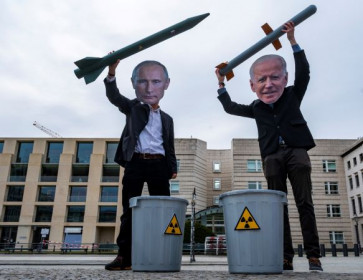
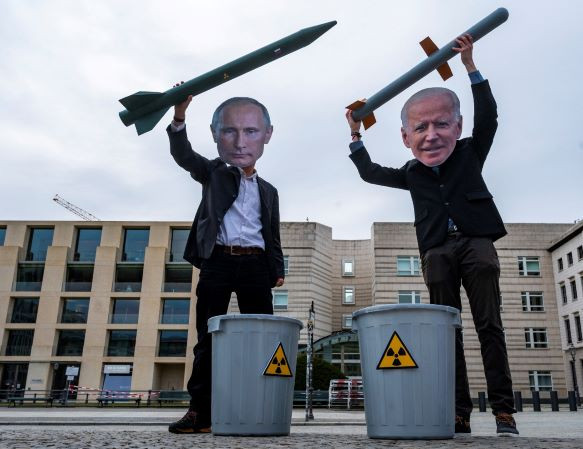 Arms race: Peace activists wearing masks of Russian President Vladimir Putin (left) and United States President Joe Biden pose with mock nuclear missiles in front of the US embassy in Berlin on Jan. 29, 2021, in an action to call for more progress in nuclear disarmament. (AFP/John Macdougall)
A
s conflicts intensify globally, from the war in Ukraine to rising tensions in East Asia, and intensifying hostilities and armed conflict in the Middle East, the specter of nuclear war looms ever closer.
The Doomsday Clock, which is set by the Bulletin of the Atomic Scientists’ Science and Security Board (SASB), now stands at 90 seconds to midnight, reflecting the highest level of danger ever recorded, surpassing even the Cuban Missile Crisis.
This ominous setting signals not only the immediate risk of nuclear conflict, but also the broader erosion of international cooperation and trust among nuclear powers. Compared to other global threats, such as climate change or pandemics, nuclear weapons pose the most urgent danger.

The belief that nuclear war is “winnable” is gaining traction in some circles, particularly among those who view tactical nuclear weapons as strategic assets in conventional conflicts.
This dangerous perspective overlooks the inherent risks of escalation and its catastrophic consequences. Often advocated by individuals without firsthand experience of war—especially not conflicts between evenly matched powers—this belief underestimates the unpredictable nature of war.
Two books, although fictional, vividly illustrate the spectrum of nuclear war scenarios. 2034: A Novel of the Next World War by Elliot Ackerman and Admiral James Stavridis, published in 2021, imagines a plausible future where a series of incidents lead to a nuclear confrontation between the United States and China.
It starts with a naval skirmish in the South China Sea and an Iranian cyberattack on a US fighter jet. Blinded by compromised surveillance systems, the superpowers escalate the conflict, pushing the world to the brink of mutual destruction.


More from The Weekender

Being Indian in English
English can be a mother tongue, a bridge across cultures and a marker of privilege. But what does belonging mean when the language of home also sets you apart from your country?
Citra Awards 2026: Who makes the cut?
An updated selection process brings fresh questions about recognition at the upcoming Citra Awards. Three movie-focused accounts weigh in on the favorites, the snubs and what makes a movie worthy of an ‘Indonesian Oscar’.

Old habits, new China
What does it take to change a city’s habits? In Beijing, rising prosperity, better public spaces and ever-watchful cameras are reshaping how people behave — with room for a little old-fashioned unruliness