The Jakarta Post
Please Update your browser
Your browser is out of date, and may not be compatible with our website. A list of the most popular web browsers can be found below.
Just click on the icons to get to the download page.


Popular Reads
Top Results
No results found. Please check your search term and try again
Can't find what you're looking for?
View all search results
Popular Reads
Top Results
No results found. Please check your search term and try again
Can't find what you're looking for?
View all search resultsCentral Africa’s Aka Pygmies struggle with stigma and poverty
Change text size
Gift Premium Articles
to Anyone
Share the best of The Jakarta Post with friends, family, or colleagues. As a subscriber, you can gift 3 to 5 articles each month that anyone can read—no subscription needed!
 Set as preferred source
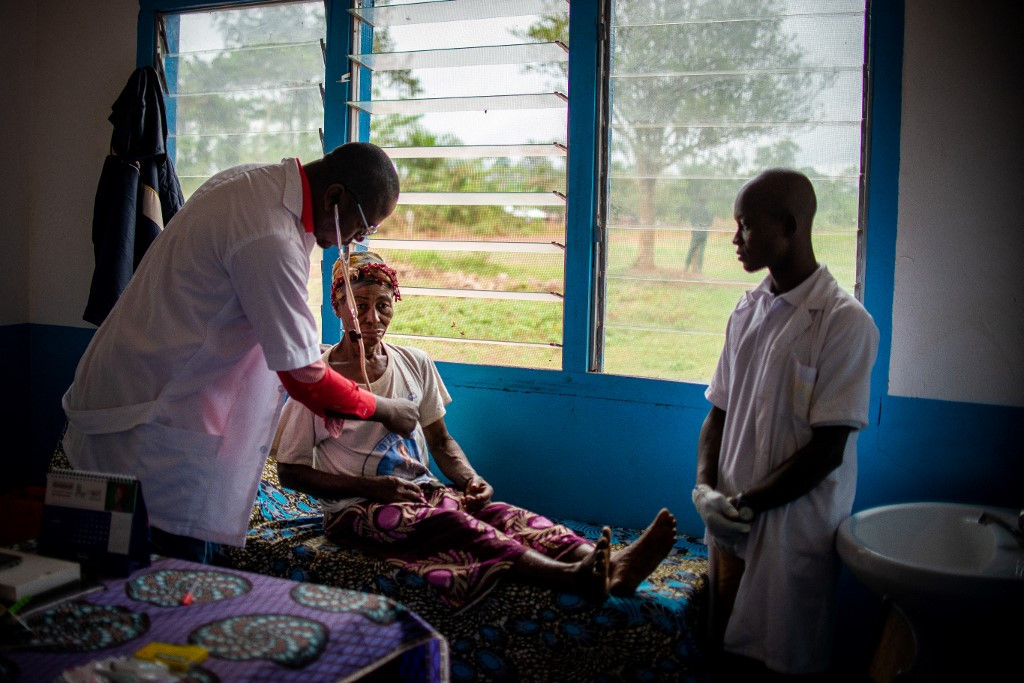 Check-up: A health worker tends to a patient during a medical check-up at a health center in Sakoungou in the Central African Republic on March 11. (AFP/Barbara Debout)
In Central Africa, indigenous people gain access to health but deforestation threatens their traditions.
Juliette sits up on the examining table and slowly pulls up her top to reveal a back marked by a constellation of fine scars and deformed by a huge abscess.
She smiles despite the nasty-looking growth on her back and her other symptoms: chest pains, dizziness and parasites.

Juliette is in her 50s, but this places her among the very oldest of the Aka — a Pygmy people living in remote southwestern Central African Republic (CAR).
"I live between the forest and the village," she says.
It is the very first time she has had access to modern medicine.
That she has is thanks to a free clinic set up by Senitizo, a small US non-profit specializing in providing access to medical care in parts of the country that would not otherwise get it. They started work here last June.

More from The Weekender

Is AI really making us better workers?
AI can make our work faster and more polished. But by eliminating the struggle, mistakes and imperfections, it may also be eliminating some of the ways we learn and become better workers.

Travels in the land of Gen Z
To become a professor to Gen Z today is to take a disorienting journey to an exotic land. First of two parts.

More trains, more stations, but Greater Jakarta still isn’t connected
Jakarta now has more trains and stations. But getting to them from Depok, Bogor, Tangerang or Bekasi still means an ojek or a car ride.