The Jakarta Post
Please Update your browser
Your browser is out of date, and may not be compatible with our website. A list of the most popular web browsers can be found below.
Just click on the icons to get to the download page.


Popular Reads
Top Results
No results found. Please check your search term and try again
Can't find what you're looking for?
View all search results
Popular Reads
Top Results
No results found. Please check your search term and try again
Can't find what you're looking for?
View all search resultsNext steps unclear after Indonesia’s pledge to stop clearing forests for rice fields
Forestry think-tank Auriga Nusantara estimates that forest loss in Indonesia surged by 66 percent in 2025 to 433,751 ha, its highest level in eight years, with more than 78,000 ha linked to food and energy self-sufficiency programs.
Change text size
Gift Premium Articles
to Anyone
Share the best of The Jakarta Post with friends, family, or colleagues. As a subscriber, you can gift 3 to 5 articles each month that anyone can read—no subscription needed!
 Set as preferred source
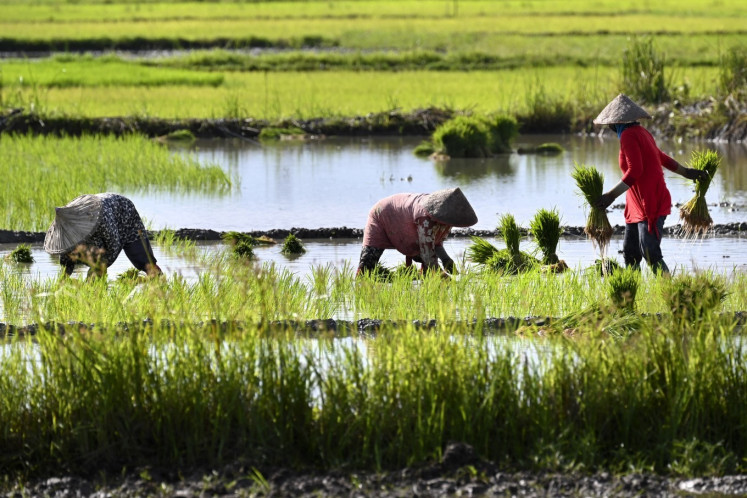
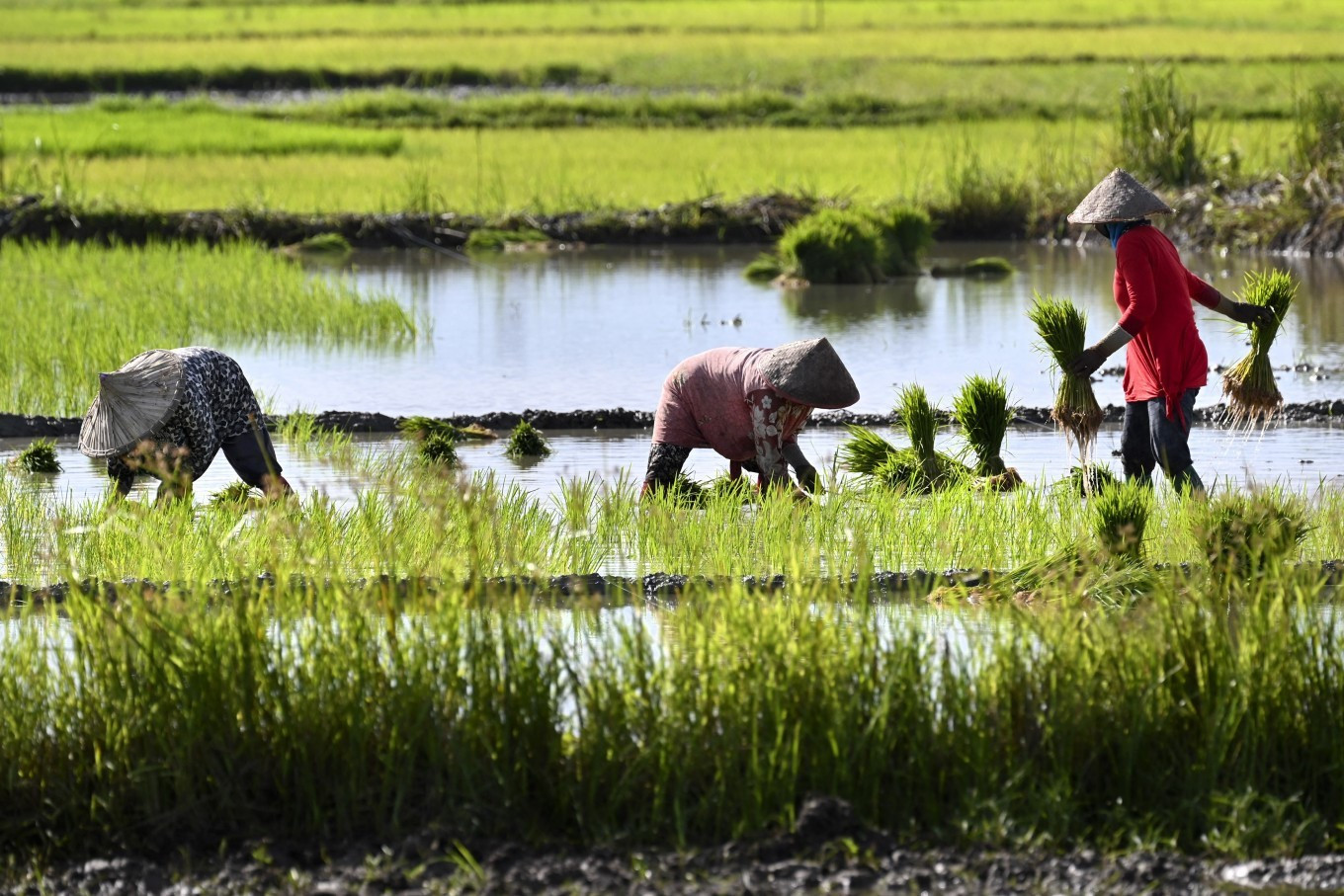 Farmers plant rice in a paddy field on June 28, 2025, at Lambaro in Aceh. (AFP/Chaideer Mahyuddin)
I
ndonesia plans to move away from clearing forests for new rice fields after achieving self-sufficiency in the staple ahead of schedule, although the government has yet to clarify what the shift means for projects already under way in South Papua and Kalimantan.
Hashim Djojohadikusumo, President Prabowo Subianto’s younger brother and special envoy for climate and energy, told a sustainability forum in Jakarta on Oct. 6 that the government had hit its rice self-sufficiency target three years early without needing to plant the two million ha of food estates it had planned.
But the Forestry Ministry said the shift was not yet clear-cut, pointing out that it sees Hashim’s remarks as affirming a policy of meeting food needs by raising productivity and making better use of existing land, in line with efforts to protect forests.
“A distinction needs to be made between new expansion plans that require the clearing of forest areas, activities that are already under way, and increasing production on agricultural land that is already available,” Ristianto Pribadi, the ministry’s head of public relations and international cooperation, told The Straits Times in a text message.
“Therefore, we cannot yet say that all activities in the two regions will automatically stop, nor confirm when they will stop,” he said, adding that this was for the Agriculture Ministry and other relevant agencies to spell out, referring to work in South Papua and Central Kalimantan.
At the Indonesia International Sustainability Forum, Hashim, who was speaking on behalf of the Agriculture Ministry, said: “The government sees no further need to expand rice cultivation in so-called forest areas.”

The two million ha food estate program had, in effect, already met its goal, he said, stressing: “It is a program that we have already achieved without even planting two million ha.”
However, thousands of hectares of forest, including swamp forest and peatlands, have already been cleared to create new rice fields as part of the program.
Mari Elka Pangestu, deputy chair of the National Economic Council, told the forum that the two million ha announced in 2025 for food production “is no longer needed”. She said Hashim had asked her to deliver “the missing part of that message”.
“Moving forward, we will be using degraded land. We have over 12 million ha of degraded land that can be used for this,” said Mari, a former trade minister. These are lands that were previously cleared or had been damaged by erosion or other causes and are either abandoned or underused.
She said Hashim had discussed the plan with the agriculture and forestry ministers, who agreed that any future production of food or biofuel would use degraded land as part of a Forestry Ministry reforestation program. Biofuels include biodiesel from blending palm oil with diesel and ethanol made from sugar cane.
Arief Cahyono, the Agriculture Ministry’s chief spokesman, did not respond to queries from ST.
On growing crops such as sugar cane and soya beans on degraded land, Ristianto said any increase in production must not add to the pressure on forests and important ecosystems.
Sites must be chosen only after verifying their land cover, the status and function, compliance with spatial plans, environmental factors and community rights, including those of indigenous people, he said.
“Designating an area as degraded land does not by itself, or automatically, mean that the area can be converted,” he said, adding that any change in land use must comply with prevailing laws and regulations.
“Food security and forest conservation need to go hand in hand, with clarity on locations and coordinated implementation,” he added.
Focus on existing farmland
Hashim and Mari said the government would focus on raising yields on existing farmland. Hashim said this would include soya beans, most of which Indonesia still imports.
“We will not embark on extensification (clearing) of arable areas. We will embark on and continue intensification measures using new breeds, new seeds, superior seeds of rice and soya beans,” said Hashim, adding that Indonesia would be self-sufficient in soya beans “within about three years, I’ve been told”.
Mari said higher yields must not come at the expense of the environment. “You can’t just increase yields but, at the same time, your soil and water are being degraded,” she said, calling for research into seeds that need less water and can cope with a hotter climate.
She also pointed to “green rice”, or growing more rice on the same land with less fertilizer and water, which cuts methane emissions and can earn carbon credits, an approach she said had been proven in Vietnam.
Prabowo had set a target for rice self-sufficiency by 2029. Hashim said government rice stocks stood at about 5.3 million tonnes and were growing so fast that the state had to rent private warehouses.
“Our warehouses are chock-a-block full of rice,” he said, adding that it was the first time in 42 years that Indonesia had become self-sufficient in the staple, a feat last achieved under president Suharto in the mid-1980s.
He credited incentives for farmers, including raising the price at which the state buys unhusked rice to 6,500 rupiah a kg from 4,000 rupiah, and cutting fertilizer costs by 20 percent.
Indonesia produced 34.71 million tonnes of rice in 2025, exceeding the demand of 31.19 million tonnes, according to the National Food Agency.
Indonesia’s statistics agency projects January-September 2026 output at 28.71 million tonnes, almost unchanged year on year, state news agency Antara reported on Oct. 6.
The most controversial food estates are in Merauke regency in South Papua, where vast rice and sugar estates are being developed in wetland forests by the Jhonlin Group and Merauke Sugar Group with the help of thousands of soldiers, despite protests from indigenous communities.
If fully developed, the estates could cover about two million ha, roughly the size of Johor, according to forestry think-tank Auriga Nusantara.
Large areas already cleared
Neither Hashim nor Mari said how much forest had already been cleared, what would happen to land cleared but not yet planted, or whether the sugar cane plantations in South Papua would be affected.
According to satellite data from environmental group Mighty Earth, more than 50,000 ha of rainforest, savannah, peat swamp and wetlands have been cleared for sugar cane and rice since the start of the project in 2024.
Auriga chair Timer Manurung told ST that satellite imagery showed several spots of extensive deforestation around the Merauke estate, though the group has yet to quantify the area.
The group also documented several large cleared areas around Sorong and Jayapura, which locals said were for rice paddy projects.
Hashim said rice had been planted “in swamp areas, not peat areas” of South Papua and Kalimantan. But during a recent visit, ST found mixed results in Central Kalimantan, with some farmers struggling to grow rice on acidic peat soil and peat forest areas that had been cleared for the staple.
Challenges remain, though.
Auriga estimates that forest loss in Indonesia surged by 66 percent in 2025 to 433,751 ha, its highest level in eight years, with more than 78,000 ha linked to food and energy self-sufficiency programs.
The shift to degraded land may also prove harder than it sounds. WRI Indonesia has identified 9.72 million ha of degraded but still productive land outside peat areas, but found that less than 10 percent of it is suitable for large-scale agriculture. About 4.1 million ha is better suited to small farms of under 100 ha.
Still, the announcement on halting forest clearance for rice brought praise.
Glenn Hurowitz, chief executive of Mighty Earth, said Prabowo and the Indonesian government had made “a globally significant decision for people, nature and climate”.
“Mighty Earth and allies will be closely monitoring implementation and supporting work with local communities in Papua to heal the damage that’s been done. We are hopeful about the potential of this decision to drive a continued shift to protecting and restoring nature and to sustainable agriculture,” he said in a statement.