The Jakarta Post
Please Update your browser
Your browser is out of date, and may not be compatible with our website. A list of the most popular web browsers can be found below.
Just click on the icons to get to the download page.


Popular Reads
Top Results
No results found. Please check your search term and try again
Can't find what you're looking for?
View all search results
Popular Reads
Top Results
No results found. Please check your search term and try again
Can't find what you're looking for?
View all search resultsDeciphering Indonesia’s data center dilemma
Indonesia needs to carefully plan where data centers can be located and avoid excessive concentration, as more than 60 percent of the country’s data centers are concentrated in just two locations, Greater Jakarta and Batam.
Change text size
Gift Premium Articles
to Anyone
Share the best of The Jakarta Post with friends, family, or colleagues. As a subscriber, you can gift 3 to 5 articles each month that anyone can read—no subscription needed!
 Set as preferred source
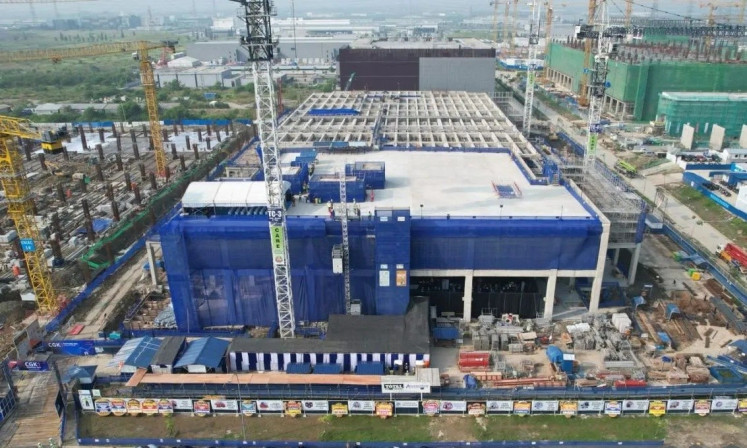
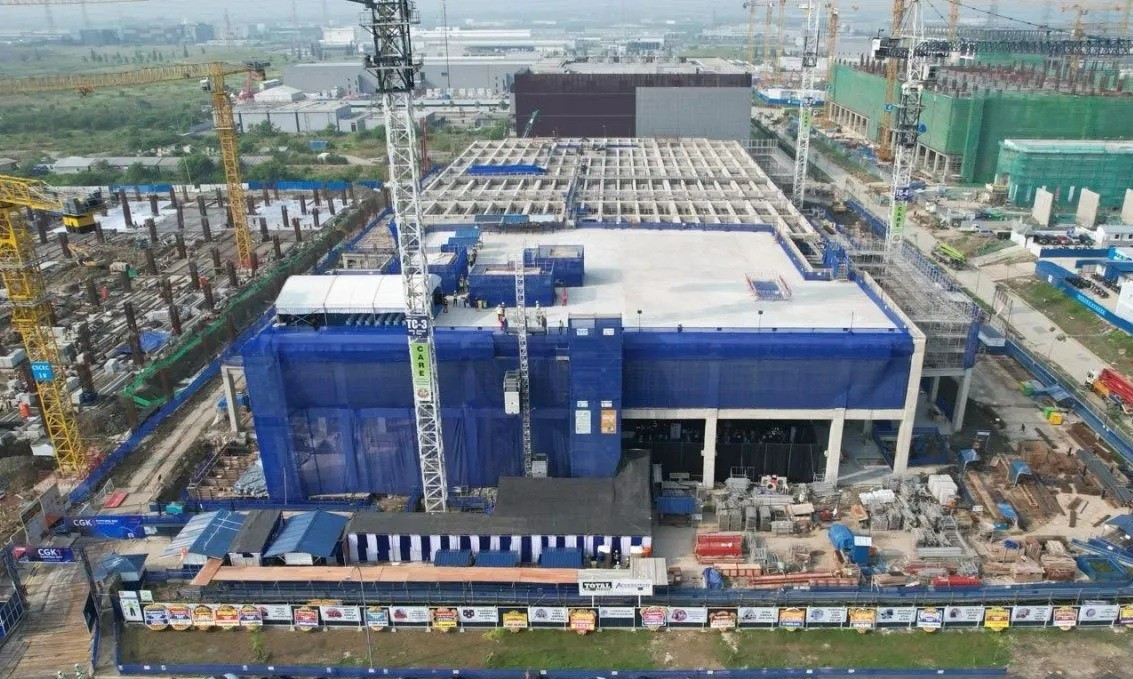 The construction of Digital Edge Indonesia data center in Cikarang, West Java is underway in this undated picture. (Antara/PT PLN)
O
n Sept. 30, the construction of a major data center project in Jatiluhur, West Java, was halted just a week after its groundbreaking ceremony. Local community’s push to review the facility’s water consumption, projected to equal the daily need of 220,000 people, has been the main reason for the delay.
Several hundred kilometers away, a similar scene is unfolding in one of Indonesia’s largest data center clusters, Batam, where the continued expansion of data centers puts pressure on the region’s limited rain-fed water supply. This condition ultimately sparked protests from the local community, prompting authorities to require data centers to develop independent seawater desalination facilities.
Jatiluhur and Batam are not isolated cases. They reflect a global challenge behind the rapid expansion of data centers to support the development of artificial intelligence. Data centers require large amounts of electricity to continuously power servers, cooling systems to remove the heat generated by dense computing workloads, reliable network connectivity and sufficient land.
As AI compute demand pushes facilities to grow larger, these resource requirements can compete with the needs of local households and industries.
The tensions are visible globally. In the United States, at least 120 projects worth approximately US$198 billion were delayed or blocked by local opposition in the first half of 2026 alone. Many cited concerns around significant electricity and water use, as well as noise pollution from the non-stop operation of data centers.
Closer to home, the first data center-related protest in Malaysia happened earlier near ZDATA’s 300 MW facility in Johor. Malaysia’s very rapid data center expansion recently raised concerns from policymakers not only on resource strain but also on limited domestic value added data centers brought.

As a result, Selangor has mandated a 30 percent local-content requirement for new data center investments while Johor has stopped approving applications for water-intensive data centers which can consume up to 50 million liters of water per day.
These cases show that the continued expansion of data centers can also raise other concerns beyond local resource pressure. Data centers can involve large capital investments while creating relatively few permanent jobs after construction, raising questions over the value retained by the domestic economy. Furthermore, countries’ effort to meet their nationally determined contributions (NDC) targets can be disrupted if new electricity demand from data center is supplied through fossil-based generation.
As of the first half of 2026, Indonesia had around 1.3 GW of data center expansion already planned and another 395 MW under construction that will complement its 356 MW operational capacity. With a significant amount of capacity in the pipeline, Indonesia needs to ensure that the investments stay within the limits of local resources. This requires greater consideration of the conditions under which projects shall or shall not proceed.
Deliberate location planning
First and foremost, Indonesia needs to carefully plan where data centers can be located. New data centers should not be concentrated in locations where resource compete with existing users. Rather than addressing the issues after the projects are operational or being developed, authorities should assess local resource and infrastructure capacity beforehand. This is crucial since in Indonesia, more than 60 percent of data centers are concentrated in two locations only, Greater Jakarta and Batam.
This spatial planning process should recognize that not all data centers need the same requirements. Those serving AI training needs typically require large amounts of electricity and cooling systems for computing power but offer greater flexibility in location. On the other hand, data centers aimed for AI inference and cloud services need proximity to users and reliable network infrastructure to minimize latency.
Building on this notion, a recent analysis by the Indonesian Business Council (IBC) Institute suggests that Indonesia needs to distribute the upcoming data center capacity more deliberately. Different locations can accommodate different computing workload according to their existing resource and infrastructure capacity. This multi-location approach can avoid further strain on local resources in each area.
Under this approach, the Greater Jakarta area could remain focused on latency-sensitive AI inference and cloud services given its proximity to users. Batam could also retain its role as a regional cloud gateway within the broader Singapore-Johor-Batam corridor.
Meanwhile, power-intensive AI training loads could instead be directed towards future power-rich area that must strictly check numerous boxes. These include reliable electricity and sufficient grid capacity, high-capacity fiber, as well as sustainable cooling solutions. Furthermore, the location should not be located in close proximity to residential areas to avoid noise pollution.
Indonesia’s renewable energy potential, such as from geothermal and solar, could provide options in some locations. Concentrating power-intensive data centers near these resources could generate demand for new electricity generation while reducing reliance on existing power capacity.
From planning to policy
Location planning will generate impact only if accompanied by appropriate policy. Rather than applying the same requirements across locations, policy should cater for the differences in local resource and infrastructure capacity.
Greater Jakarta and Batam would require closer consideration of existing resource constraints as additional capacity is developed. In particular, proposals for the development of power-intensive loads near these resource-constrained areas shall face greater scrutiny and eventually be cancelled or diverted towards the future power-rich areas.
Fiscal incentives and fast-track facilitation can be directed to projects that invest in additional infrastructure capacity. These include new renewable electricity generation, grid reinforcement and dedicated cooling infrastructure that does not use local water. It can then be expanded to projects with significant domestic value creation, such as through the use of domestic suppliers, talent development, R&D investment or advanced computing capabilities.
Location-specific project assessment provides a clearer basis for determining which projects can proceed, while targeted incentives and facilitation help direct capital toward projects that create greater value for the society. Ultimately, the objective is not to simply accommodate more data center capacity, but to ensure that the expansion creates wider economic value without creating unsustainable resource pressures.
*****
The writer is an associate researcher at the Indonesian Business Council (IBC).