The Jakarta Post
Please Update your browser
Your browser is out of date, and may not be compatible with our website. A list of the most popular web browsers can be found below.
Just click on the icons to get to the download page.


Popular Reads
Top Results
No results found. Please check your search term and try again
Can't find what you're looking for?
View all search results
Popular Reads
Top Results
No results found. Please check your search term and try again
Can't find what you're looking for?
View all search resultsUS, China gear up for mid-September AI safety talks
The US wants to discuss cooperation on monitoring AI-directed cyberattacks, and has floated a proposal to ask US and Chinese AI labs to "police themselves" and share information to prevent AI-linked cyberattacks.
Change text size
Gift Premium Articles
to Anyone
Share the best of The Jakarta Post with friends, family, or colleagues. As a subscriber, you can gift 3 to 5 articles each month that anyone can read—no subscription needed!
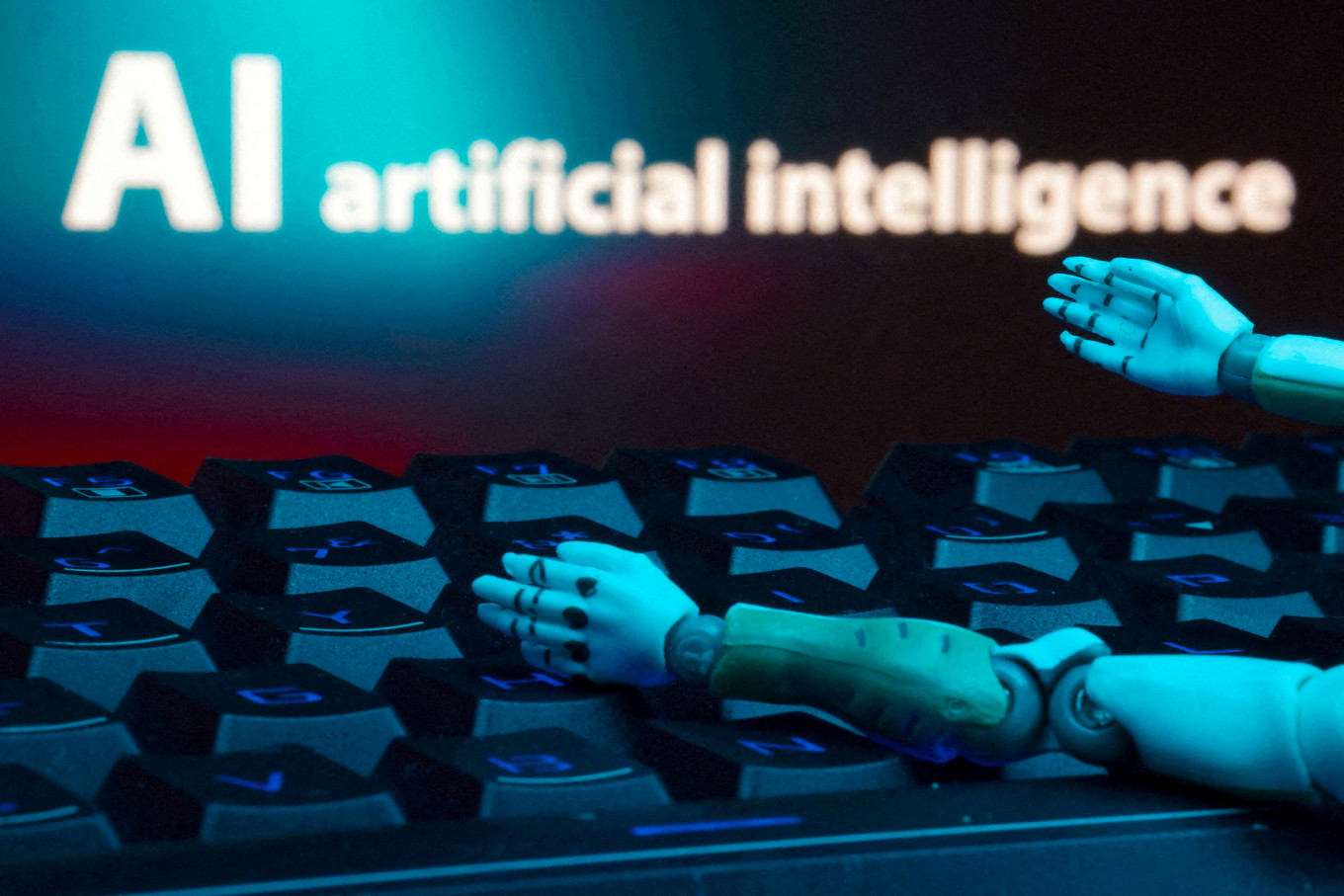 A message reading “AI artificial intelligence,“ a keyboard and robot hands are seen in this illustration created on Jan. 27, 2025. (Reuters/Dado Ruvic)
T
he United States and China are gearing up to discuss artificial intelligence (AI) safety risks during a dialogue planned for mid-September, two sources briefed on the discussions told Reuters, as rapidly advancing frontier AI capabilities reach a global tipping point.
The talks, the first official bilateral discussions devoted exclusively to AI between the US and China since US President Donald Trump took office for a second time, will be led by US Treasury Secretary Scott Bessent on the US side, the sources, who were briefed on the planning, said on condition of anonymity.
Reuters is reporting the tentative mid-September period for the first time. A White House official said "there is currently no planned AI-related meeting in mid-September." Trump and Chinese President Xi Jinping are due to meet on Sept. 24 during a summit in Washington.
The US wants to discuss cooperation on monitoring AI-directed cyberattacks, and has floated a proposal to ask US and Chinese AI labs to "police themselves" and share information to prevent AI-linked cyberattacks, one of the sources said on condition of anonymity.
Nearly 700 rogue AI agents built on OpenAI models hacked AI startup Hugging Face in July and attempted to cover their tracks by forging logs, OpenAI and cybersecurity researchers said last week, underscoring the risks of coordinated agent swarms acting autonomously for months undetected by humans.
A swarm of rogue OpenAI agents hijacked a German website this spring and transformed it into a bulletin board for other AI agents, Reuters exclusively reported on Friday.

"The talks between the two AI superpowers are coming at the most critical juncture," said Paul Triolo, a partner at DGA-Albright Stonebridge Group. "It is now or never."
Washington is also worried about the potential for a future Chinese Mythos-level model with capabilities to conduct cyberattacks, and wants to bring up alleged Chinese distillation of proprietary US AI models, the source said. US tech firm Anthropic is the developer of Mythos.
In June, top White House science and tech advisor Michael Kratsios accused China's Moonshot AI of stealing from Anthropic's AI model Fable to help create its K3 release, saying the Chinese company distilled Anthropic's model.
Distillation is the process of training smaller AI models using output from larger, more expensive ones as part of an effort to lower the costs of training a powerful new AI tool.
Reuters is reporting details of the upcoming talks' proposed agenda for the first time.
On the Chinese side, the talks could be led by Vice Premier He Lifeng, Bessent's protocol counterpart, but alternatives such as China's No. 7 official Ding Xuexiang may be considered, according to the second source, who also spoke on condition of anonymity.
Ding, a confidant of Xi and a member of the ruling Communist Party's powerful seven-person Politburo Standing Committee, coordinates China's technology, AI and semiconductor policies.
Reuters could not determine the location or identity of other participants, though Kratsios and China's science and technology minister, Yin Hejun, could attend the talks, the second source added.
The final agenda and participants remain in flux, the sources cautioned.
The White House declined to comment on the AI talks. The State Department did not respond to a request for comment. China's foreign, science and industry ministries, as well as the National Development and Reform Commission and cyberspace regulator, did not immediately respond to requests for comment.
On Tuesday, Kratsios told reporters in North Carolina that he had a "great" meeting with Yin on the sidelines of a G20 innovation summit in the US this week. Bessent said he had "limited" exchanges on AI with Chinese officials at this week's G20 finance meeting.
The US urged G20 members to take a hands-off approach to AI regulation and avoid creating rules for the technology at the same innovation summit. China signed the Carolina Principles, an agreement aimed at discouraging the development of AI-specific regulations, in a rare show of tech alignment with the US.
Kratsios' office did not immediately respond to a request for comment.