The Jakarta Post
Please Update your browser
Your browser is out of date, and may not be compatible with our website. A list of the most popular web browsers can be found below.
Just click on the icons to get to the download page.


Popular Reads
Top Results
No results found. Please check your search term and try again
Can't find what you're looking for?
View all search results
Popular Reads
Top Results
No results found. Please check your search term and try again
Can't find what you're looking for?
View all search resultsBigger 'kurban', thinner wallets
National data on sales of sacrificial animals for Idul Adha show that while the kurban market might appear healthy, changes in consumer behavior over the past few years indicate growing caution in spending.
Change text size
Gift Premium Articles
to Anyone
Share the best of The Jakarta Post with friends, family, or colleagues. As a subscriber, you can gift 3 to 5 articles each month that anyone can read—no subscription needed!
 Set as preferred source
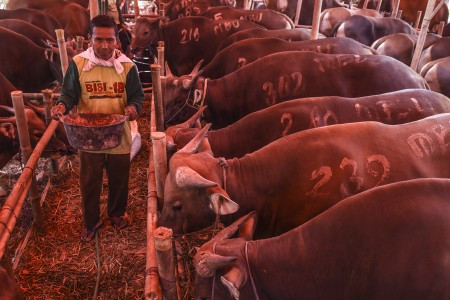 A cattle trader prepares feed for his livestock on July 10, 2019, as he awaits buyers for Idul Adha (Day of Sacrifice) at a makeshift pen in Jakarta. (Antara/Muhammad Adimaja)
M
uslims across Indonesia last week celebrated Idul Adha 1447 Hijriah, a holiday closely associated with kurban: offerings of sacrificial animals.
Beyond its religious significance, kurban has also become a major economic activity. Data from the National Alms Agency (Baznas) show the country’s kurban market reached Rp 34.9 trillion (US$1.4 billion) in 2025, up 1.6 percent from Rp 34.3 trillion a year earlier.
Yet beneath this growth lays an early warning sign, as momentum has slowed sharply from the 11.3 percent expansion recorded in 2024. The moderation suggests households are becoming more cautious, particularly with regard to spending on big-ticket items.
The national kurban economy was equivalent to roughly 0.15 percent of nominal household consumption in 2025, a sizeable figure considering the activity is concentrated in only a few days. The market was also nearly 30 times larger than Malaysia’s kurban economy of an estimated Rp 1.1 trillion, far exceeding the difference implied by the two countries’ Muslim population ratios.
The scale reflects more than demographics alone, as Indonesians display exceptionally strong participation in kurban activities. Baznas data show the number of kurban participants surged 29.5 percent year-on-year (yoy) to 3.56 million people in 2025, the highest level in four years. The sacrificial livestock total also increased to 2.85 million heads, while shares of cattle continued to gain for the third consecutive year, climbing from 21.5 percent in 2023 to 22.7 percent in 2025.
On the surface, the market appears healthy. Yet consumer behavior tells a more nuanced story. Google Trends data show that searches for “kurban” started roughly three and a half weeks before Idul Adha this year, earlier than the typical pattern of two to three weeks seen previously. The shift suggests households are spending more time comparing prices and preparing budgets before committing to major purchases.

The same pattern is visible in searches for “patungan sapi”, or cattle-sharing schemes for groups. Search intensity ahead of Idul Adha 2026 reached its highest level in six years, with interest emerging as early as April. The trend suggests households still aspire to purchase cattle, traditionally viewed as a higher-tier kurban option, but they are increasingly relying on collective schemes to manage tighter budgets.
Indonesia is therefore displaying two parallel trends: Participation continues to expand, but households are becoming more selective in how they execute festive spending.
The divergence is clearest at the individual level: In 2025, kurban spending per participant fell 21.5 percent yoy to Rp 9.8 million, while meat volume per donor declined 5.4 percent and livestock ownership per donor dropped 4.5 percent.
These figures indicate that broader participation does not necessarily translate into proportionally stronger economic value. While more people are taking part in kurban activities, each participant is spending less. Households remain committed to preserving religious and social obligations, though with increasingly tighter financial discipline.
The pattern mirrors Indonesia’s wider household consumption trends. Data as of May 24 from the Mandiri Spending Index (MSI) show that weekly spending growth slowed 0.24 percent in the fourth week of May, ending a three-week positive streak driven by long holidays. Monthly spending growth also softened, compared with the same period last year.
Even so, upper-income consumers continue to underpin overall consumption growth with spending expansion more than twice as strong as a year earlier. The divergence highlights an uneven recovery: Affluent households remain relatively resilient, while middle- and lower-income consumers are becoming more defensive and efficiency-oriented in managing expenditures.
This year’s kurban season ultimately offers a revealing snapshot of Indonesia’s broader consumption landscape. Activity remains vibrant on the surface, but consumers are becoming more cautious underneath. Participation is rising, yet spending decisions are shifting from spontaneous purchases toward more calculated, budget-conscious behavior.
That may be the most important signal of all. As long as consumption growth gradually depends more on upper-income households while the middle class continues to retrench, Indonesia’s recovery may appear healthy on the surface but remain fragile at its core.
*****
The writer is an analyst at the Mandiri Institute.