The Jakarta Post
Please Update your browser
Your browser is out of date, and may not be compatible with our website. A list of the most popular web browsers can be found below.
Just click on the icons to get to the download page.


Popular Reads
Top Results
No results found. Please check your search term and try again
Can't find what you're looking for?
View all search results
Popular Reads
Top Results
No results found. Please check your search term and try again
Can't find what you're looking for?
View all search resultsUS military confirms Iran war has led to munitions shortfall
Change text size
Gift Premium Articles
to Anyone
Share the best of The Jakarta Post with friends, family, or colleagues. As a subscriber, you can gift 3 to 5 articles each month that anyone can read—no subscription needed!
 Set as preferred source
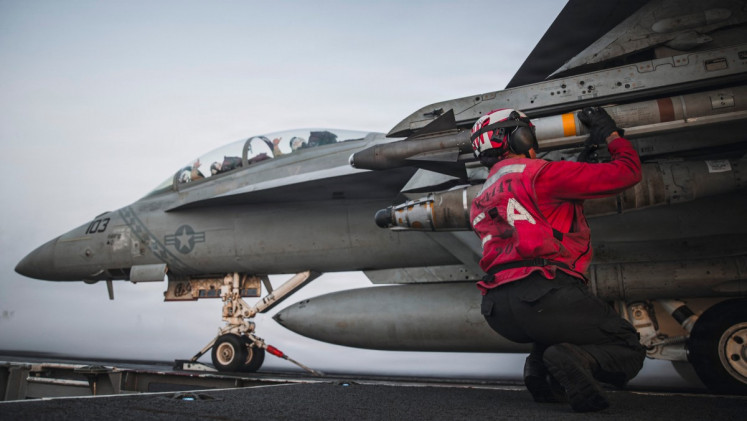
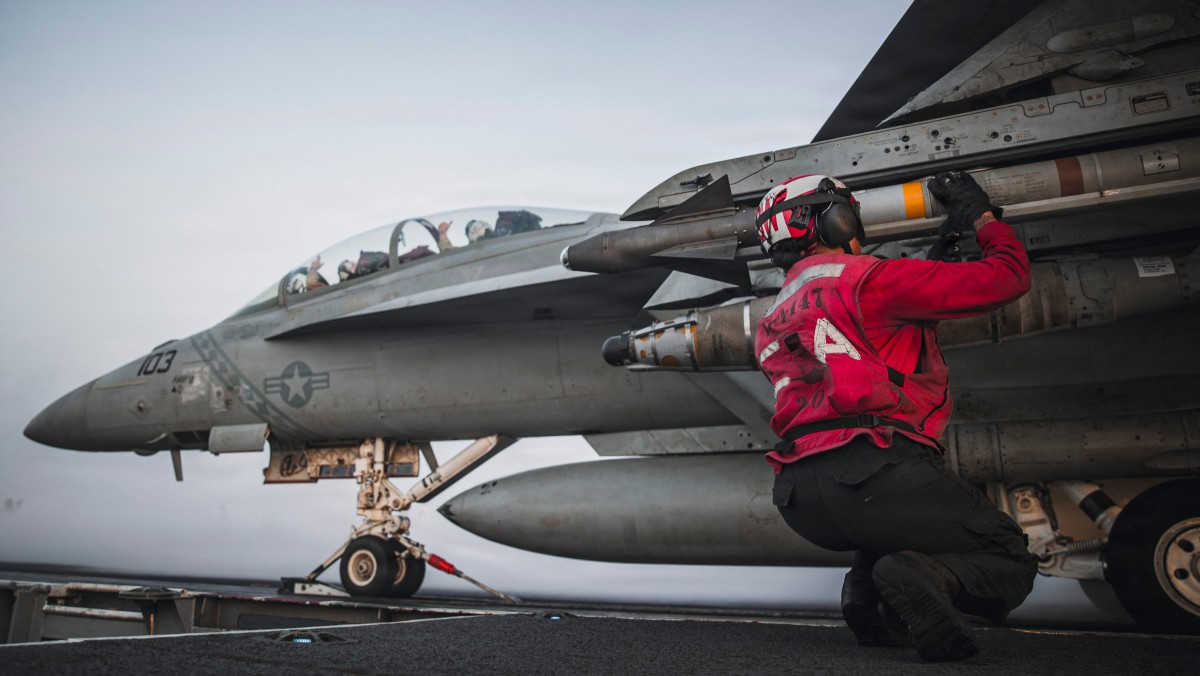 This handout picture released by the US Navy on September 13, 2026, shows a US Sailor checking ordnance on an FA-18 Super Hornet, attached to Strike Fighter Squadron (VFA) 102, aboard Nimitz-class aircraft carrier USS George Washington (CVN 73) on September 13, 2026.
The USS George H.W. Bush Carrier Strike Group is deployed to the US 5th Fleet area of operations to support maritime security and stability in the Middle East. (AFP/US Navy)
This handout picture released by the US Navy on September 13, 2026, shows a US Sailor checking ordnance on an FA-18 Super Hornet, attached to Strike Fighter Squadron (VFA) 102, aboard Nimitz-class aircraft carrier USS George Washington (CVN 73) on September 13, 2026.
The USS George H.W. Bush Carrier Strike Group is deployed to the US 5th Fleet area of operations to support maritime security and stability in the Middle East. (AFP/US Navy)
T
he United States is facing a shortfall in ammunition as a result of its war against Iran, the Defense Department's inspector general confirmed Monday, contrasting with President Donald Trump's assertions of full stocks.
In a first-of-its-kind mandatory report to Congress, the inspector said that between Feb. 28 and June 30, Operation Epic Fury (OEF) had an estimated cost of $33.4 billion, including $22.3 billion spent on expended munitions.
"The munitions expenditure on OEF has resulted in strategic inventory shortfalls and revealed industrial base bottlenecks for munitions resupply," the report said.
OEF is the US name for its joint campaign with Israel to "destroy Iran's ability to project military power," according to US Central Command (CENTCOM).
To deal with shortfalls and delays, the Pentagon is "working to streamline procurement processes and production lead times, and to stockpile critical materials, components, and selected munitions," the report said.
Though it noted that expanding production capacities requires "significant lead time."
The shortfall is likely to cause concern among governments like Ukraine and Taiwan, who rely on weapons purchases from the United States to fight or deter much larger, hostile neighbors.
Ukraine urgently needs more interceptor missiles for US-made Patriot air defense systems in its war against Russia, while Taiwan depends on arms agreements with Washington to ward off China, which claims the self-ruled island as its own.
'Virtually unlimited'
Trump has repeatedly brushed off concerns of depleted weapons stores during the six months of war in the Middle East, saying recently that the US has "virtually unlimited" ammunition.
On Monday he posted on his Truth Social platform that the US is producing "more Exquisite and Elite Weapons than at any time in our History."
CNN previously reported shortages of long-range guided missiles and air-defense interceptors had affected Trump's strategy in the conflict with Iran, with the US military having "nearly exhausted 80%" of its stock of THAAD interceptors.
During the first 24 hours of war against Iran, the United States struck more than 1,000 targets, CENTCOM has said, and has not returned to such large scale attacks in recent months.
The report identified losses to the American fleet, including four F-15s fighters destroyed, one F-35 fighter damaged, seven KC-135 tanker aircraft damaged and up to 30 MQ-9 Reaper drones destroyed.
It also confirmed that the US Navy's main logistics hub in the region, located in Bahrain, had been targeted by Iran with drone and ballistic missile strikes.
Hundreds of buildings and structures at US bases in Kuwait, Bahrain, Qatar, the United Arab Emirates, Saudi Arabia, Iraq, Oman, and Jordan have been damaged or destroyed by Iranian strikes during the conflict.
The report does not include those costs in its estimates, saying it is not yet clear if all the bases will be rebuilt, or who will foot the bill.
As of June 30, seven US service members had been killed in action and seven killed in non-hostile events during OEF combat operations, the report said.
An additional 417 service members were wounded in action, it added.
The US and Israel launched the war against Iran on Feb. 28.
For decades, Western powers have accused the Islamic republic of seeking nuclear weapons, a claim that Tehran categorically denies.