The Jakarta Post
Please Update your browser
Your browser is out of date, and may not be compatible with our website. A list of the most popular web browsers can be found below.
Just click on the icons to get to the download page.


Popular Reads
Top Results
No results found. Please check your search term and try again
Can't find what you're looking for?
View all search results
Popular Reads
Top Results
No results found. Please check your search term and try again
Can't find what you're looking for?
View all search resultsFar right and far left battle for power in polarized Berlin
Far from the city's bohemian neighborhoods with their hip clubs and trendy cafes -- areas which reliably vote for leftist and green parties -- this working-class district is Berlin's ground zero for a shift to the hard right.
Change text size
Gift Premium Articles
to Anyone
Share the best of The Jakarta Post with friends, family, or colleagues. As a subscriber, you can gift 3 to 5 articles each month that anyone can read—no subscription needed!
 Set as preferred source
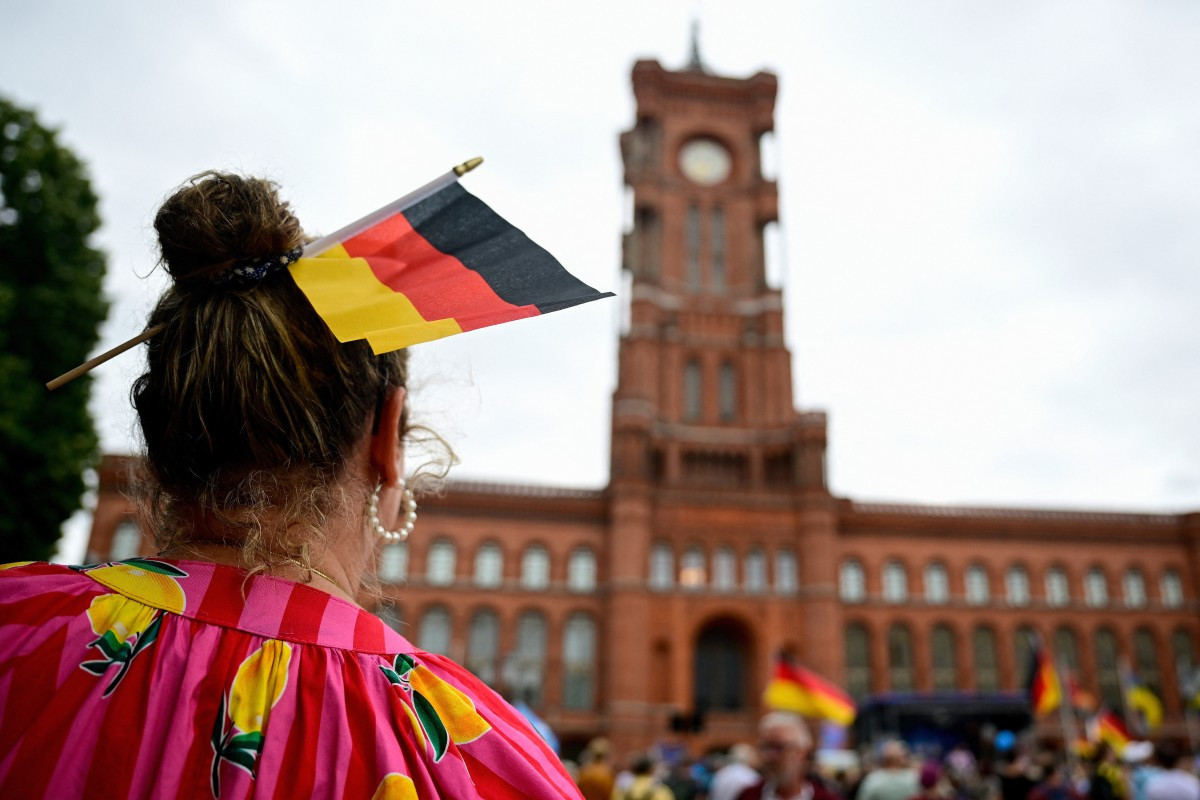 A supporter of the far-right Alternative for Germany (AfD) party wears a German flag in her hair as she attends a campaign rally in front of the Berlin City Hall on June 29, 2026. (AFP/Tobias Schwarz)
O
ne recent day in Berlin, a few hundred Pride demonstrators with rainbow flags rallied in eastern Marzahn district, a sweep of communist-era residential blocs that is a hotspot of far-right AfD support.
Far from the city's bohemian neighborhoods with their hip clubs and trendy cafes -- areas which reliably vote for leftist and green parties -- this working-class district is Berlin's ground zero for a shift to the hard right.
In last year's national election, the anti-immigration, anti-Islam and Moscow-friendly Alternative for Germany (AfD) topped the polls with 31 percent in Marzahn, which is home to many Russian speakers.
Ahead of September polls in the city-state of Berlin, many progressive-leaning voters fear the AfD may again win big -- perhaps boosted by public anger over a deadly jihadist attack that targeted the city's main annual LGBTQ Pride event last weekend.
"If we demonstrate in an area where the AfD polls very strongly, we're sending a powerful signal," said one of the recent demonstrators at the smaller march in Marzahn, Andreas, who was joined by his husband Sumudu.
Sumudu, from Sri Lanka, said he came to Berlin to live in a place that celebrates "democracy, human rights and openness".
The 24-year-old said he views the AfD's rise with "disgust" and insisted the party has "no place in this city".
Berlin has long prided itself on being a somewhat chaotic but fun-loving bastion of diversity and openness.
So many were stunned when the AfD last week topped the polls for the first time there, scoring 19 percent in an Insa survey.
The other occasional front-runner has been the far-left Linke party, which emerged from the communist party that ruled East Germany until the Berlin Wall fell in 1989.
The Linke's antifascist battle cry of "onto the barricades" and vows for dramatic reforms to ease a housing crisis have endeared it to many young voters.
Many also support its pro-Palestinian stance in a country where the national government is a steadfast supporter of Israel.
The Linke's top candidate, Elif Eralp, a lawyer with Turkish heritage, said she also fears the AfD could exploit the attack in which a man ploughed a vehicle through a crowd, then attacked people with a machete.
The presumed attacker, a German man with Lebanese roots who pledged allegiance to the Islamic State group, was later shot dead by police after running towards them with a bladed weapon.
Eralp told AFP about the attack that "I strongly fear this could benefit the AfD, because the AfD always exploits such events for racist narratives".
It's a concern shared by Mario Paul, 46, a mourner at a memorial for the victims -- a Polish woman who was killed and some 30 people who were injured.
The attack "will make the situation worse", he said. "I am shocked that people are shifting further to the right."
The outcome of the September 20 vote remains wide open as a crowded field of parties vie to govern the city now ruled by the center-right CDU of Chancellor Friedrich Merz and the Social Democrats.
Berlin's unpopular CDU mayor Kai Wegner recently stepped down, replaced as top candidate by the little-known Stefan Evers.
Under one scenario, the city could next be ruled by a leftist coalition of the Linke, Greens and SPD.
The AfD for now has been shut out of power across Germany as all other big parties maintain a "firewall" of non-cooperation with it.
In highly polarized times, the election is also seen as a battle for the heart and soul of Berlin, famously described by a former mayor as "poor but sexy".
Some fear the worst in a city which a century ago was partying through the "Roaring Twenties", an era of flamboyant variety shows, jazz bars and queer culture under the Weimar Republic.
Those hedonistic and turbulent days gave way to the rise of the Nazi regime, World War II and the Holocaust.
During the Cold War, when Germany and Berlin were divided, the city's western half became a haven for alternative counter culture, which blossomed further after the Wall collapsed.
Recent decades have seen a spike in housing prices and the arrival of migrants from Syria, Iraq and Ukraine to what has long been a hub for Germany's Turkish community.
The AfD is also campaigning on Berlin's housing crisis, heaping some of the blame on foreigners.
Its top candidate in Berlin, Kristin Brinker, told AFP she wants to reserve social housing for "locals", which she defined as people with jobs "who have lived here for a long time".