The Jakarta Post
Please Update your browser
Your browser is out of date, and may not be compatible with our website. A list of the most popular web browsers can be found below.
Just click on the icons to get to the download page.


Popular Reads
Top Results
No results found. Please check your search term and try again
Can't find what you're looking for?
View all search results
Popular Reads
Top Results
No results found. Please check your search term and try again
Can't find what you're looking for?
View all search resultsChanging global order puts ASEAN's relevance to the test
Evi Fitriani, an international relations expert at the University of Indonesia, said wars had long been driven by competition over territory and resources, but today's conflicts were increasingly shaped by globalization and economic interdependence.
Change text size
Gift Premium Articles
to Anyone
Share the best of The Jakarta Post with friends, family, or colleagues. As a subscriber, you can gift 3 to 5 articles each month that anyone can read—no subscription needed!
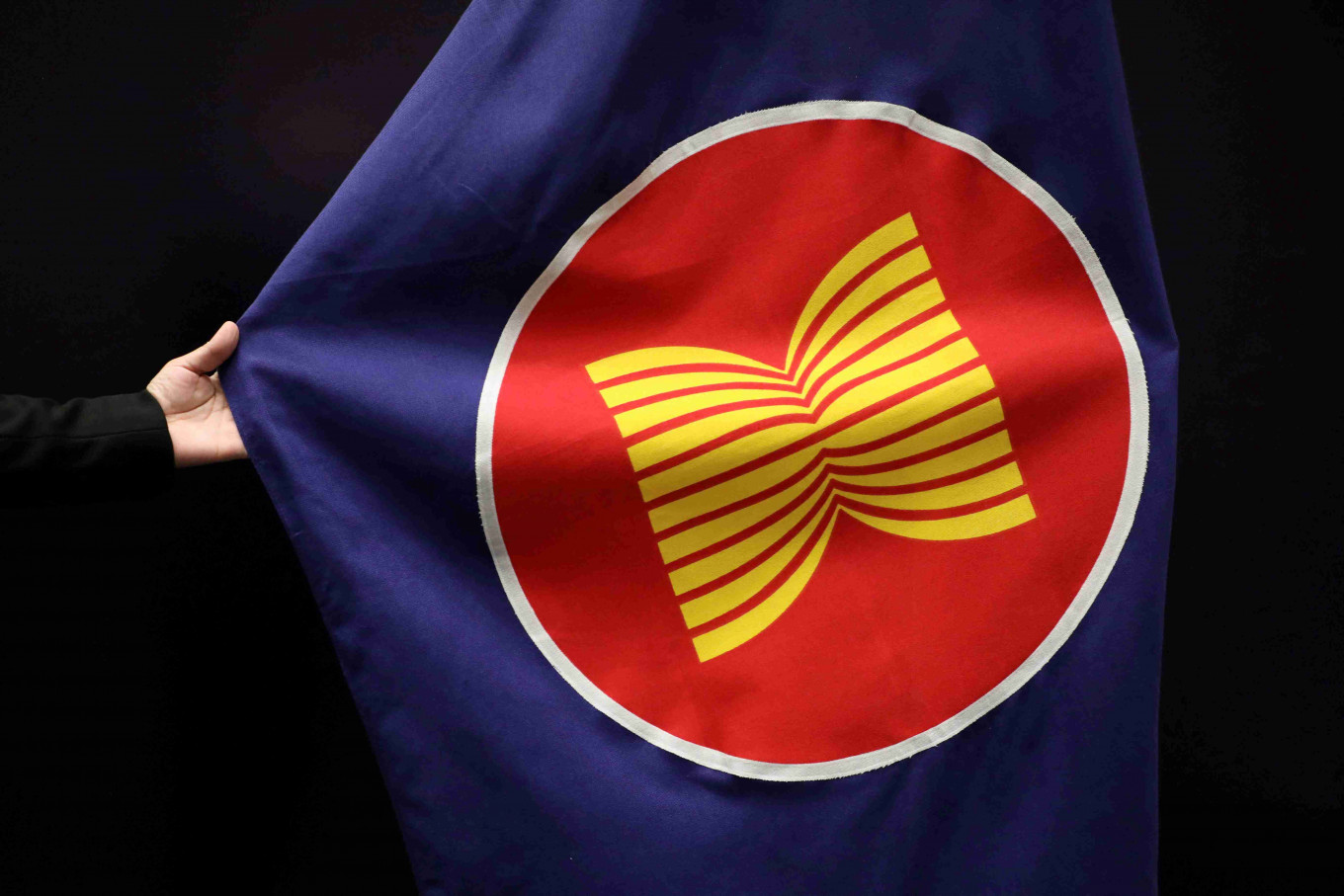 A worker adjusts an ASEAN flag at a meeting hall in Kuala Lumpur on Oct. 28, 2021. (Reuters/LIM HUEY TENG)
A
s geopolitical rivalry expands beyond the battlefield into trade, technology and economic influence, Indonesia and ASEAN face mounting pressure to prove they can adapt to a more fragmented global order instead of being sidelined by competition among major powers, experts said during a discussion on Wednesday.
Evi Fitriani, an international relations expert at the University of Indonesia, said wars had long been driven by competition over territory and resources, but today's conflicts were increasingly shaped by globalization and economic interdependence.
"Globalization has created value-added economies and encouraged industrialization, leading to greater economic interdependence. But it has also enabled extensive political control," Evi said during a discussion hosted by think tank The Habibie Center and the Indonesian Academy of Sciences (AIPI) in Jakarta.
She said the global order was becoming increasingly multipolar, prompting countries to pursue more pragmatic foreign policies instead of relying solely on ideology or shared values.
Evi pointed to the growing alignment between China and Russia despite their historical rifts, while many Western European countries were seeking new partners after realizing they could no longer depend solely on the United States.
She said the emerging multipolar order could benefit middle powers such as Indonesia by allowing them to build flexible partnerships based on the functions and objectives of different multilateral groupings through which they could advance their interests.
"There is no prohibition against joining more than one multilateral institution. That's what Indonesia has done by joining this grouping or that grouping," Evi said, referring to Jakarta's pursuit of membership in both BRICS and the OECD despite their seemingly contradictory aims.