The Jakarta Post
Please Update your browser
Your browser is out of date, and may not be compatible with our website. A list of the most popular web browsers can be found below.
Just click on the icons to get to the download page.


Popular Reads
Top Results
No results found. Please check your search term and try again
Can't find what you're looking for?
View all search results
Popular Reads
Top Results
No results found. Please check your search term and try again
Can't find what you're looking for?
View all search resultsUS, Philippines deploy anti-ship missile system near Taiwan
The Philippines' northernmost province, with about 20,000 residents, sits around 100 miles south of Taiwan, along the Luzon Strait, a strategic corridor on the frontline of the great power competition between the US and China for dominance in the Asia-Pacific region.
Change text size
Gift Premium Articles
to Anyone
Share the best of The Jakarta Post with friends, family, or colleagues. As a subscriber, you can gift 3 to 5 articles each month that anyone can read—no subscription needed!
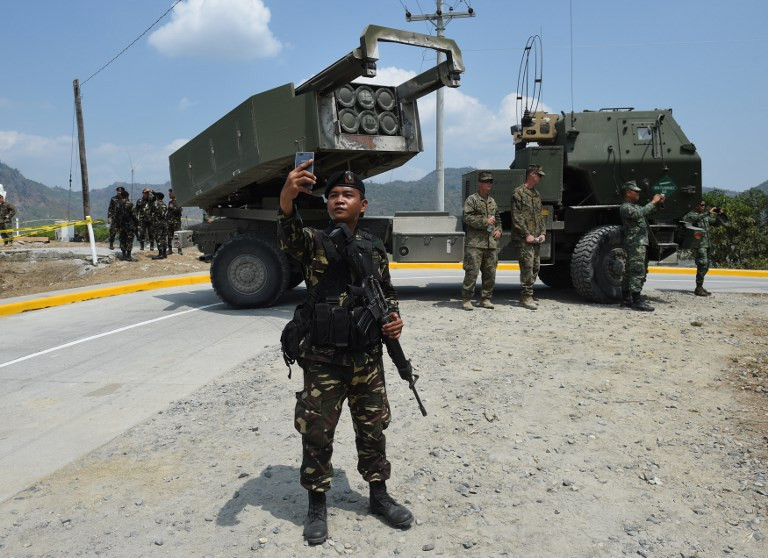 A Philippine soldier takes a selfie in front of an M142 High Mobility Artillery Rocket System (HIMARS) after a live fire exercise as part of (AFP/Ted Aljibe)
P
hilippine and US forces on Saturday showcased the NMESIS anti-ship missile system in Batanes province, near Taiwan, during annual war games, as tensions simmer over the self-governed island that China views as its own territory.
The Philippines' northernmost province, with about 20,000 residents, sits around 100 miles south of Taiwan, along the Luzon Strait, a strategic corridor on the frontline of the great power competition between the US and China for dominance in the Asia-Pacific region.
"Training out here in Batanes allows us a different environment than what we're normally allowed to operate in," said US Staff Sergeant Darren Gibbs.
"So it gives us unique opportunities to actually utilize the system and train within our capabilities, and it offers experiences we don't normally get offered in our day-to-day training."
Gibbs said the NMESIS is designed for remote operation, and that "the purpose of this system is for it to be fully autonomous, for us not to require a driver or passenger inside the vehicle itself."
"We will tell it where to go and then we program what it needs to do," he said.
The NMESIS, a highly mobile coastal anti-ship missile system designed to target surface vessels from land-based positions at ranges of about 185 km (115 miles), was flown into Batanes on a US C-130 transport aircraft, and positioned in the capital Basco, which has one of the island province's two small runways.
Francisco Lorenzo, Philippine exercise director, told Reuters that deployment of US weapons such as the NMESIS to Batanes was part of efforts to test operational feasibility in remote locations. The NMESIS was also deployed to Batanes in last year's war games.
"It is part of training so as to test the feasibility or rehearse their deployment there when need arises," Lorenzo said. One of the objectives of the Balikatan, as the annual "shoulder-to-shoulder" drills of US and Philippine forces are called, is to practice "defence of our territory with our allies", he said.
The NMESIS would not be used in live exercise operations and was brought to Batanes only for deployment rehearsal and simulation support during the war games.
He said the system would be withdrawn from Batanes once the drills were finished. The US also deployed its Typhoon missile system to the Philippines in 2024 for use in joint exercises.
Beijing routinely criticises the deployment of US weapons in the Philippines, saying it heightens regional tension.
Security analyst Chester Cabalza, founder and president of the Manila-based think tank International Development and Security Cooperation, told Reuters "the NMESIS can spark a powder keg for Beijing and asymmetric deterrence for Manila and Taipei in the Bashi Channel along the Luzon Strait."
The system can be airlifted and deployed to any coastline in the Philippine archipelago within hours, Cabalza said, and its placement in Batanes is likely viewed by Beijing as part of the "US-led encirclement" of China.
Philippine President Ferdinand Marcos warned in November that given his country's proximity to the island democracy, "a war over Taiwan will drag the Philippines, kicking and screaming, into the conflict."
In February, US, Japanese and Philippine aircraft patrolled over the Bashi Channel that separates the Philippines from Taiwan to test what Manila called their "ability to operate seamlessly together in complex maritime environments".