The Jakarta Post
Please Update your browser
Your browser is out of date, and may not be compatible with our website. A list of the most popular web browsers can be found below.
Just click on the icons to get to the download page.


Popular Reads
Top Results
No results found. Please check your search term and try again
Can't find what you're looking for?
View all search results
Popular Reads
Top Results
No results found. Please check your search term and try again
Can't find what you're looking for?
View all search resultsMore jobs, not yet more productivity
The challenge is not simply to create more jobs, but to strengthen the economy's capacity to generate increasingly productive ones.
Change text size
Gift Premium Articles
to Anyone
Share the best of The Jakarta Post with friends, family, or colleagues. As a subscriber, you can gift 3 to 5 articles each month that anyone can read—no subscription needed!
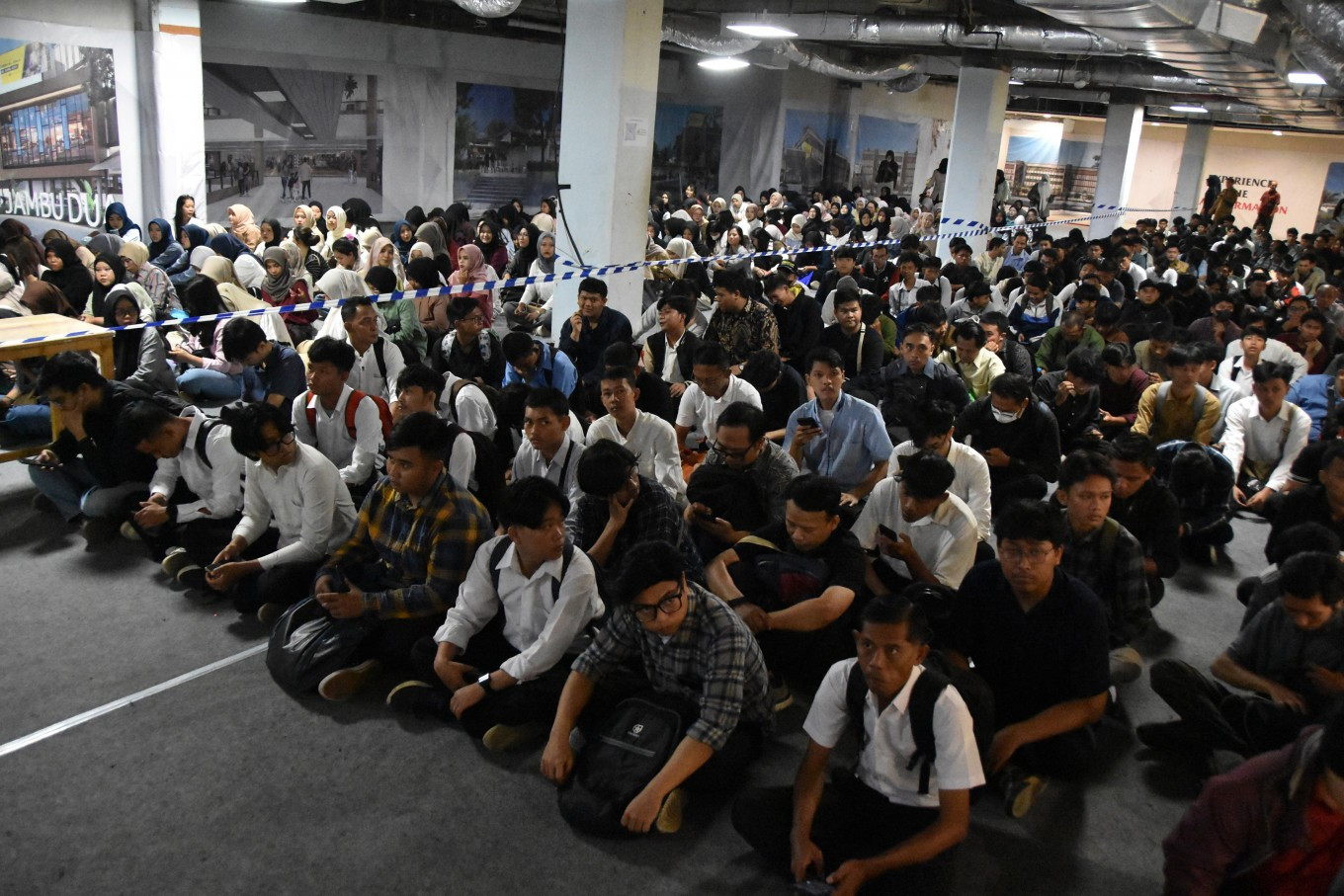 Jobseekers wait in line on June 8 during the opening of the 2026 Bogor Job Fair at Plaza Jambu Dua in Bogor, West Java. (Antara/Arif Firmansyah)
I
ndonesia’s employed population grew by around 1.44 million over the past year. Statistics Indonesia (BPS) reported that the number of employed people reached 147.99 million in August 2026, up from August 2025. The open unemployment rate also declined to 4.75 percent. Yet one figure deserves closer attention: 41.73 million workers, or 28.2 percent of the employed population, were working in agriculture, forestry and fishing.
The large number of people employed in agriculture is not inherently a problem. The sector remains a vital source of livelihoods for millions of households and an important part of the economy. But the figure raises a more fundamental question: is the expansion of employment being matched by an increase in productivity and the value that the economy generates?
This question matters as Indonesia pursues its ambition of becoming a high-income country by 2045. In its January 2026 report, "Indonesia Growth and Jobs", the World Bank observed that job creation in Indonesia remains concentrated in activities with relatively low value added, while more productive employment has yet to expand on a sufficient scale. The challenge, therefore, is not simply to create more jobs, but to strengthen the economy's capacity to generate increasingly productive ones.
Lower unemployment is often regarded as a key measure of economic progress. But the number of people employed does not, by itself, reveal how productive their work is. The issue is not how many workers are employed in a particular sector, but how much value they generate through their work, capital, technology and production processes.
The World Bank's June 2026 "Indonesia Economic Prospects" report offers a useful perspective. Between August 2024 and August 2025, Indonesia created around 1.9 million jobs. Yet nearly half of these additional jobs were absorbed by agriculture and accommodation and food services. Meanwhile, higher-skilled sectors such as financial services stagnated or contracted. This composition suggests that employment growth has not yet shifted decisively toward activities capable of generating greater productivity.
One of the central messages of the World Bank's "Indonesia Growth and Jobs" report is the importance of firms in determining economic productivity. Productivity depends not only on workers' skills or the sectors in which they are employed, but also on firms' ability to adopt technology, improve production processes, reach wider markets and expand their operations.

This is where job creation intersects with the dynamics of the business sector. Indonesia needs more firms that can grow, not simply more business units that remain small and struggle to expand.