The Jakarta Post
Please Update your browser
Your browser is out of date, and may not be compatible with our website. A list of the most popular web browsers can be found below.
Just click on the icons to get to the download page.


Popular Reads
Top Results
No results found. Please check your search term and try again
Can't find what you're looking for?
View all search results
Popular Reads
Top Results
No results found. Please check your search term and try again
Can't find what you're looking for?
View all search resultsAnalysis: Political fractures, market woes test investment climate
Change text size
Gift Premium Articles
to Anyone
Share the best of The Jakarta Post with friends, family, or colleagues. As a subscriber, you can gift 3 to 5 articles each month that anyone can read—no subscription needed!
 A woman walked past in front of an electronic board displaying stock prices on Oct. 30 at the Indonesia Stock Exchange (IDX) building in South Jakarta. (JP/Iqro Rinaldi)
T
he Indonesia Stock Exchange has struggled to recover in November, after the Jakarta Composite Index (JCI) fell from 5,863.78 on Oct. 15 to 5,304.76 on Nov. 17. The decline reflects mounting concerns on several fronts, from MSCI’s proposed reclassification of Indonesia’s equity market and political uncertainty following Gibran Rakabuming Raka’s resignation as vice president to growing tensions surrounding foreign investment. Taken together, these developments have raised broader questions about the country’s political stability, investment climate and economic outlook.
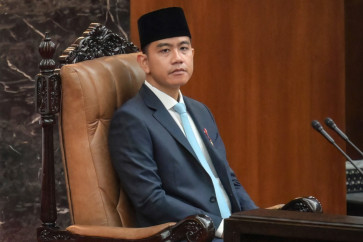
Gibran’s departure from the vice presidency marks the end of one political controversy but potentially opens another. While it brought an end to mounting challenges over his legitimacy in holding the post, it has also raised questions about the future of the political alliance between President Prabowo Subianto and his predecessor Joko “Jokowi” Widodo, Gibran’s father.
The implications extend beyond Prabowo and Jokowi’s relationship. As the alliance comes under increasing strain, investors may encounter greater uncertainty over the administration’s policy priorities and fiscal commitments. Prabowo could increasingly prioritize his own flagship programs at the expense of projects he inherited from Jokowi, including the new national capital, Nusantara, and the Whoosh high-speed rail, both of which already face significant operational and financial challenges. Uncertainty over the government's willingness to sustain these commitments could further complicate investment planning and expectations of policy continuity.
Political uncertainty, however, is only one part of a broader investment challenge. The Prabowo administration must also ensure that its investment ambitions translate into more productive economic activity and better employment opportunities. Despite efforts to attract manufacturing investment and expand industrial capacity, informal employment continues to account for the majority of the workforce. This persistent weakness raises questions about how effectively economic growth and new investment are translating into improvements in employment quality, productivity and household purchasing power.
The recent protests at BYD’s manufacturing facility in Subang, West Java, illustrated the tensions that could arise between attracting foreign investment and meeting local employment expectations. Demonstrations involving residents and community organizations in late October, which have since reoccurred, called for greater recruitment of workers from surrounding communities, alleging that the factory had not provided sufficient employment opportunities for the local population.
BYD, which employs nearly 6,000 workers at the facility, has attributed its recruitment difficulties to a limited availability of candidates with prior automotive manufacturing experience, saying this had prompted the Chinese electric carmaker to recruit more widely across West Java. The company has also said around 90 percent of its workforce consists of Indonesian nationals, of which 80 percent come from West Java. The dispute highlights a more fundamental challenge: a mismatch between the local labor supply and the specific skills demanded by industrial investment.

Automotive manufacturing requires specialized technical capabilities and prior industrial experience, which may be more readily available in established manufacturing centers and urbanized parts of West Java than in Subang. Consequently, local hiring targets alone may not resolve the underlying problem. Requiring manufacturers to prioritize local candidates who might not meet operational requirements could compromise production efficiency. At the same time, this could overlook the need to develop local skills, leaving nearby communities unable to benefit fully from incoming investment.