The Jakarta Post
Please Update your browser
Your browser is out of date, and may not be compatible with our website. A list of the most popular web browsers can be found below.
Just click on the icons to get to the download page.


Popular Reads
Top Results
No results found. Please check your search term and try again
Can't find what you're looking for?
View all search results
Popular Reads
Top Results
No results found. Please check your search term and try again
Can't find what you're looking for?
View all search resultsThe 2026 fires could scar Indonesia for centuries
The 2026 wildfires in Indonesia destroyed carbon reserves formed over the last thousands of years. Recovery will take hundreds of years.
Change text size
Gift Premium Articles
to Anyone
Share the best of The Jakarta Post with friends, family, or colleagues. As a subscriber, you can gift 3 to 5 articles each month that anyone can read—no subscription needed!
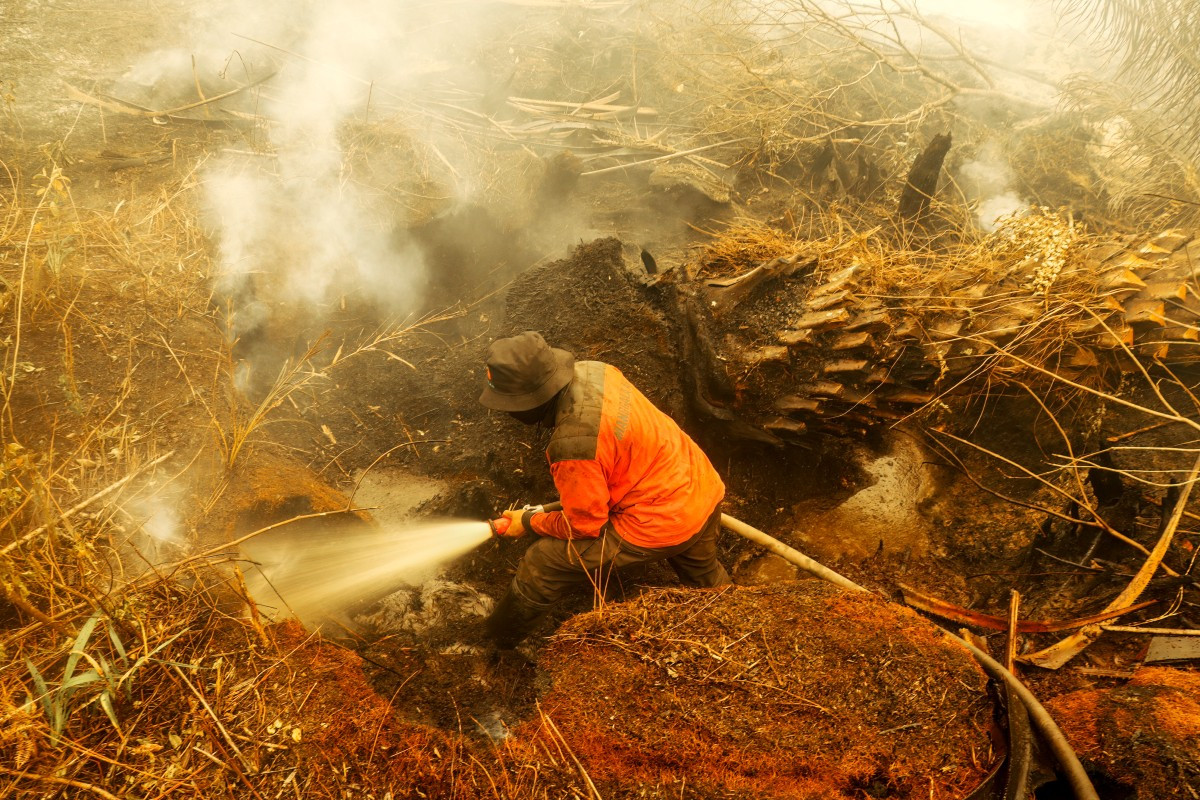 A firefighter sprays water to extinguish a wildfire burning organic-rich peatland, which smolders underground and releases dense smoke, on Oct. 4 in Pulang Pisau regency, Central Kalimantan. (AFP/Reina)
Throughout most of 2026, fires have been burning across Indonesia, from savannas on Papua to peatlands on Sumatra and Kalimantan.
Firefighters have been scrambling to put the blazes out. But after the haze and flames are gone, a more important question arises: How long will it take for these burned landscapes to return to their original condition?
To answer this question, we can assess how much carbon has been lost from the burning of plants and soil, as well as the time needed to recover them. The recovery rate depends on the extent and depth of the burning, as well as the vegetation and soil type.
Our analysis shows that it would take decades to centuries to fully recover land burned in Indonesia throughout 2026 — only if the restoration efforts are done seriously, and the land has stopped smoldering.
As of late September, the total area burned across Indonesia reached about 1.9 million hectares, according to data from independent monitoring platform Nusantara Atlas. The area, about 12 times the size of London, is 38 percent larger than the burnt area during the 2019 wildfire season, when Indonesia also saw an El Niño episode.
Using calculations from previous studies on land use management and emission factors, we estimated that wildfires in Indonesia had emitted around 100 million tonnes of carbon as of late September, or around 370 million tonnes of carbon dioxide (CO2). That figure equals the annual emissions of 97 coal-fired power plants.

Actual emissions, however, could be higher because satellites could not always detect small fires or those covered by thick haze. Scientists at Copernicus Atmosphere Monitoring Service even predicted that carbon emissions from wildfires in Indonesia could reach 200 million tonnes by October.
Peatlands accounted for around 20 percent of the total area burnt, with 400,000 ha. Yet they produced 80 percent of the total carbon emitted into the atmosphere.
Peat is made of partially decomposed plant material that gradually accumulates over tens of thousands of years, creating vast carbon reserves. When burnt, it releases millennia of stored carbon in just weeks — or even days.
Consequently, peatlands take considerably longer to recover than other ecosystems, where most carbon is stored in soils or vegetation.
Indonesia experienced much more severe peatland fires in 2015, when more than 900,000 ha of peatland burnt.
The total area of burnt peatland so far this year was still lower than that in 2015. But we should remember that we have not fully recovered from the damage seen back then.
Even if we could rewet all peatland burnt in 2015 one year after the fire, the amount of carbon that could be restored would only reach 3 percent of those lost 11 years ago.
The time required for land to recover after a fire depends on the type of ecosystem affected and its capacity to absorb and store carbon.
Grasslands, of which about 300,000 ha have burnt so far this year, can generally recover in a few rainy seasons. Shrubland, cropland, and plantations, of which up to 550,000 ha have burned, may need a few more years to return to productivity.
Tropical rainforests (with around 80,000 ha burned so far) take longer to recover. Carbon reserves in secondary forests that have been previously disturbed may need 20 to 50 years to be restored, while a pristine primary forest may take longer. The recovery of the forests’ ecology and biodiversity may even need hundreds of years.
Peatland takes the longest to recover. Rewetted and revegetated peatland can only form up to 0.8 tonnes of carbon per ha every year, with the amount equivalent to up to 2 millimeters of peat per annum.
We estimate that peatland burned in 2026 may take 400 years to recover. Even this estimate assumes ideal conditions: that the land is promptly rewetted, vegetation is restored and no further fires occur.
If the degraded peat is abandoned or even used as oil palm plantations, recovery may be impossible because the drained peat will keep losing 10 to 20 tonnes of carbon per ha every year even without fires.
Our analysis suggests that under a restoration scenario in which recovery continues to face disturbances, rewetting peatlands would require approximately 140-200 years to replace half of the carbon lost. Restoring 90 percent of the lost carbon would take around 350 years.
After the devastating 2015 fires, the Indonesian government established the Peatland Restoration Agency (BRG) with the aim of restoring 2.5 million ha of peat. The agency pushed to block thousands of peat drainage canals to keep the ground wet and prevent it from burning.
By the time it was disbanded in 2025, the agency claimed to have restored 1.6 million ha of peatland located outside business concessions across Indonesia.
However, wildfires have broken out this year in provinces once named as priority areas for peatland restoration, such as South Sumatra province on Sumatra Island, as well as West Kalimantan and Central Kalimantan provinces in Borneo.
Recurring forest and land fires suggest that the main obstacles to successful restoration are not simply technological. They also involve human behavior, economic incentives and land-management practices.
For some communities, the slash-and-burn method is still the cheapest way to clear land for agriculture. Burnt land can also be more profitable for landowners. In Riau province on Sumatra Island, land cleared by burning can sell 1.3 times the price of land cleared by slashing.
Peatland restoration is further complicated by overlapping land ownership claims and the popularity of commodities such as oil palm. Meanwhile, harvests from plants suitable for wetlands, such as sago and jelutong (Dyera costulata), do not have strong market support to be profitable.
Restoring degraded peat and other lands cannot rely solely on blocking drainage canals or replanting trees. It also depends on creating economic incentives for the locals to keep peat wet.
Rain eventually puts out the fire, and forests gradually recover. However, the carbon released in 2026, particularly from peatlands, may not be replaced for hundreds of years. Serious restoration efforts are therefore essential to prevent these carbon losses from becoming an environmental debt passed on to future generations.
---
 Budiman Minasny is a professor in soil-landscape modelling at University of Sydney. Daniel Murdiyarso is a principal scientist at the Centre for International Forestry Research. Rudiyanto and Wirastuti Widyatmanti contributed to this article. This article is republished under a Creative Commons license.