The Jakarta Post
Please Update your browser
Your browser is out of date, and may not be compatible with our website. A list of the most popular web browsers can be found below.
Just click on the icons to get to the download page.


Popular Reads
Top Results
No results found. Please check your search term and try again
Can't find what you're looking for?
View all search results
Popular Reads
Top Results
No results found. Please check your search term and try again
Can't find what you're looking for?
View all search resultsThe broken meritocratic bargain: When 'orang dalam' beats exams
Indonesia’s meritocratic bargain is collapsing under jobless growth, rigid labor rules and entrenched political nepotism, threatening social stability, unless opportunity is restored to young outsiders over well-connected insiders.
Change text size
Gift Premium Articles
to Anyone
Share the best of The Jakarta Post with friends, family, or colleagues. As a subscriber, you can gift 3 to 5 articles each month that anyone can read—no subscription needed!
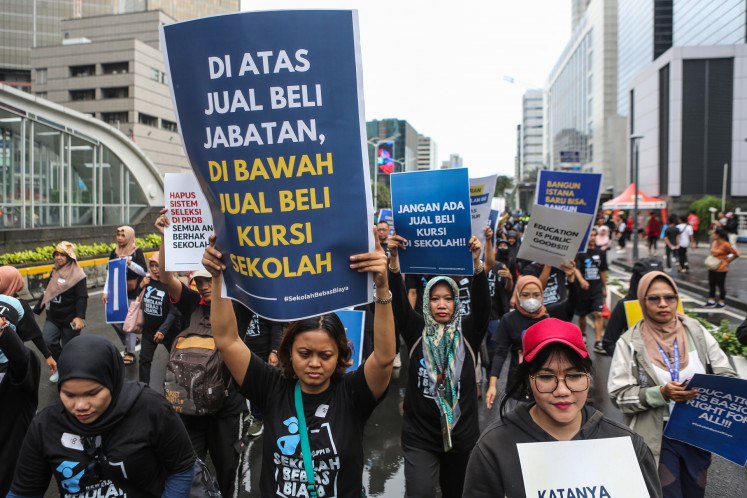
 A demonstrator carries a poster reading “Rigged government posts on top, rigged school placements on the bottom” on July 7, 2024, during a Car Free Day march in downtown Jakarta to protest against illegal levies and corruption in school admissions. (Antara/Asprilla Dwi Adha)
R
ecently, The New York Times ran a piece by Amanda Taub on the breakdown of what she calls the "meritocratic bargain": Study hard, and you will get ahead. From India to France, students are protesting exams and admissions they no longer trust.
Reading it in Jakarta, I found the diagnosis familiar, with an uglier Indonesian twist. Our young people are learning not only that degrees pay less than promised but also that what decides the job, the seat or the contract is often not the exam but being orang dalam, or insider.
If education is open to all, it is a legitimate route upward, and that makes inequality bearable. People who believe the competition is fair blame any loss on themselves; people who believe it is rigged blame the system.
I am a product of that bargain. I grew up in Sigli, Aceh, entered the University of Indonesia through a national exam that did not ask who my father was and earned my doctorate abroad on a government scholarship. The New Order had many sins, but for millions of families, this part of its social contract was believable.
Today, the bargain is breaking on two fronts. The first is that growth no longer creates enough jobs. Real gross domestic product has grown above 5 percent, yet employment rose only around 1 percent through August 2026.
That is 1.44 million jobs, compared to 4.53 million a year in 2022-24. Each 1 percent of growth now brings around 0.18 percent more employment, down from 0.37 percent in 2015-19. Even allowing for the post-COVID rebound, the decline is stark.

Technology explains some of this. Automation, and now AI, lets firms raise output without raising payrolls, and they hit the entry-level jobs graduates used to take. But policy explains more. Our growth leans on capital-intensive smelters, data centers and commodity exports, while textiles, garments and footwear shed workers.