The Jakarta Post
Please Update your browser
Your browser is out of date, and may not be compatible with our website. A list of the most popular web browsers can be found below.
Just click on the icons to get to the download page.


Popular Reads
Top Results
No results found. Please check your search term and try again
Can't find what you're looking for?
View all search results
Popular Reads
Top Results
No results found. Please check your search term and try again
Can't find what you're looking for?
View all search resultsAnalysis: MSCI recurring warning exposes persistent governance failures
Change text size
Gift Premium Articles
to Anyone
Share the best of The Jakarta Post with friends, family, or colleagues. As a subscriber, you can gift 3 to 5 articles each month that anyone can read—no subscription needed!
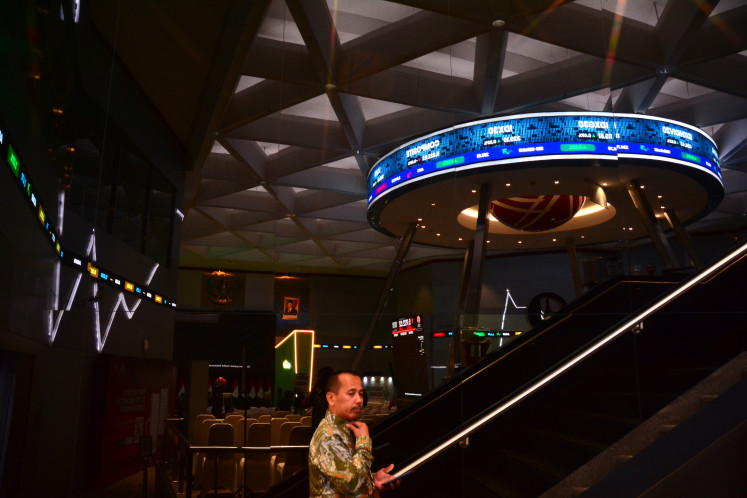
 An electronic board displays stock prices on Jan. 29 at the Indonesia Stock Exchange (IDX) in Jakarta. (AFP/Yasuyoshi Chiba)
I
ndonesia's capital market is once again under pressure following MSCI's warning of a potential downgrade from emerging market to standalone market status. The warning prompted an immediate regulatory response, including measures to address high shareholding concentration and suspected market manipulation. However, the sudden response raises a broader question: Why have longstanding market governance weaknesses and investor protection concerns only received serious attention after repeated threats of a market downgrade?
Ironically, this was not the first warning. MSCI had already raised concerns in 2025 before imposing an interim freeze on index additions and increases in Indonesian securities' weights in January 2026. The decision reflected unresolved issues surrounding free-float transparency, ownership structures and market liquidity.
After the first interim freeze, The Financial Services Authority (OJK) subsequently announced eight capital market reform measures, including higher free-float requirements, greater ultimate beneficial ownership transparency and stock exchange demutualization.
In parallel, the Indonesia Stock Exchange (IDX) began disclosing shareholders holding more than 1 percent of listed companies' shares, improving direct ownership transparency. However, this measure does not fully reveal who ultimately controls companies and benefits from their financial performance. This distinction matters in Indonesia, where complex, multilayered arrangements known as pyramidal ownership structures can allow controlling shareholders to exercise substantial voting power despite holding relatively limited economic interests, potentially influencing corporate decisions at the expense of minority shareholders.
Later on May, Indonesia successfully avoided a more serious setback in May as MSCI maintained its emerging market classification. However, the review still delivered disappointing results, removing six stocks from its Global Standard Index and 13 from its Global Small Cap Index without adding new constituents, resulting in Indonesia's index weighting decreased.
Despite the sequences of reform, questions over the reform consistency remain, particularly when politically connected businesspeople are involved. In September, the agreement for Jhonlin Baratama, controlled by Haji Isam, a businessman with ties to President Prabowo Subianto, to acquire a 30 percent stake in Bayan Resources for an 80.76 percent discounted price drew attention amid regulatory uncertainty over Bayan's coal production quotas. The government approved additional quotas shortly after the agreement was signed, raising questions about regulatory transparency and consistency, although there is no evidence linking the approval to the transaction.

Such concerns illustrate why the effort made by OJK and BEI may not convince investors that Indonesia's market governance has improved. In October, MSCI again raised concerns over coordinated trading and insufficient evidence of meaningful enforcement, warning that Indonesia could be downgraded to standalone-market status. MSCI considered the reforms insufficient to address coordinated trading behavior and a market governance. The warning immediately rattled investors, sending the Jakarta Composite Index (JCI) down 11.57 percent on the following trading day and triggering a trading halt.