The Jakarta Post
Please Update your browser
Your browser is out of date, and may not be compatible with our website. A list of the most popular web browsers can be found below.
Just click on the icons to get to the download page.


Popular Reads
Top Results
No results found. Please check your search term and try again
Can't find what you're looking for?
View all search results
Popular Reads
Top Results
No results found. Please check your search term and try again
Can't find what you're looking for?
View all search resultsThe two faces of Eisenkot, who could be Israel’s PM
While mainstream media paints Gadi Eisenkot as a moderate alternative to Benjamin Netanyahu, it sidelines a brutal truth: the retired general laid the very doctrinal blueprint for Gaza’s obliteration.
Change text size
Gift Premium Articles
to Anyone
Share the best of The Jakarta Post with friends, family, or colleagues. As a subscriber, you can gift 3 to 5 articles each month that anyone can read—no subscription needed!
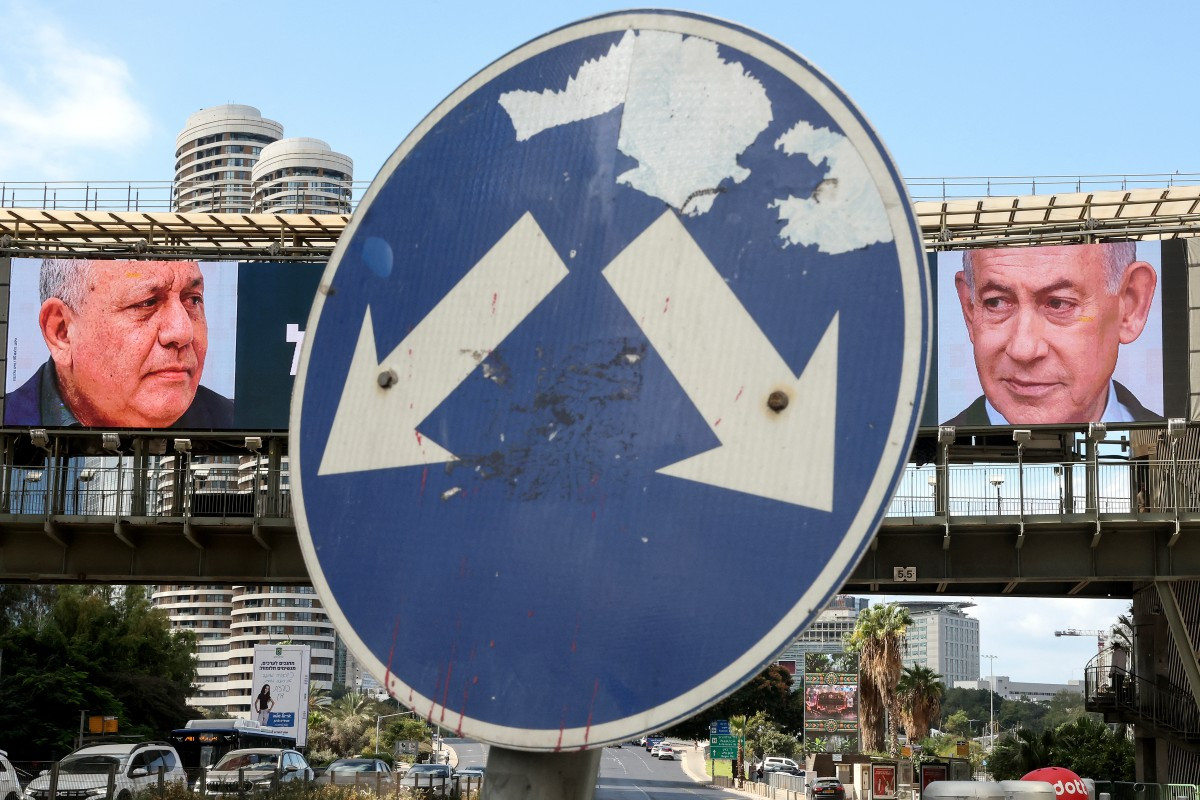 A road sign stands in front of a large billboard featuring Israel's Prime Minister Benjamin Netanyahu (right) of the Likud party and former military chief and leader of the centrist Yashar party, Gadi Eisenkot, in Ramat Gan on Oct. 20, 2026. (AFP/Jack Guez)
A
s expected, the early Israeli exit polls indicate that Prime Minister Benjamin Netanyahu and his prime adversary former chief of staff Gadi Eisenkot face deadlock.
In the past 10-15 years, the country’s political center of gravity has shifted sharply toward security and military power, documented in my The Fall of Israel.
That was also expected is the ongoing white-washing of Eisenkot’s military record. In the mainstream media, Netanyahu’s rival is portrayed as a centrist, security-oriented but moderate. Typically, both CNN and TIME, which now offer features on Eisenkot, tend to depict his role in Netanyahu’s war cabinet as a voice of reason. Yet, the fact that he remained in the cabinet through the worst obliteration of Gaza is effectively sidelined.
Neither mentions the word genocide even once in the context of their features. The neutral language is the norm, not an exception.
Though born in Israel, Eizenkot is of Jewish Moroccan descent. He grew of age in Tiberias and Eilat, outside the country’s centers of political power. His story contrasts sharply with Netanyahu’s deep United States roots and elite Jerusalem upbringing in the circles of power.
After high school, Eisenkot was drafted to the Israel Defense Forces (IDF) and served in the legendary Golani Brigade. As the chief of staff, he prepared Israel for forever wars with the formalization of the Campaigns Between the Wars (CBW) doctrine: covert operations designed to weaken enemies, degrade capabilities and postpone future conflicts between major engagements.

Eisenkot's tenure saw numerous clashes with the Palestinians. At the same time, he contributed significantly to US-Israel strategic cooperation.
Eizenkot made his name as Israeli general, politician and leader of the Yashar party. He served from 2015 to 2019 as the chief of staff of the IDF. Five days after Oct. 7, 2023, he was sworn in as a minister without portfolio after his party joined the government following the outbreak of the Gaza war.
Eisenkot left the government in June 2024. While he served as an observer in Israel's emergency war cabinet for the first eight months of Gaza’s genocidal atrocities, the official actions of the International Criminal Court (ICC) initially primarily focused on other senior figures.
But in July 2024, an advocacy group called the March 30 Movement officially submitted a comprehensive complaint to the ICC prosecutor. The petition requested that the court expand its investigation and issue warrants for former war cabinet members, including Eisenkot. Various Palestinian human rights organizations have similarly sent letters to the ICC prosecutor urging for the prosecution of all decision-makers within the war cabinet
Even as a minister without portfolio, Eisenkot shares complicity for the genocidal atrocities that Netanyahu and his defense minister Gallant initiated in late fall 2023.
In a recent book on the Gaza genocide (and the West’s reluctance to prevent them), I concluded that Israeli military actions were fueled by the Obliteration Doctrine, which was first outlined in 2005 by Eizenkot.
Interestingly, he is no extremist. Officially, he supported Israeli democracy and a two-state solution, which he downplayed during the election campaign.
Eisenkot was appointed head of the Northern Command following Maj. Gen. Udi Adam’s resignation amid criticism over the latter’s conduct in the 2006 Lebanon War. At the time, many Israelis were frustrated that the military had failed to secure a comprehensive victory over the Hezbollah militia or retrieve the two soldiers whose capture had triggered the conflict. It was this popular frustration that set the stage for “tougher measures”.
Eisenkot’s strategy was based on the idea that to create effective deterrence against Hezbollah, the IDF would have to severely damage Dahiya, a densely populated Shia southern suburb of Beirut that served as a Hezbollah stronghold and was heavily bombed by Israel in 2006.
After all, his predecessor had been compelled to quit for having been “too cautious”. Hence, Eisenkot’s new strategy of disproportion. It was this strategy that paved the way to Gaza’s inferno in 2023:
When the IDF embraced the nascent Obliteration Doctrine, the Genocide Convention was in the ICC's Rome Statute, ad hoc tribunals had been set up, United Nations organizations had many references to it and the UN even had its special adviser with a mandate for warning the UN on the prevention of genocide.
So, ostensibly, things were in place to deal with a military doctrine that explicitly targeted civilians and civilian infrastructure. Yet, when Eisenkot stated publicly that Israel would embrace the military doctrine in the future, there was no consequential international outcry, not to speak of intervention.
Following the 2006 Lebanese War, the same doctrine was deployed in the 2008-09 Gaza War, or Operation Cast Lead, as Israel called it. This was a three-week armed conflict between the Gazan Palestinian groups and the IDF. It caused 1,200-1,400 Palestinian and a dozen Israeli deaths, over 46,000 homes were destroyed, making more than 100,000 people homeless.
Subsequently Eisenkot coauthored the Guidelines for Israel’s National Security Strategy, barely four years before Oct. 7, 2023, urging Israel’s security establishment to ensure effective deterrence because “once deterrence collapses, it is imperative to stop the threat as rapidly and clearly as possible to renew deterrence, return to routine life, and allow an extended period of calm based on security strength”.
That was the objective of the Netanyahu war cabinet in 2023; one that thoroughly failed. After just one month of the Gaza War, Eisenkot charged the Netanyahu cabinet for “near-criminal behavior” as the PM tried to hide protocols, leak lies to media and sway war goals to appease the Messianic far-right.
During the Israeli obliteration of Gaza, Eisenkot lost his own son and two nephews in a war he now opposed. Yet, the doctrine that was foundational for Gaza’s obliteration was to a great extent his own handiwork.
There is abundant irony in the fact that Eisenkot is now portrayed as a moderate alternative to Netanyahu, and a reasonable champion of change. As a politician, he does not have far-right background. But as a military leader, he perfected the Obliteration Doctrine.
***
The writer is the founder of Difference Group and the author of The Fall of Israel and The Obliteration Doctrine. The commentary was first released by Informed Comment.