The Jakarta Post
Please Update your browser
Your browser is out of date, and may not be compatible with our website. A list of the most popular web browsers can be found below.
Just click on the icons to get to the download page.


Popular Reads
Top Results
No results found. Please check your search term and try again
Can't find what you're looking for?
View all search results
Popular Reads
Top Results
No results found. Please check your search term and try again
Can't find what you're looking for?
View all search resultsThe Arctic: From the Northern Sea Route to Greater Eurasia
Developing the full potential of the Trans-Arctic Transport Corridor is becoming a major priority for Russia’s cooperation with international partners in the Arctic.
Change text size
Gift Premium Articles
to Anyone
Share the best of The Jakarta Post with friends, family, or colleagues. As a subscriber, you can gift 3 to 5 articles each month that anyone can read—no subscription needed!
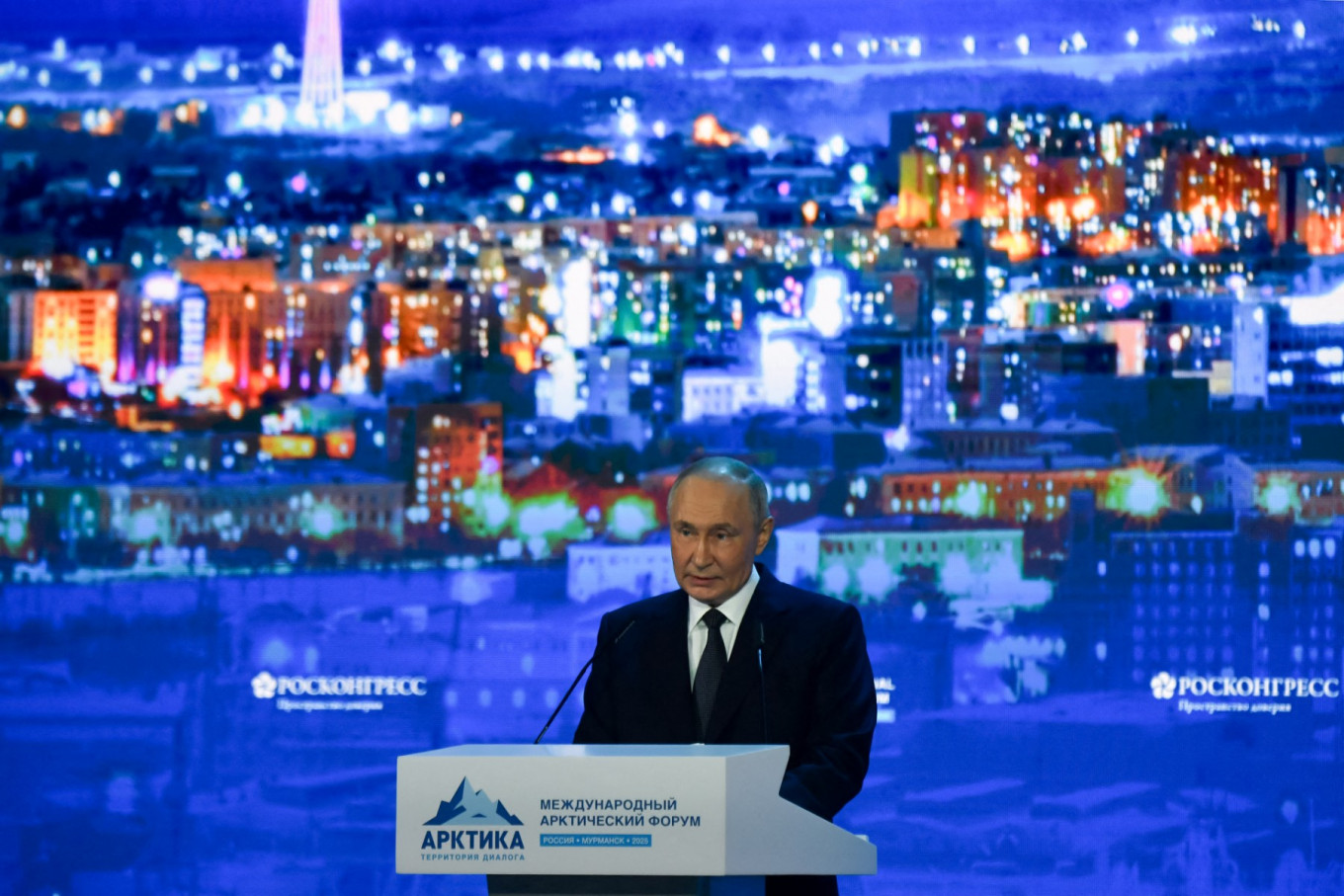 Russian President Vladimir Putin gives a speech at the International Arctic Forum in Murmansk, Russia, on March 27, 2025. (AFP/Olga Maltseva)
T
he Arctic holds a special place in Russia’s domestic and foreign policy. Maintaining peace and stability in the region, reducing national security threats and creating favorable external conditions for Russia’s socio-economic development are among the key priorities outlined in the Concept of the Foreign Policy approved by the President of the Russian Federation on March 31, 2023.
Another key strategic document approved by the President, the Strategy for Developing the Russian Arctic Zone and Ensuring National Security until 2035, sets out the goals of improving living standards in the Russian Arctic, promoting regional economic growth, protecting the environment and developing mutually beneficial international cooperation.
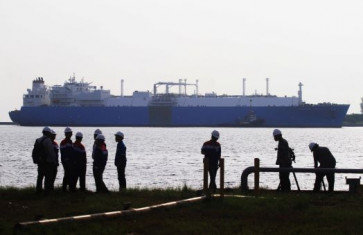
The Northern Sea Route (NSR) is central to the development of the region. It is the shortest maritime route connecting the European part of Russia with the Russian Far East, running through the Arctic Ocean and, in part, the Pacific Ocean.
Amid growing geopolitical uncertainty, the NSR is becoming an increasingly attractive alternative to traditional southern shipping routes. Its advantages include shorter distances, lower environmental impact and the economic benefits of reduced transit times, as well as greater security. Developing the full potential of the Trans-Arctic Transport Corridor, of which the NSR is a key component, is therefore becoming a major priority for Russia’s cooperation with international partners in the Arctic.
Speaking at the plenary session of the 11th Eastern Economic Forum in September, Russian President Vladimir Putin noted: “The Trans-Arctic Transport Corridor that runs from St Petersburg and Murmansk through the Northern Sea Route to Vladivostok and further to the countries in the Asia-Pacific Region, with the situation in the world as challenging as it is, when there are apparent risks for global maritime navigation and trade, is intended to ensure the flexibility and security of international supplies, opening new opportunities for transit and coastal shipping.”
The waters along the Northern Sea Route are free from piracy, armed conflict, military confrontation and territorial disputes. Russia’s efforts have played a significant role in maintaining these conditions, guided by the consistent principle that the Arctic should remain a region of peace and cooperation.

At the same time, Western countries have increasingly treated the Arctic as an arena of geopolitical competition and sought to establish military superiority in the region. NATO continues to expand its military activities in the High North, including through operation Arctic Sentry, launched in February to strengthen the Alliance’s military presence at high latitudes.
Russian businesses operating in the region are also facing further rounds of targeted illegitimate economic sanctions. These developments have contributed to rising tensions in the Arctic and increased the risk of inadvertent escalation.
One of the consequences of the West’s policy towards Russia has been the disruption of previously effective mechanisms for multilateral cooperation in the High North. The Arctic Council remains the only structure still in operation, although it is not functioning at full capacity. The suspension of full-scale cooperation within the Council in 2022, prompted by its Western members, dealt a serious blow to the organisation.
Despite these obstacles, Russia continues to promote initiatives that support the Arctic’s humanitarian and cultural development. One example is the project Digitalisation of the Linguistic and Cultural Heritage of the Indigenous Peoples of the Arctic, launched in mid-2020. Among its tangible results is the preservation of the language and cultural heritage of the Forest Yukaghirs, indigenous people whose language is at risk of extinction.
Another promising initiative is the international “Snowflake” International Arctic Station, which has been under development since 2020. The station is intended to serve as a platform for scientific experiments, environmental monitoring and the development and testing of new technologies across various fields, particularly those related to combating climate change.
Preserving the Arctic as a region of peace and cooperation is in the interests of a wide range of countries that support constructive international engagement. More and more states are showing an interest in working with Russia to develop the region.
Russia maintains close cooperation with China and India on Arctic issues. There are also promising opportunities to strengthen ties with other BRICS members, including Indonesia.
In April 2025, for example, the Far East and Arctic Development Corporation (KRDV) and the Indonesian Chamber of Commerce and Industry (Kadin) signed a cooperation agreement in Jakarta. It opened up opportunities for expanding bilateral investment cooperation, enabling interested businesses to participate in joint sector-specific events and facilitating targeted business missions.
During the same time, KRDV representatives visited the Science and Technology Park of the University of Indonesia to discuss joint projects involving Russian and Indonesian research institutions and industrial companies in support of the development of Russia’s Far East and the Arctic Zone.
The two countries are also deepening their cooperation in science and education. Links have been established between Gadjah Mada University (UGM) and Russia’s Arctic and Antarctic Research Institute. During my recent visit to Yogyakarta, I suggested that UGM explore opportunities to establish partnerships with other relevant Russian institutions, in particular Northern (Arctic) Federal University, Murmansk Arctic University and the North-Eastern Federal University.
We believe that studying the Arctic is of strategic importance to Indonesia, particularly in understanding and anticipating the effects of global climate change. Conditions in the Arctic have significant implications for the environmental resilience of tropical countries and global sea levels. Developments in the region also have wider geopolitical and economic implications, including through the opening of new maritime routes.
Russia is working to establish standards for responsible Arctic governance and sustainable socio-economic development, while safeguarding the region’s natural resources and the cultural heritage of its indigenous peoples. It continues to promote the Arctic as an integral part of a broader Eurasian space of security and cooperation. As a key component of the Trans-Arctic Transport Corridor, the Northern Sea Route is expected to play an important role in advancing Russia’s President Vladimir Putin’s flagship initiative to build the Greater Eurasian Partnership.
---
The writer is Russian ambassador to Indonesia.