The Jakarta Post
Please Update your browser
Your browser is out of date, and may not be compatible with our website. A list of the most popular web browsers can be found below.
Just click on the icons to get to the download page.


Popular Reads
Top Results
No results found. Please check your search term and try again
Can't find what you're looking for?
View all search results
Popular Reads
Top Results
No results found. Please check your search term and try again
Can't find what you're looking for?
View all search resultsAnother day, another warning
The government has underestimated wildfires and their consequences before; it cannot afford to make the same mistake again.
Change text size
Gift Premium Articles
to Anyone
Share the best of The Jakarta Post with friends, family, or colleagues. As a subscriber, you can gift 3 to 5 articles each month that anyone can read—no subscription needed!
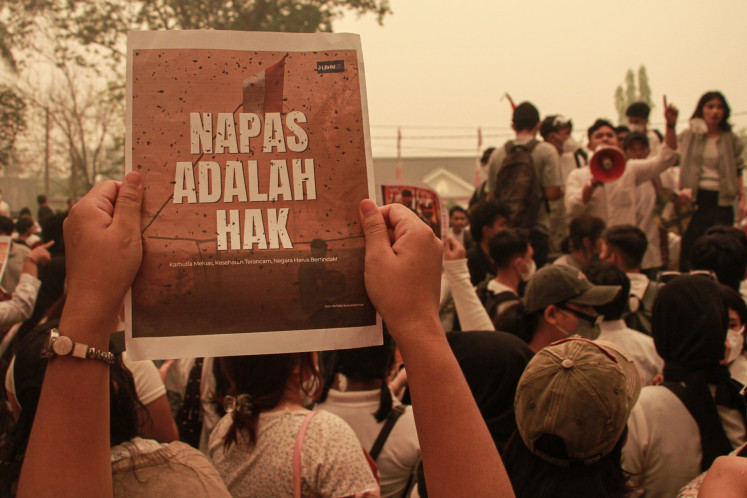
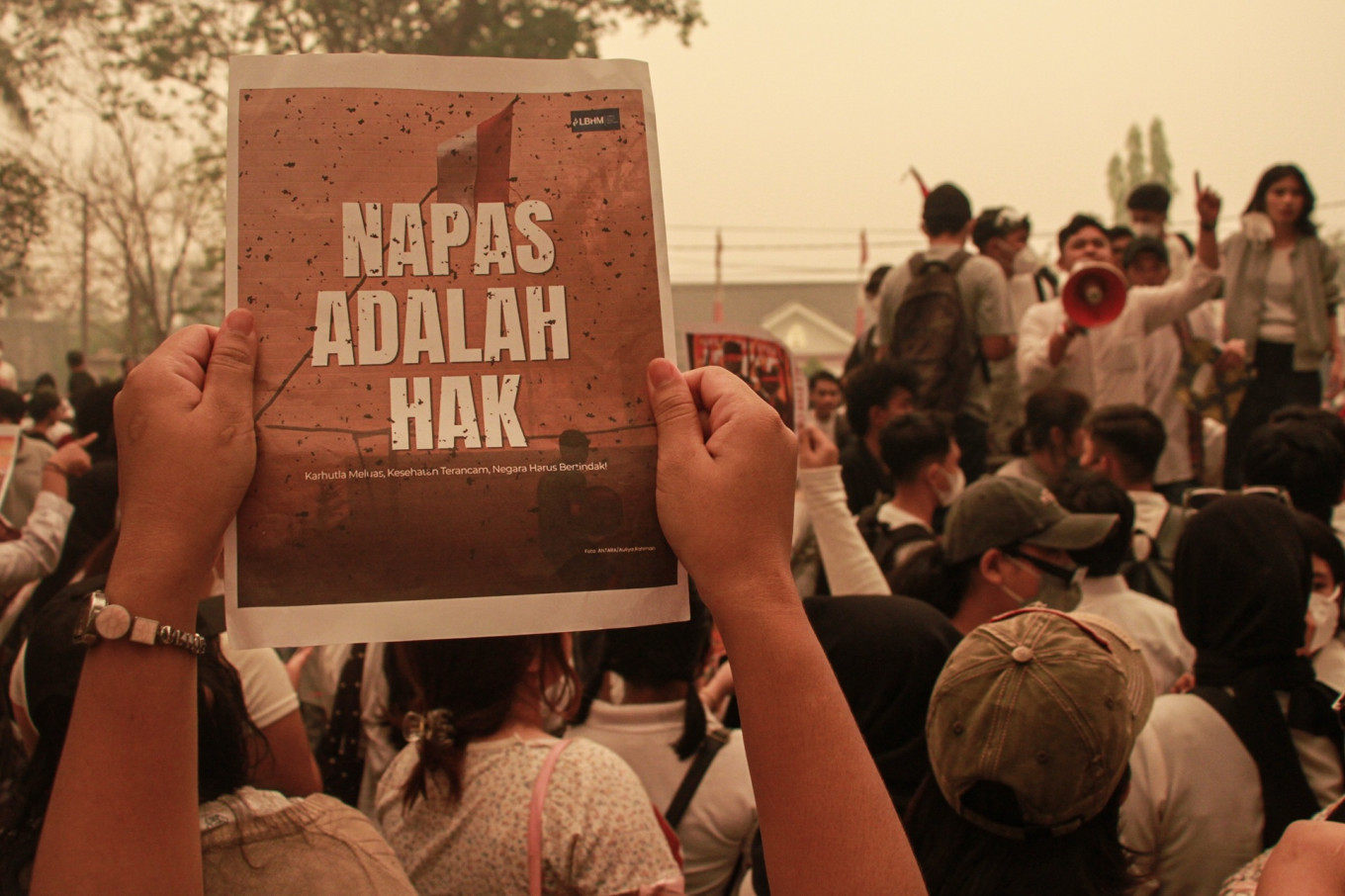 A rallygoer holds a poster that reads “Breathing is a right” during a protest on Oct. 23 in front of the Central Kalimantan gubernatorial office in Palangka Raya to urge the central government to declare the widespread forest and peatland fires as a national disaster. (Antara/Auliya Rahman)
D
o we really need another warning about the dire consequences of unresolved forest and peatland fires in this country? The answer is an unequivocal yes.
In the first three months of this year, fires scorched at least 42,000 hectares of peatland—an area roughly four times the size of Paris. Most hot spots were detected in Riau, West and Central Kalimantan and East Nusa Tenggara (NTT).
At the time, the government treated the crisis as business as usual, even slashing the disaster mitigation budget despite explicit warnings from meteorologists and environmentalists that a severe El Niño dry spell would aggravate this recurring, human-made and entirely preventable catastrophe.

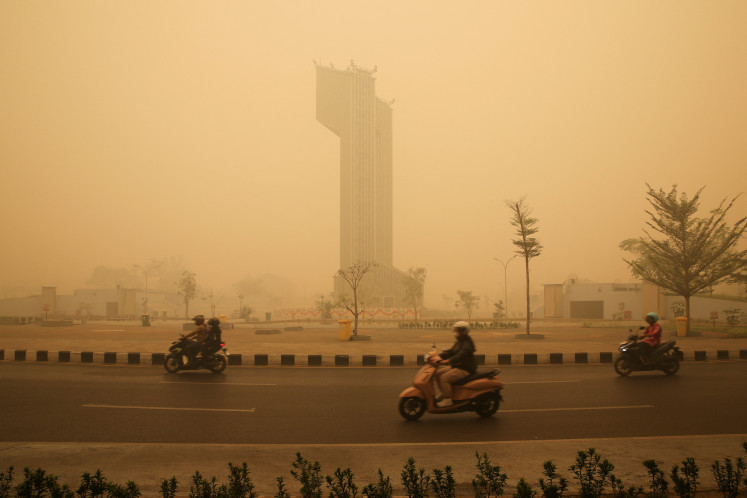
Months later, the blazes had ripped through more than 1.9 million ha across multiple provinces, primarily in Sumatra and Kalimantan. The country is now enduring its worst wildfire season in a decade, as persistent, toxic smoke chokes millions of citizens at home and across national borders.
The haze is saturated with PM2.5—fine particulate matter measuring less than 2.5 micrometers in diameter, or a fraction of the width of a human hair. Tiny enough to penetrate deep into lung tissue and enter the bloodstream, it poses immediate risks of severe respiratory infection. Between Aug. 20 and Oct. 19, the Health Ministry recorded more than 310,000 cases of acute respiratory illness across Sumatra and Kalimantan. Roughly a quarter of those afflicted—some 77,000 cases—were schoolchildren aged 6 to 9, closely followed by children under five, who accounted for another 69,000 cases.
The toll extends far beyond immediate respiratory trauma. Prolonged exposure to these particulates sharply elevates the risk of immune dysfunction, cardiovascular disease and lung cancer—a major blow to the country’s bid to build a quality future generation. Daily life has ground to a halt under an ominous amber sky: Schools are shuttered, routine economic activity is paralyzed and public anxiety is soaring under the prolonged disruption.

Financially, the damage is staggering. The Center of Economic and Law Studies (Celios) estimates that the fires inflicted up to Rp 123.1 trillion ($6.67 billion) in combined economic and health losses between January and August 2026—a figure poised to climb steeply if the fires burn through year-end. Public frustration over the government's sluggish intervention has already spilled into street protests across several cities as seen in the Oct. 20 rally in Jakarta.